


 Sign In
Scan Space Cuts Dilapidation Reporting Time by 30% with Matterport Digital Twins
When heavy machinery, excavation, and demolition move into a neighbourhood, every home and business nearby carries risk — and a missed crack or an undocumented defect can turn into a costly dispute later. Learn how Scan Space uses Matterport to be 30% more efficient in preparing dilapidation reports in pre- and post- construction phases.
Founded in Perth two years ago, Scan Space has grown from a 50-space pilot package into a business that captures more than 1,000 spaces at a time for residential, commercial, and civil construction projects across Western Australia. Co-founder Seb Buser brought a construction recruiting and labour-hire background to the venture, while co-founders Lachlan and Roslyn brought hands-on surveying and dilapidation experience from the industry. Seeing firsthand how inaccurate measurements, inconsistent reporting, and inefficient communication held the industry back, the trio combined their property and construction expertise with Matterport's Pro3 technology to build a 3D digital twin, construction, and surveying business from the ground up.
Dilapidation reporting remains Scan Space's core service, but the same Matterport foundation now enables them to branch out into developing virtual stores and asset management services for clients beyond the build sector — all built around the idea that spatially accurate digital twins can serve builders, homeowners, retailers, and facility managers alike.
The Challenge
Disrupting slow, error-prone reporting built on still photography
Dilapidation reporting exists because construction work — residential, commercial, or civil — puts nearby properties at risk of damage from vibration, excavation, and demolition. For at least the last two decades, the industry standard for documenting property condition before and after these works has been still photography. That created several recurring problems for Scan Space's clients and their own team:
Time-intensive report production Building a single dilapidation report meant sorting, uploading, editing, and formatting still photos, then manually inserting every image into a PDF — a process that could take two to three hours per property.
Reports that ballooned with project size A property with 100–150 defects meant 100–150 photos to place and caption, turning some reports into 50–60 page documents that were slow to produce and just as slow for clients to read.
High risk of human error Photographing a crack on a wall gave no spatial reference. By the time a report was compiled, it was easy to lose track of exactly where in the property a defect was located.
Disputes over missed or ambiguous defects When a homeowner later raised a new crack or mark, teams had only a flat photo library to check against — making it hard to prove definitively whether the damage pre-dated the works.
Limited visibility for anyone who wasn't on site Homeowners, business owners, and builders had no way to independently verify property condition; they had to trust a written report with no easy way to explore the space themselves.
Matterport as the cornerstone platform for Dilapidation Reports
A comprehensive digital twin in place of a photo library
Scan Space built Matterport into every stage of its dilapidation workflow. Field surveyors walk each property with a Matterport camera, tagging defects — chipping, corrosion, cracking, water damage, separation — directly onto the 3D scan as they go. Key capabilities that reshaped the workflow:
Fast, spatially accurate capture A typical residential scan takes 60–90 minutes on site — comparable to still photography — but produces a fully navigable, spatially referenced model instead of a loose set of images. The time saved is replacing hours of manual picture filing and referencing images to actual site locations to just tagging defects in the digital twin itself.
In-context defect tagging Every defect is tagged directly to its location in the model as surveyors move through the property, removing the guesswork of matching a photo back to a room.
One link instead of hundreds of photos Instead of embedding every image, Scan Space's reports link straight to the online scan, letting anyone view a bird's-eye view of the property and click through every tagged defect.
Automatic time-stamping Every scan is time-stamped, giving Scan Space and its clients a verifiable, auditable record of property condition at the moment of capture.
Side-by-side comparison of conditions Matterport's newer side-by-side feature lets Scan Space line up pre- and post-construction scans of the same property, making before-and-after handover documentation far faster to produce.
A complete record, not just a defect list Alongside tagged defects, Scan Space's scans also document undamaged areas of a property, giving builders and homeowners a complete condition baseline rather than just a list of problems.
“Our goal is to eliminate human error by leveraging Matterport technology to create comprehensive assessments of property conditions, complete with embedded images and measurements that highlight key findings." — Seb Buser, Director, Scan Space
Key Use Cases
1. Dilapidation Reporting
Matterport replaced still-photography-based PDF reports across residential, commercial, and civil projects, letting Scan Space's surveyors:
Tag every defect — cracking, chipping, corrosion, water damage, separation — directly within the 3D scan
Produce a short summary table by room, linked to the full interactive scan, instead of a photo-heavy PDF
Give each homeowner or business owner their own individual scan link and report by email
2. Handover and Post-Construction Documentation As projects reach completion, builders increasingly re-engage Scan Space to re-scan the same properties:
Post-construction condition reports compared directly against pre-construction scans using Matterport's side-by-side feature
As-built documentation for completed developments, including the head office Scan Space captured for Pack Construction's Roy Hill project in West Perth
3. Civil Infrastructure Walkthroughs For civil works such as pipeline installations spanning 15–20 kilometres, Scan Space captures the entire road and footpath corridor as a continuous walkthrough:
A full record of a multi-kilometre stretch that would be impossible to fully document with still photography alone
Remote access for clients and asset owners to restricted or hard-to-access areas without needing physical site passes, which can otherwise take months to arrange
4. Facilities and Asset Management For clients with control rooms and control centres inside large commercial buildings and warehouses, Scan Space has helped them tag equipment directly within the scan:
Manuals and warranty documents attached to tagged machinery and assets
A persistent digital reference any future staff member can consult without a site visit
5. Retail and Virtual Showrooms Scan Space has also applied Matterport beyond construction, running a pilot with Perth furniture retailer Danks Furniture:
A full walkthrough scan of the showroom, with tags on individual furniture items linking through to product pages
Built-in measuring tools letting online shoppers check whether a piece would fit their space before visiting in person
The Business Impact
The clearest gain has been in report production time. Where the old still-photography workflow took two to three hours of editing, formatting, and manual photo placement per property, Scan Space now produces a finished report in around 20 minutes — roughly 10 minutes trimming and editing the scan, and 10 minutes assembling the report itself. On-site capture time has stayed broadly similar to the old method, so the entire efficiency gain has come from eliminating manual post-processing.
From 2–3 hours to ~20 minutes per dilapidation report – achieving an overall 30% more efficiency per report
Turning traditional 50–60 pages of dilapidation reports to a concise 10-15 page report (even for larger properties with over 150 tagged defects)
Business grew from a 50-space pilot to 1,000+ spaces captured within two to three months of launch
Beyond speed, the qualitative shift has been just as significant for Scan Space's clients:
A fully auditable, time-stamped survey available to builders, clients, and homeowners at any time
Far fewer disputes over existing versus new damage, since nothing captured in the scan can be missed after the fact
Zero cost to homeowners, who are legally entitled to decline participation but rarely do, since the dilapidation survey protects both them and the builder
A stronger position at tender: Scan Space competes on price with still-photography competitors while offering a materially more comprehensive service
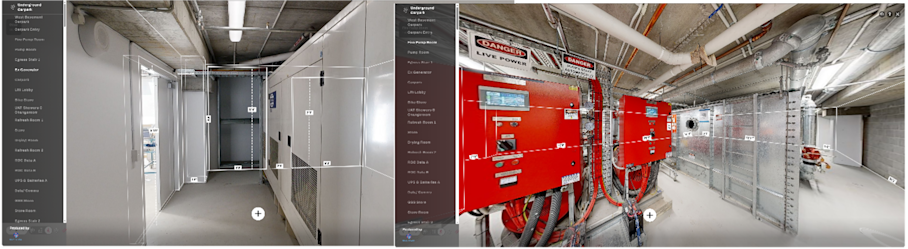
One of the largest commercial spaces Scan Space has scanned with Matterport - Project Dove
Looking Ahead
Two years after launch, Scan Space is looking to extend Matterport further across the project lifecycle and into new sectors, such as virtual stores, facilities and asset management involving the tagging of equipment manuals and warranty documentation for commercial and industrial clients, as well as expanding into clients with projects requiring remote project management. This is where layering of trade-specific information (e.g. electrical, carpentry) onto scans can help distributed teams manage builds without being on site daily. They also see value in expanding business opportunities in civil and infrastructure projects to document large-scale, multi-kilometre projects.
Conclusion
For Scan Space, Matterport turned a slow, photo-based admin process into a fast, defensible digital record that protects builders, homeowners, and business owners alike.
"The big shift here that Matterport is enabling - is to transform the limited visibility of traditional reporting to complete transparency of 3D digital twins." — Seb Buser, Co-Founder, Scan Space
By replacing hours of manual photo editing with a single spatial model, Scan Space has been able to scale from a handful of properties to more than a thousand spaces at a time — while giving every client a more transparent, more trustworthy record of their project.


