

 Sign In
How To Navigate Change Management in Construction Projects: Strategies for Agile Teams
Every construction project changes. Specs get revised, owners adjust their vision mid-build, and hidden site conditions force crews to rethink entire sequences. Experienced teams know this. What they often underestimate is not the changes themselves but the organizational friction that surrounds them. Miscommunications and misaligned expectations can easily spiral into schedule delays, budget overruns, and strained relationships that outlast the project itself.
The difference between organizations that absorb change and those that are destabilized by it comes down to a concept increasingly central to high-performing construction teams: effective change management. Change management in construction is the organizational capacity to anticipate, absorb, and respond to project changes without losing momentum, control of the budget, or the trust of the stakeholders who depend on you.
This guide will explore how construction teams can develop change management strategies that help anticipate and respond to project changes without losing momentum, budget, or stakeholder trust.
6 most common reasons for change and why they escalate
Understanding why changes occur is the first step toward containing their impact. While every project faces unique circumstances, certain triggers appear consistently across construction work. Recognizing these patterns helps teams build defenses against the most common sources of disruption.
The triggers that show up most often are:
Design revisions: Whether driven by evolving owner preferences, value engineering, or iterative refinement from the design team, revisions that surface after construction has begun carry a compounding cost: work already in place must be assessed, sometimes undone, and redone to reflect the updated intent.
Coordination conflicts between trades: These occur when the work of different subcontractors intersects in ways that were not resolved duringm preconstruction. Trade coordination conflicts are among the most avoidable causes of field change, yet they remain pervasive on projects where documentation isn’t handled efficiently.
Errors and omissions in original project documentation: Inaccurate drawings, missing details, or conflicting specs are a persistent reality, even on well-managed projects. They can sit dormant in a document set until someone in the field tries to build from it. By that point, the cost of resolution, in time, materials, and disruption, has already multiplied.
Unforeseen existing site conditions: Surprises that surface after work begins are particularly common on renovation, adaptive reuse, and infrastructure projects. In these, what lies behind a wall or beneath a slab is, to some degree, always unknown. The downstream effects can be substantial, including potential redesign, procurement delays, scope adjustments, and schedule compression.
Regulatory and code compliance requirements: A mid-project code update or a previously overlooked permitting requirement can force scope changes that no one budgeted for. These are rarely anyone's fault, but they are reliably expensive when they surface, especially when there is no clear protocol for evaluation and response.
Late client revisions: Clients add features, upgrade finishes, or rethink layouts after contracts are signed, and these requests are often legitimate. But without a structured process for evaluating the true cost and schedule impact of that request, the team absorbs a burden that quietly erodes the project's margins and timeline.
Each of these triggers has the potential to create ripple effects across scope, budget, and schedule.
Even the most efficient construction teams cannot eliminate change. That is neither possible nor particularly desirable in a dynamic industry. Instead, they build internal infrastructure that means the organization bends rather than breaks when change arrives.
Properly coordinated construction change management strategies identify, evaluate, approve, and implement modifications in a controlled, documented way. They prevent scope from growing without authorization, budgets from absorbing unapproved costs, schedules from compressing, and client trust from breaking down.
How to prepare construction teams for change before it happens
The most effective construction change management strategies begin long before the first change order is written. How construction companies plan, document, and standardize at an organizational level determines how well they absorb disruption once projects are underway.
Align early on standards and expectations
Before construction begins, owners, designers, project managers, field teams, and subcontractors should all share a common understanding of how changes will be:
Identified
Escalated
Evaluated
Approved
To do so, it’s important to:
Define roles and approval authority explicitly.
Establish escalation paths before they are needed.
Set communication expectations that every party has agreed to.
Early alignment has a compounding benefit: when changes arise mid-project, teams are not negotiating the process under pressure. The framework already exists, and every stakeholder already understands their place in it.
A critical and often overlooked element of early alignment is shared spatial context. 3D digital twins are now essential construction tools that are widely used to provide all stakeholders with a photorealistic, dimensionally accurate visual reference of existing conditions from the outset. Organizations that implement them as a project standard eliminate reliance on secondhand descriptions, scattered site photos, or conflicting interpretations of 2D drawings. Every team member starts with the same reference of the space, so the downstream potential for miscommunication shrinks considerably.
Document existing conditions thoroughly
Some of the most disruptive and contested change orders on construction projects originate from discrepancies between what was assumed and what was actually found once work began. Comprehensive preconstruction documentation is the most reliable way to reduce that risk.
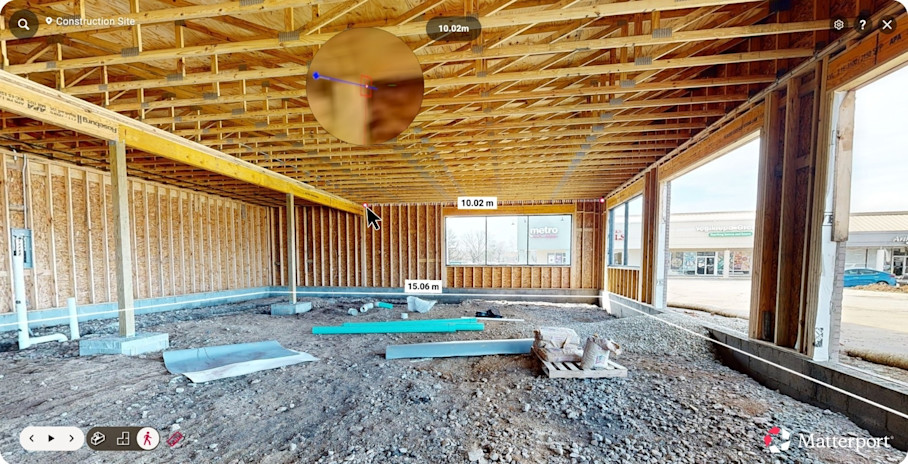
Digital twins provide dimensionally accurate, visual records of existing conditions so teams have a reference to return to at any point in the project lifecycle, without scheduling a site visit, waiting on a field report, or relying on memory. The Matterport Pro3 camera delivers that record with reliable, as-built grade accuracy of ±20mm at a 10-meter range. Automated Measuring allows remote teams to capture precise dimensions directly from the model for clearance verification, materials confirmation, and design validation without stepping foot on site. That capability is particularly valuable during change evaluation. Teams can quickly verify whether a proposed modification is spatially feasible before committing to it.
Build repeatable, standardized workflows
Change management processes that are reinvented for each project create unnecessary risk. Workflows that vary by job, team, or project manager lead to results that vary too, and under real jobsite conditions, inconsistency is expensive.
Standardized change workflows should follow a consistent structure across every project:
Identification
Documentation
Evaluation
Approval
Implementation
Closeout
Each stage should have defined responsibilities, clear handoffs, and documented outputs. When the process is templated, it becomes easier to learn, easier to follow under pressure, and easier to enforce across diverse teams and subcontractors who may be new to working with your organization.
Critically, these workflows should be embedded into the project management systems teams already use rather than administered as a separate parallel process. Workflow steps can be anchored to actual site locations within a digital twin using integrations with Procore, Autodesk Construction Cloud, and similar platforms. Field teams then have the spatial context they need to follow standardized processes accurately and consistently, in the tools they are already using. This reduces the errors that stem from incomplete documentation or miscommunication about where, exactly, a change applies.
Communication strategies that keep cross-functional teams aligned on change
Even well-prepared teams face alignment challenges when changes do occur in projects. Changes rarely affect a single team in isolation: a design revision impacts procurement, which impacts scheduling, which impacts field sequencing. Without structured communication, that chain of consequences becomes a chain of surprises. The strategies below focus specifically on how teams communicate once a change is in motion.
Establish clear communication pathways
When a change enters the system, the first questions answered should be:
Who needs to know?
In what order?
Who is responsible for approval?
Defining communication channels and regular cadences before they are needed means teams are not improvising stakeholder management at the same time they are managing the change orders themselves.
Mapping communication responsibility at each stage of a change removes ambiguity and prevents the delays that accumulate when the right people are looped in too late. It also reduces resistance: field teams, subcontractors, and project managers are significantly more likely to engage constructively with a change when they understand the reasoning behind it and can see the evidence supporting it.
Tags and Notes with @mentions allow teams to embed instructions, clarifications, and documentation directly within the digital twin of the space, giving every stakeholder access to the same information and context in a shared hub, rather than chasing details across disconnected email threads, texts, and file systems.
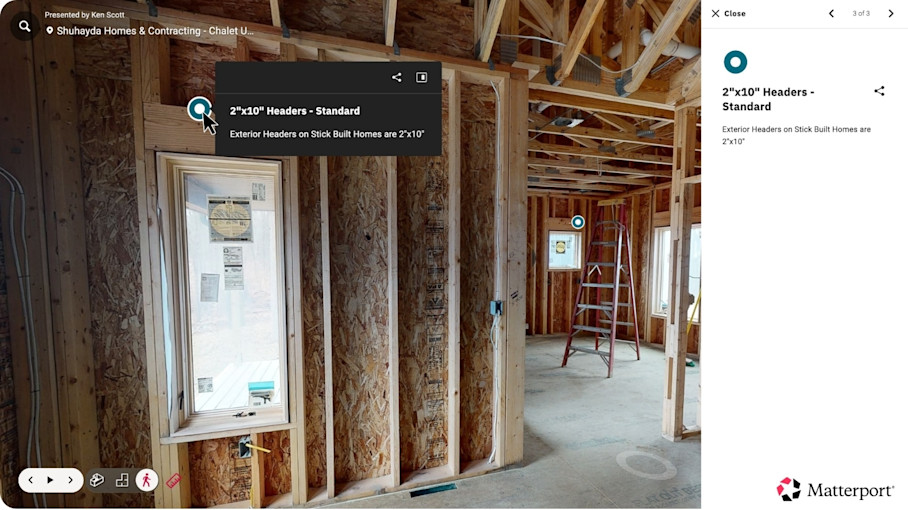
Implementing proper roles and permissions allows teams to create tailored versions of a digital twin for different audiences, so clients and owners can be kept informed and visually oriented without being exposed to the operational detail intended for field teams or subcontractors. The result is cleaner communication at every level of the project, with each party seeing exactly what they need to move forward.
Centralize document access to speed up approvals
Scattered documentation is one of the most reliable sources of approval bottlenecks. When site photos are buried in email, measurements exist only on paper, and conditions have been described verbally in meetings, decision-makers cannot act without first assembling a picture from fragmented sources. Those processes introduce delays, interpretation errors, and avoidable back-and-forth.
A single, accessible source of truth means that decision-makers can independently review accurate site conditions on their own time, from anywhere. Approvals move faster and with greater confidence.
Digital twins are hosted in the cloud, so stakeholders can remotely evaluate site conditions and assess the impact of proposed changes without scheduling additional site visits. They can also serve as a comprehensive, searchable record of construction documentation, with processes and updates captured in context. Using a digital twin as a centralized documentation hub compresses approval cycle times and keeps projects moving when changes arise.
Use visual evidence to justify and communicate changes
Disputes over change orders frequently come down to disagreements about what existed before, what was agreed to, and what the change actually involved. Visual evidence resolves those disagreements faster than written descriptions, and often prevents them from escalating at all.
Showing stakeholders a clear, spatially accurate view of conditions, before and after a change, builds confidence, reduces pushback, and creates a defensible record that protects all parties. Digital twins can be recaptured at key stages of the project and conditions compared in Side-by-Side Spaces across time. Visual evidence provides clear justification for change orders and helps communicate the impact of design revisions or process updates to owners, GCs, and subcontractors alike.
Turn construction change management from overhead into habit with digital twins
Even the most well-designed change management framework fails if teams do not use it consistently. Adoption is both a cultural and a procedural challenge. Digital twins address both sides of that challenge: they give teams a shared, intuitive reference point that makes processes easier to follow, and they create transparency that builds willingness to follow them.
Teams that get this right tend to share a few common habits:
Communicate the "why" clearly: Teams that understand how structured change management protects them, by reducing disputes, clarifying accountability, and preventing rework, are far more likely to follow the process.
Use immersive, visual training: Walkable digital twins let teams experience processes in the actual context of the space they are working in, making training more intuitive and easier to retain than abstract documentation.
Keep workflows simple and integrated: Processes that live inside the tools teams already use daily create far less friction than standalone systems.
Anchor workflow steps to real locations: Embedding change management actions within a digital twin connects process to place, reducing errors from miscommunication about which area, element, or scope item a change actually affects.
Reinforce adoption over time: Periodic process reviews, structured feedback loops, and recognition for teams that follow workflows consistently signal that compliance is an ongoing expectation, not a launch-week priority.
Maintain consistency across projects: Standardization builds institutional knowledge, shortens onboarding time, and makes each successive project more efficient than the last.
Construction change management works best when shared context, clear communication, and accurate spatial information move together. Matterport gives every stakeholder, from owner to field crew, a precise, visual picture of the project, making change processes not just easier to enforce, but easier to trust.
When teams can see the evidence, verify the conditions, and access the same information from anywhere, construction change management stops feeling like overhead and starts feeling like the way work gets done.
Power your AEC/DCM workflows with Matterport

