


 Sign In
Emergency Preparedness in Assisted Living: Planning for Real-World Scenarios
Most assisted living facilities have an emergency plan filed somewhere. But having a plan and being able to execute it under pressure are two different things. Staff must be able to recall procedures under stress and locate critical equipment without hesitation.
In assisted living communities, the stakes are uniquely high. Staff aren't just responsible for their own safety. Many residents rely on support for standard Activities of Daily Living (ADLs) and 44% have been diagnosed with some form of cognitive decline. When an emergency unfolds, they may require 1:1 guidance, wheelchairs, oxygen, or physical transfer assistance. Confident response is especially critical when the people counting on you can't move quickly on their own.
This guide walks through compliance foundations and core elements of emergency preparedness in assisted living facilities. It also covers practical ways to ensure what's written in an emergency disaster plan for residential care facilities can be executed when the alarm sounds.
Core elements of assisted living facility emergency plans
An effective emergency preparedness plan for an assisted living facility is built from several interdependent components, each of which must be tailored to the building's layout, the local hazard profile, and the resident population's care needs.
The framework below outlines the minimum elements an assisted living emergency plan should address. Each one connects directly to your team's ability to protect residents when conditions deteriorate.
Element | What to Account For | Notes |
|---|---|---|
Regulatory foundations | - State-specific licensing rules - CMS emergency preparedness requirements (for facilities accepting Medicare/Medicaid) - Local fire codes - Emergency management expectations | Regulators increasingly expect documented evidence of ongoing preparedness activities, not just the existence of a written plan. |
Risk assessment and hazard identification | - Geographic hazards - Infrastructure vulnerabilities - Internal hazards - Resident-specific risk factors | Risk assessments must be reviewed and updated regularly, not treated as a one-time exercise. |
Evacuation procedures | - Defined triggers for evacuatio - Designated routes - Assembly points - Transportation arrangements - Clearances - Elevator dependencies - Stairwell alternatives | Evacuation route planning must account for residents with limited mobility, and clearance through corridors and doorways for specialized equipment such as wheelchairs, stretchers, oxygen tanks, etc. |
Shelter-in-place protocols | - Extended power outage procedures - Generator capacity - Medication refrigeration - Life-sustaining equipment continuity - Infection control lockdowns - Medical emergency scenarios | Plans should specify how long the facility can sustain safe conditions independently and when that threshold triggers escalation. |
Emergency communication plans | - Backup contact lists - Pre-drafted message templates - Designated communication leads per shift - Notifications to families, vendors, emergency responders | Plans must cover pre-incident, real-time, and post-incident communications across per diem staff, overnight teams, families, and external agencies. |
Coordination resources for first responders | - Current floor plans - Building access point - Hazard locations - Utility shutoff points - Resident care area maps | Effective coordination with fire departments, EMS, and receiving facilities starts well before an incident through pre-planning meetings and shared documentation. |
Resident accountability and continuity of care | - Headcounts - Wristbands - Digital check-in systems - Paper rosters - Portable access to resident info including medications lists, medical conditions, mobility needs, dietary requirements, emergency contacts | Continuity of care must address medication supply, medical equipment access, and arrangements with nearby facilities for temporary relocation. |
Ensuring all of these elements are fully covered in an emergency preparedness plan addresses both immediate response needs and longer-term operational continuity. This helps to create a system for confident decision-making when conditions deteriorate rapidly.
How to prepare assisted living teams for real emergencies with real-world context
Even when the right documentation exists, operational understanding can remain shallow. In moments of panic, staff often default to what they can intuitively understand, not what they last read in a binder.
Effective emergency procedures should be accessible, teachable, and grounded in a real-world context. The following strategies help bridge the gap between written plans and confident execution during actual emergencies.
Connect emergency plans to the real building
Start by ensuring that emergency documentation is accurate, centrally managed, and easy to access under pressure. Staff who reference inaccurate layouts while planning or during a live emergency face compounded confusion.
The solution is to ground emergency plans in an accurate representation of the building itself. This means moving beyond static documents and toward 3D documentation methods that reflect facilities more clearly. Digital twins, dimensionally accurate virtual representations of physical buildings are increasingly adopted by facility management teams, who reference the dimensionally accurate models for planning and operations workflows.
Once a digital twin is created, planners can navigate a 3D tour of the virtual building to identify hazards, mark vital life safety systems, and identify evacuation bottlenecks before an emergency occurs.
Tags help pin the precise locations of fire extinguishers, defibrillators, emergency exits, utility shutoff valves, oxygen storage areas, and first-aid stations directly in the 3D model. Emergency protocols, instructional videos, and reference documents can be easily attached to each location, creating a centralized, visual emergency reference map that responders can access for planning, or from any device during a live emergency response.
Build staff confidence through immersive disaster scenario training
Turnover for assisted living staff positions was over 34% in 2025. High churn rates are a common problem in the industry, and institutional knowledge can erode quickly. Comprehensive training programs are essential, ensuring staff are onboarded effectively and can confidently navigate high-risk situations.
Emergency onboarding programs that rely solely on written records leave new staff unprepared. A staff member who doesn't know where the nearest stairwell is can't help a resident who needs immediate evacuation assistance.
Immersive exercises via remote safety walkthrough tools are an impactful alternative. Instead of practicing on the facility floor, staff walk through a digital twin and familiarize themselves with emergency response procedures. Everyone can learn escape routes, room layouts, and equipment positions virtually before running a live drill. This is especially valuable for per diem and agency staff who lack the spatial familiarity that full-time employees build over months.
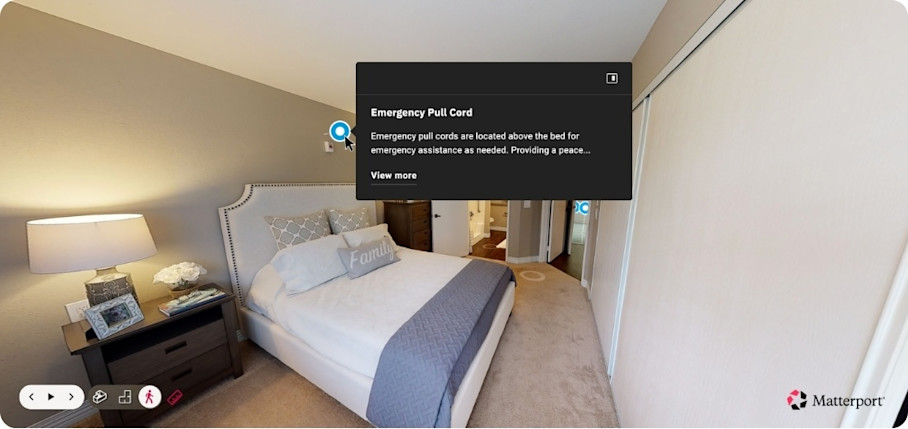
Guided Tours provide curated walkthrough paths with captions for specific training scenarios. You can build separate tours for fire evacuation, severe weather response, and medical emergency protocols. These guides can even be generated automatically using AI Auto-Tours, reducing the time needed to create training content.
Account for resident-specific evacuation needs in real time
Assisted living evacuations are highly variable. Every resident has a different combination of mobility, cognitive, and medical support needs that directly affects how they must be assisted. A resident who uses a wheelchair needs a different route than someone who walks with a cane. A resident on continuous oxygen requires equipment to travel with them.
Staff should have instant visibility into individual assistance requirements at all times, so they can easily identify residents who need assistance during an emergency. This is especially urgent during shift changes or when agency staff are on duty.
Floor plans generated from digital twins map resident room locations within the physical layout, helping planners quickly assess proximity to exits, stairwells, and safe zones. Automated Measuring tools help remotely verify that evacuation route clearances match any specialized equipment residents may need. With this information, they can prioritize the evacuation strategy based on location and level of assistance required.
During a live evacuation scenario, accurate 3D tours can be accessed remotely via any device. Tags make it easy to identify high-need areas and access resident-level response plans that are attached to resident rooms. This awareness reduces the time it takes for staff members to identify where assistance is needed first and which route to use.
Strengthen decision-making during uncertain or partial failures
Emergencies rarely follow a script. Power loss, blocked routes, or communication breakdowns can contribute to unexpected adjustments to emergency response.
In these moments, staff must make fast decisions. They might need to reorient quickly to alternative routes, locate backup equipment, and find secondary safe zones without overhead lighting or clear sightlines. Fragmented information increases the risk of hesitation or error.
Digital twins provide a reliable visual reference when physical conditions are compromised, supporting quick reassessment of plans. Staff can pull up the 3D model to confirm the nearest alternative exit, find the backup generator, or identify which stairwell connects to the wing they need to reach.
Information embedded in an accurate 3D model, such as the locations of generators, utility shutoffs, and emergency equipment, is searchable, helping staff locate critical infrastructure even when the building doesn't look or function the way it normally does.
Give first responders faster access to assisted living facility layouts
Effective coordination with first responders requires reliable access to accurate, current facility information, ideally before they arrive on scene. When firefighters or EMS arrive at an unfamiliar assisted living facility during an active emergency, every minute spent orienting to the layout is a minute not spent reaching residents.
Models can be shared as fully-resourced “facility passports” with emergency responders, who are able to familiarize themselves with a facility's layout before arriving on scene. This reduces confusion during critical response windows and improves situational awareness from the first moment of entry.
Matterport digital twins are cloud-based, so emergency coordinators and local responders can access the facility layout remotely from any device. This supports faster coordination when on-site presence is limited or unsafe. It also ensures that multiple agencies are working from the same visual reference rather than relying on outdated paper floor plans or verbal descriptions. Access controls ensure external stakeholders only see essential information, so resident privacy standards are upheld.
Document conditions and update plans after every incident
Emergency preparedness is an ongoing process that requires regular review and updates as resident populations change, new threats emerge, and lessons are learned from each drill or real-world event. But post-incident documentation is often where facilities fall short. The immediate crisis absorbs all attention. By the time conditions are assessed and recorded, cleanup or restoration work has already altered the evidence.
Capturing a post-incident high-fidelity 3D model preserves the facility's condition at a specific point in time. That record supports insurance claims, regulatory reporting, and restoration scoping with photographic and dimensional evidence rather than subjective descriptions. Side-by-Side comparisons of pre-incident and post-incident captures provide clear visual evidence of what changed, making damage assessment faster and less prone to dispute.
Every incident, whether a full evacuation, a partial power failure, or a near-miss, should trigger a review cycle. That cycle should use the most recent experience to reassess and update:
Emergency plans
Evacuation routes
Risk assessments
A pattern of continuous improvement separates facilities that survive inspections from facilities that survive emergencies.
Make safety second nature for assisted living teams
Emergency preparedness in assisted living facilities comes down to whether teams can navigate the real environment under pressure. That confidence isn't built by reading a plan once a year. It's built through continuous visibility into the care environment: knowing the layout, understanding evacuation routes, and staying familiar with changing facility conditions over time.
Digital twins and virtual tours keep emergency planning connected to the actual building. When staff, administrators, and first responders all share the same accurate, navigable reference, decisions get faster and residents get safer outcomes.
Deliver better Assisted Living experiences with Matterport