


 Sign In
Hotel Brand Standards: A Multi-Property Guide to Compliance & Consistency
Hotel brand standards govern everything from guestroom dimensions to check-in scripts. Every property under a flag is expected to meet them consistently, verifiably, and on demand when an inspector shows up. If they don't, the consequences materialize as forced Property Improvement Plans (PIPs), franchise fees, and, in serious cases, termination.
For multi-property operators, the problem isn't knowing what the brand requires. It's enforcing those requirements across dozens of locations where teams, physical conditions, and maintenance histories vary, and where a single underperforming property drags down scores across the whole portfolio.
This article covers what brand standards typically include, what auditors look for during inspections, and how multi-property teams build audit workflows they can sustain at scale.
What hotel brand standards cover
Hotel brand standards span several distinct categories. Each governs a different dimension of the property experience.
Major hotel companies like Marriott, Hilton, and IHG run structured brand compliance and quality assurance programs. While specific requirements vary by flag and tier, the underlying structure is consistent across the major operators.
Brand standards themselves fall into four main areas: physical design, operations and service, safety and accessibility, and technology.
Design and physical requirements
These standards define the tangible, built-environment elements guests see and interact with, covering the look and feel of the hotel and the required capital improvements. Design standards are prescriptive requirements tied to the flag, not suggestions.
Concrete hotel brand standard examples in this category include:
Minimum guestroom square footage and approved bedding configurations
Bathroom fixture standards and approved material finishes
Corridor lighting levels and approved color palettes
Lobby furniture specifications and approved signage placement
These standards go far beyond aesthetic preferences. They're non-negotiable guidelines covering functionality and safety, including dimensions and clearances to ensure brand-compliant furniture fits seamlessly in standard room layouts.
Design and physical requirements also specify materials and finishes that align with the brand's aesthetic. Standards vary by brand tier, with select-service properties facing different specifications than full-service or luxury flags.
Operational and service standards
These standards are designed to create a predictable guest experience regardless of location. They form a cornerstone of brand standards, from guest greetings to efficient check-in processes.
Service delivery expectations that brands mandate include:
Check-in and check-out procedures
Housekeeping protocols and room turndown requirements
F&B presentation and dining service standards
Staff grooming and uniform requirements
Response time benchmarks for guest requests
Amenity stocking requirements and replenishment schedules
Effective service standards are achieved through employee competency and operational consistency. Staff must possess essential skills to deliver personalized guest experiences, and properties need formalized standard operating procedures (SOPs) and measurement tools for consistent delivery across all departments.
Safety, accessibility, and life-safety compliance
Properties must demonstrate compliance with both regulatory obligations and brand-specific safety protocols.
Examples include:
Emergency egress signage and evacuation route documentation
ADA-compliant room counts and configurations
Fire suppression system specifications and testing schedules
Pool and fitness area safety protocols
Slip-resistant flooring requirements in wet areas
These standards often overlap with regulatory requirements but may exceed local minimums. A brand operating across the U.S. and Europe, for instance, may apply its most stringent market's fire suppression or egress requirements to all properties, even where local code would permit less.
Technology and guest-facing systems
Technology standards evolve faster than physical standards, and require properties to plan for periodic upgrades within the brand's refresh cycle.
Technology standards brands mandate include:
Property management system compatibility and integration requirements
Wi-Fi speed minimums in guestrooms and public areas
In-room entertainment platforms and streaming capabilities
Mobile check-in capabilities and digital key access
Keyless entry systems and guest-facing apps
Digital signage requirements in lobbies and public spaces
Technology standards present a unique challenge because they require ongoing investment rather than one-time capital expenditure. A guestroom refresh might last seven years, but a PMS integration or Wi-Fi upgrade can become obsolete within three.
How to implement and maintain hotel brand standards across properties
Implementing hotel brand standards at scale is an ongoing practice. Standards have to hold up across audit cycles, capital events like PIPs, and changes in ownership or management.
This section covers the key operational strategies multi-property teams use to maintain compliance.
Distribute and translate standards across the portfolio
Major brands publish their requirements through proprietary manuals or digital portals, accessible to franchisees and management companies under license. The documents are detailed. A full brand standard manual can run hundreds of pages, covering everything from guestroom dimensions to check-in scripts.
Getting that material to actually govern what happens on a property floor is its own problem. Regional ops leaders are the primary mechanism: they interpret brand requirements, train department heads, and monitor consistency across their assigned properties. Properties also build their own translation layer via:
Onboarding programs for new GMs and department heads
Department-level SOPs aligned to brand requirements
Pre-opening checklists for new properties or conversions
Quarterly refresher training on updated standards
The breakdown happens when standards live in static documents disconnected from the spaces they govern. A binder describing FF&E specifications doesn't tell a regional leader which properties have fallen out of compliance since the last refresh, or which ones never met the standard to begin with.
Digital twins address this by tying standards directly to the physical environment. As a navigable 3D model of a property, it gives regional leaders a remotely accessible, up-to-date visual record of real property conditions. With features like Tags, standards can be pinned to the specific locations where they apply, and condition issues become visible without a site visit.
Monitor property conditions between audits
Distributing standards and conducting periodic audits don't, on their own, keep a property compliant. Between formal audits, conditions drift. Carpets wear, paint chips, and fixtures fail. By the time an auditor arrives, the deficiency list is long and expensive to remediate.
Practices regional ops leaders and GMs use to catch drift early include:
Routine internal QA walks led by the GM or regional ops leader using brand checklists
Property-level self-assessments tied to the brand's published standards, conducted monthly or quarterly
Periodic condition captures that document the property's current state at a fixed cadence (quarterly, post-renovation, post-seasonal turnover)
Here, digital twins can shift the operating model for ongoing compliance. Regional leaders can pull up a recent capture of any property, compare it to a baseline or to the previous capture, and identify what's drifted without scheduling a site visit. Every detail, big or small, is visible immediately rather than months later or during a formal inspection.
Tags are the ideal day-to-day mechanism for tracking and resolving drift. GMs and regional leaders can pin condition issues, follow-up notes, photos, and remediation owners directly to the location in the digital twin where the issue was spotted.
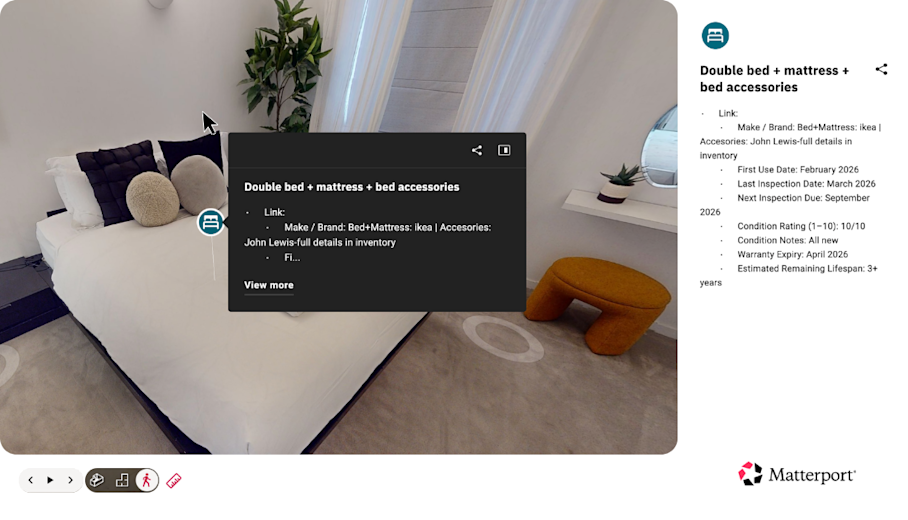
Action items are tied to a specific place in the property rather than buried in an email thread or a separate punch list. That means accountability is clear and follow-through is measurable.
Verify compliance through audits and inspections
Audit readiness is about demonstrating an ongoing, documented compliance practice. Brands want to see that properties are monitoring conditions and addressing deficiencies proactively. They want a visual record of the completed work.
The typical audit and inspection cadence includes:
Scheduled brand QA inspections (annual or biennial, depending on the brand)
Mystery shopper visits evaluating service delivery and operational standards
Pre-opening reviews for new builds and conversions
Renewal evaluations tied to franchise agreement expirations
Reviewers physically assess the property during a walk. They conduct room-by-room condition checks, evaluate public areas, and review back-of-house standards and amenity presentation.
The physical walk, however, is only part of the evaluation. Auditors also need documentation, including:
Date-stamped photography showing current conditions
Dimensional measurements verifying compliance with layout requirements
Deficiency logs and remediation records from prior inspections
Completion sign-offs from contractors and vendors
For regional leaders overseeing multiple properties, that documentation burden is where audit preparation tends to collapse. Property-submitted photos are inconsistent, self-reported checklists are hard to verify, and traveling to every location ahead of an inspection isn't realistic at a portfolio scale.
This is where the digital twin carries its weight as a compliance tool specifically. A date-stamped 3D walkthrough satisfies the photographic record requirement and, unlike a folder of JPEGs, provides reviewers with spatial context. Automated Measuring pulls dimensional data directly from the captured space, covering the layout compliance verification that would otherwise require a tape measure and a site visit. Deficiency logs and remediation records from prior inspections can be pinned to the exact locations they reference in the twin, so there's a clear, navigable record of what was flagged and what was fixed.
Regional leaders can walk a property virtually, verify clearances, and confirm that deficiencies from the last inspection were remediated before the brand auditor arrives.
Document compliance during PIPs, renovations, and flag renewals
Teams face a documentation gap during PIPs, renovations, and flag renewals. They need to capture existing conditions accurately and produce before-and-after proof that ownership and brand reps can review. The compliance process involves multiple stages: initial review, design approval, construction documentation, and final brand inspection.
Maintaining detailed documentation throughout the construction process is essential for successful PIP compliance. Before-and-after images showcase upgrades and improvements, demonstrate compliance, and support marketing efforts. That said, static photos don't give regional teams or brand reviewers the spatial context they need to verify that work was completed correctly or that dimensional requirements were met.
Once again, digital twins can serve as the compliance record across project phases because captures are date-stamped and tied to a persistent model of the property.
A side-by-side comparison view loads two captures of the same space in a synchronized walkthrough so reviewers can move through both states together and verify that work was completed to specification. For teams managing active renovation projects, integrations with construction management platforms like Procore can connect inspections, RFIs, and punch list items directly to the model, so contractors, ownership groups, and brand teams can work from a single shared visual record.
Build a consistent compliance record across your hotel portfolio
Standards exist because consistency across properties is what builds repeat bookings and brand loyalty. When a property drifts from standards, the cost shows up in guest reviews and loyalty rates.
Matterport digital twins give regional teams the tools to catch that drift before it compounds. They support the full compliance workflow without requiring regional leaders to be on-site for every check. Fewer on-site inspections and walkthroughs also mean less disruption to paying guests during compliance checks, PIP milestones, and renovation reviews.
Get started with Matterport for Travel & Hospitality

