


 Anmelden
6 Luxury Hotel Marketing Strategies to Build Premium Brand Perception
Key takeaways
Luxury hotel marketing should sell identity, emotion, and transformation, not simply rooms and amenities. A distinctive story, heritage, design, and signature experiences help justify premium rates.
Affluent guests are not one audience, so tailoring content to distinct segments with guest data builds loyalty and reduces reliance on online travel agencies.
Immersive 3D virtual tours can make luxury properties tangible before booking, allowing guests to explore suites, amenities, layouts, and signature experiences rather than relying on static photography.
Matterport’s virtual tours with interactive Tags, Guided Tours, and Property Intelligence can help hotels showcase experiences, personalize the virtual property journey, and create consistent property descriptions.
Affluent travelers gravitate toward brands that feel exclusive, distinctive, and worth the premium. They rarely choose hotels based on price. Instead, they select a property based on how it makes them feel long before arrival, and on whether it looks like the kind of place that matches their expectations.
That instinct makes the luxury market hard to win. A property must justify its rate before a guest even begins to weigh amenities. The strategies that best reach these guests use emotion-led storytelling and a tangible sense of the space. When a high-value guest can picture the stay in detail, they can book more confidently.
This guide covers six luxury hotel marketing strategies that help reach affluent segments and build premium perception for your brand.
1. Differentiate through story, heritage, and design
A luxury booking is a purchase of an experience and a lifestyle, not a room with a higher nightly rate. The guest is paying to belong to something for a few nights. When two properties offer comparable suites, comparable spas, and comparable service scores, the one with a distinct identity is more likely to win reservations. A distinctive brand story distinguishes a memorable property from a merely comfortable one.
Build that story from what only your property has:
The property's origin story: how it was founded, restored, or reimagined
Heritage and history: the architecture, past guests, and cultural moments tied to the building
Location and local culture: the neighborhood, landscape, and traditions that shape a stay
Service philosophy: the specific way your team anticipates and cares for guests
These assets all give you material competitors cannot copy. Differentiate by naming them clearly and making them central to your marketing narrative. Make sure that imagery frames distinctive details deliberately, copy carries its story, video shows it in use, and social posts return to it over time. When a guest sees the same voice and story everywhere, the brand feels more intentional.
The Beverly Hills Hotel, for example, emphasizes its service philosophy first and foremost. The property has been a refuge for stars seeking privacy for decades, and that story of discretion is central to its branding. It positions itself as a sanctuary for those who value seclusion, with marketing that emphasizes lush gardens, private areas, and personally tailored services.
Meanwhile, Loire Valley Lodges in Touraine, France, leans into its woodland setting, organizing their marketing around a single line: "Let the forest enter you". Website copy emphasizes locally sourced building materials, and imagery highlights panoramic views of the forest. Even the shop points back to the land, with a signature oil that captures the scent of the surrounding fir trees.
Whichever asset leads, the marketing philosophy is simple: identify what sets your property apart, and let that shape the story you tell across every channel.
2. Invest in premium visual presentation to make the property tangible
Your visuals set the price expectation before a guest reads a word. Photography, video, social creative, web design, and digital brochures all have to match the quality of the on-property experience. Light and stage each room so it reads the way it does in person, and make sure to shoot the property in its best light, at the times of day the spaces were designed for. Hold that quality across every format, from the hero video to the smallest social crop.
No matter the quality of your photography, static imagery has limits. A photo gallery shows isolated moments that viewers will click through quickly. To convey how a space really feels, include an immersive format like a 3D virtual tour.
In a navigable model of the space, guests can walk through signature suites, villas, ocean-view rooms, spas, restaurants, and event spaces as if they were on site. Exploring holds attention in a way that scrolling does not, and listings with virtual tours are browsed 3x longer than those with traditional photos.
3D models present the property in a number of different ways. Guests can:
Explore Matterport's digital twins as immersive walkthroughs to see the space at eye level.
Click into floor plans that read the layout from above and see how one room opens into the next.
Pull up dollhouse views that lift the whole property into a single, rotating 3D form, so the scale of a villa or the flow from room to pool registers at a glance.
Together they answer the questions a flat photo leaves open: how big, how connected, how it all fits. Instead of flattening the property into rates, thumbnails, and reviews, create content that invites the guest inside.
3. Highlight signature experiences
Luxury hotel guests rarely remember and recommend a property based on the room alone. Signature experiences like wellness retreats, culinary programs, private tours, spa offerings, and local cultural experiences set a destination apart from a place to sleep and give an affluent guest a reason to choose one property over another.
Package and promote your signature experiences as marketing hooks that sell transformation rather than amenities. "Spa access" is a line item. A spa ritual timed to the season is a reason to book. Frame each experience around what the guest takes away from it, not what the property offers, so it sells an outcome instead of a feature.
Then show the experience instead of asking the guest to imagine it. Within a virtual tour, Tag interactive hotspots at the locations where signature experiences happen. Drop a hotspot at the chef's table, the treatment room, or the trailhead, and a prospect exploring the property can open each one to see what it holds. These land with more weight than a line on a separate amenities page and the guest can build a picture of everything on offer without ever breaking their tour.
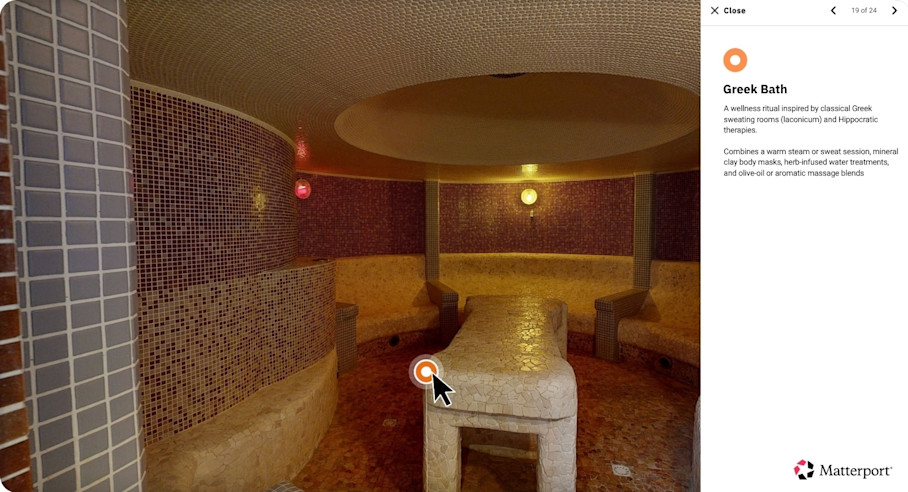
For an even stronger narrative, build a Guided Tour that leads viewers through the property in a set sequence. You can move guests from the arrival courtyard to the suite to the rooftop restaurant in the order that best tells your story, the way a concierge would walk a VIP through the property.
Framed well, a single experience can become the reason a guest books a luxury hotel. A sunrise hammam ritual followed by a private terrace breakfast is unlikely to be on an amenity list, but when it’s well marketed, a guest will pay more to reserve it.
At Lindner Hotels & Resorts, prospective guests can look into a spa or an outdoor bamboo hut before deciding where to book a massage, or picture a candlelit dinner at the resort's restaurant before reserving a table.
Surfacing signature experiences early gives guests more chances to add them to a stay, lifting the total value of a booking beyond the room rate.
4. Use guest stories and social proof
Authentic guest stories carry weight that brand copy cannot. A detailed account of a specific stay persuades far more than a five-star score with no context, so pull the reviews that describe what made a visit exceptional and lead with those. Feature a considered few rather than a wall of scraped ratings, and give them room to breathe so they reinforce the exclusive positioning instead of cheapening it.
Press accolades work the same way, but often with greater impact. A Forbes or Travel + Leisure listing, a Michelin key, or an industry award signals that an outside judge ranked the property among its peers — credibility the brand can't claim on its own behalf.
Choose a few of the most articulate testimonials and give them room to breathe. Match their presentation to the rest of the site, and position them at the moments a prospect might hesitate:
A top award or press mention on the landing page. A Forbes Travel Guide star or a Travel + Leisure ranking establishes credibility before a prospect reads a single detail.
A guest telling a specific story beside a signature experience. Next to the spa or the tasting menu, highlight a guest describing that exact experience.
A high rating from a source luxury travelers trust near the price. A strong score from a respected name reassures the guest at the moment the rate appears.
A recent, detailed review at the booking step. One clear account of a stay from the last few months answers the guest's final hesitation before they commit.
A recognized membership or certification at confirmation. A mark like Leading Hotels of the World leaves the guest with a last signal that the property ranks among the best.
Link testimonials to Tags in your virtual tour, so that they appear at the exact space it describes. Together, these validate that the experience justifies a premium rate.
5. Design content for affluent guest segments
Affluent travelers aren't one audience. A couple booking a wellness retreat and a company planning an executive offsite are buying from the same property for entirely different reasons, and one generic message won’t serve either well.
You should know what each segment values and speak to those guests directly.
Segment | What they value most | How to tailor messaging | Amenities to prioritize |
|---|---|---|---|
Leisure, wellness, and culinary travelers | Restorative, memorable experiences | Lead with transformation and outcomes | - Retreats - Spa and wellness programs - Signature dining - Curated local experiences - Seasonal packages |
Luxury family travelers | Space, safety, and togetherness | Emphasize ease and peace of mind | - Connecting accommodations - Family dining - Supervised programs - Pools and grounds - Secure spaces |
Event and wedding clients | Flawless coordination and standout venues | Show the team and the spaces in action | - Function and ceremony spaces - Internal coordination teams - Catering - Accommodation blocks |
Business and group luxury | Discretion, service, and productivity | Stress privacy and seamless service | - Meeting spaces - Private dining - Dedicated service - Dependable connectivity - Streamlined arrival for large groups |
Tailoring at this level depends on knowing who you're speaking to before they book. Use signals in guest data, past stays, behavior tracking, and the booking source to send the offer that fits rather than the same email to everyone. A returning wellness guest should hear about the new retreat; a corporate planner should hear about the refreshed conference floor.
Each of these segments also judges the property through a different lens. A wedding planner studies flow and capacity, while a wellness traveler might look for calm and light. An immersive virtual tour lets each one explore what matters to them, on their own terms. Events professionals can pace event spaces, gathering measurements remotely and examining layout possibilities. Retreat seekers can explore the spa and choose their package based on the flow of amenities.
6. Choose the right channels and partnerships
The right mix of marketing channels maximizes reach and drives direct bookings, which reduces the margin lost to online travel agencies. Be sure to prioritize the channels a luxury audience already trusts, so your brand appears where they are most likely to research, compare, and make booking decisions.
The core channels below each play a distinct role:
SEO: Publish destination and experience content that ranks for specific, high-intent terms affluent travelers use, not broad volume keywords. Structured data and schema markup help search engines read the property's details and present them well.
Paid search: Bid on branded and category terms to capture guests already comparing premium properties and match your ad copy to the premium positioning.
Social media: Clarify which platforms your audience is most likely to use, and demonstrate your narrative with high-quality images and share short, cinematic clips that pull viewers into the full experience.
Email: Segment your list and send tailored offers powered by your booking and CRM data. A marketing automation platform can trigger the right message from a guest's past behavior.
Content marketing: Build authority with guides, guest stories, and behind-the-scenes features about the destination and the experience. Make sure you have a capable CMS and content tooling to keep production consistent.
Retargeting: Re-engage guests who browsed a suite or event page but did not book. Pixel-based ad platforms track the visit and serve the follow-up.
Earned media placements: Pursue coverage and awards that reinforce credibility. Digital PR tools and media databases help find and reach the right writers.
Distribute your virtual tour across these channels to extend their reach. Matterport spaces are cloud-hosted, so teams can embed tours on web pages, email templates, digital brochures, or share them in social posts and messages without managing any infrastructure.
Another new marketing channel for luxury hotels is rising fast. LLMs and AI-powered assistants now shape decisions, and affluent travelers often ask conversational tools for recommendations before they ever reach a search engine or booking site. Properties that are easy for these tools to read and cite will gain an edge.
Use structured content to make sure your content can be surfaced by these tools. Publish clear, question-and-answer pages and descriptive property details that AI can cite, and keep facts consistent across the web so assistants surface accurate information. Matterport’s Property Intelligence generates room descriptions automatically, adjustable by tone and length, to give teams consistent, detailed copy that AI tools can draw on.
Partnerships expand reach even further. Collaborate with creators, luxury brands, media, and travel advisors to put a property in front of affluent audiences who already trust the messenger. Choose partners whose audience and aesthetic match your brand, and brief them carefully so their content reflects your story and standards. Virtual tours help here too, giving partners and travel advisors ready-to-use assets that reinforce the brand story.
From inspiration to reservation with immersive virtual tours
These luxury hotel marketing strategies combine story, presentation, and proof to create premium brand perception that a guest feels before they ever reach the booking button.
When a high-value guest has already walked the suite, seen the spa, and pictured the event space, choosing to book directly feels natural. Properties that use virtual tours see more time spent on site and more page views, and fewer unknowns mean fewer reasons to defer to an OTA or a competitor.
Get started with Matterport for Travel & Hospitality


