


 サインイン
サインインFrom E57 Scans to Digital Twins: A New Workflow for AEC Teams
How Matterport - Import E57 turns structured point clouds into connected digital twins that plug directly into your exiting workflows


Most AEC Scan Data Goes Unused
A design build firm completes a major renovation scan. Terabytes of LiDAR data get archived on a server. Months later, the team needs to verify an existing condition that could delay a decision. Instead of using the scan they already paid for, they fall back to drawings and another site visit because the point cloud is too heavy and disconnected from their daily tools. This is not an edge case. It is the norm. Industry research shows that more than 95 percent of data generated in the engineering and construction sector goes unused, including high value reality capture that could inform design and coordination.
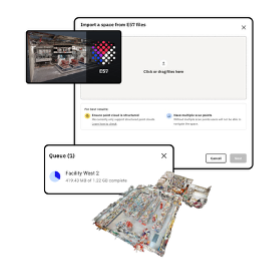
Matterport’s Import E57 changes how AEC teams operate. It converts structured E57 scan data into connected digital twins that move directly into Autodesk and Procore workflows. Archived point clouds become active project infrastructure.
Industry Reality Check
Over 95 percent of AEC data captured goes unused in common workflows
Many organizations are treating digital twin technologies as strategic business assets that accelerate digital transformation and operational performance
Industry research finds the AEC sector is at a digital inflection point where digital twins can transform project delivery and lifecycle performance
How Import E57 Turns Point Clouds into Operational Digital Twins
Importing E57 point clouds does more than convert files. It changes how scan data moves through a project.
Instead of storing structured LiDAR scans as isolated point clouds, project teams convert them into navigable digital twins that live inside their active project environment. For example, survey teams using the Leica BLK360 that want to make their data more accessible to all team members for downstream workflows can turn a Leica point cloud into a digital twin. Once imported, the model functions like any other standard Matterport digital twin for visualization and coordination workflows. Teams explore, measure, tag, and share it as part of everyday coordination. Unlike traditional point cloud workflows that require dedicated desktop software, a Matterport digital twin can be accessed by anyone through any device, turning captured reality into a shared working surface for the entire project team.
With that accessibility comes responsibility for source quality.
The Showcase experience reflects the quality of the source scan. Import E57 does not reinterpret or correct underlying point cloud data. If registration, point density, or completeness are inconsistent in the original file,
those characteristics will carry through to the imported model. Organizations should treat E57 ingestion as part of a governed workflow, validating scan integrity before import to ensure the resulting digital twin meets operational expectations.
This shifts scan data from archive storage to operational use. It also consolidates
previously disjointed source modeling into a unified, streamable view, giving project teams a single actionable environment for all their scanning workflows.
After processing, imported E57 files plug into the broader Matterport ecosystem, where imported files can purchase Matterport add-ons, including schematic floor plans, CAD files, and BIM deliverables. The only exceptions are for imported E57 files cannot order Matterport E57 and SketchFile add-ons, for imported spaces. These models function as a shared spatial reference that support visualization, coordination and collaboration across projects, while the system supports large multi-file datasets and API automation that enables enterprises to ingest scan libraries at scale.
Import E57 is currently available in private beta for Enterprise customers.
Who Gains the Most from E57
The advantage looks different depending on your role. Import E57 affects different teams in different ways, but the common thread is operational leverage. It lets organizations turn scan data into a working advantage.
For AEC design or construction firm
You move from reactive verification to proactive design. Teams import E57 scans and immediately reference real world conditions inside active projects, bringing their broader scanning workflows into a single Matterport platform. Instead of scheduling extra site visits or relying on incomplete documentation, designers and builders work from a shared digital twin. This reduces rework, shortens decision cycles, and improves coordination across disciplines.
For Survey or Reality Capture provider
You deliver outcomes, not just files. Converting structured scans into interactive digital twins gives clients a usable environment instead of a static dataset. This positions your services as part of the client’s workflow infrastructure and increases the long-term value of your capture work.
For managing facilities at scale
You activate dormant documentation. Legacy scan archives become searchable digital assets that support renovations, maintenance planning, and lifecycle management. Instead of storing scans as historical records, you use them as an operational reference for ongoing decisions.
Aligning With AEC Workflows and Strategic Partners
Modern AEC projects run on connected ecosystems. Reality capture moves from isolated workflows into an embedded part of the ecosystem.
Construction Coordination Platforms
Most large AEC projects use cloud platforms to manage drawings, models, schedules, and field communication. Within these systems, teams use shared workflows such as Requests for Information (RFIs), Issues, and Observations to formally document questions, coordination conflicts, and field findings. These tools create a traceable project record that helps teams assign responsibility, resolve problems, and capture decisions across design and construction
Autodesk and Procore anchor design and construction workflows, and reality capture is often managed in separate tools or formats that are not always seamlessly connected to those systems. Import E57 connects scan data into the Matterport platform as a complementary layer within the operational environment teams use every day.
Autodesk ecosystem
Design and BIM teams rely on Autodesk platforms, including Autodesk Construction Cloud and authoring tools, to coordinate models, drawings, and critical project decisions. Shared workflows such as RFIs and Issues inside Autodesk Construction Cloud create the system of record for coordination across disciplines. When E57 scans are converted into Matterport digital twins, they become persistent spatial references that link directly into Autodesk environments, reinforcing those workflows rather than operating outside of them.
A designer can navigate to a specific location within the digital twin, reference real world conditions, and

resolve a coordination question using the same shared context as the broader project team inside Autodesk. RFIs and Issues are anchored to verified spatial context, reducing interpretation errors, strengthening model accuracy, and ensuring decisions remain grounded in captured reality.
Procore and field collaboration
Field teams use Procore to manage RFIs, Issues, and Observations. These are standard project management tools used to track questions, coordination problems, and field findings during construction, helping teams document decisions and resolve work in context. High accuracy terrestrial LiDAR scans that produce E57 files are typically commissioned at the beginning or end of a project, or when pinpoint accuracy is required for

complex fabrication, retrofit conditions, or critical coordination. These scans represent a significant investment in time and cost, which makes operationalizing them inside daily workflows essential. When Matterport models created from E57 scans are linked into Procore, those actions attach to a visual record of the jobsite.
Teams do not just describe a problem. They point to it inside a shared digital twin. This shortens feedback loops between the field and the office and creates a continuous visual history of project decisions.
Migrating legacy scan archives
Many organizations maintain years of E57 data on local servers. E57 Import migrates that content into a centralized cloud platform that connects with Autodesk and Procore driven workflows. Imported spaces become searchable, shareable, and reusable across projects.
Merging and comparison
Imported spaces can merge with existing Matterport models or display side by side for comparison. Teams track changes, verify as built conditions, and document renovations with a continuous visual record.
Use Cases That Deliver Value
Consider a typical renovation workflow. A mid-sized design build firm imports legacy E57 scans from an earlier site capture. Within hours, the team is reviewing the space in Matterport, linking it to Autodesk Construction Cloud, and attaching RFIs directly to specific locations. What was once an archived file becomes an active coordination surface.
That same pattern applies across several repeatable workflows. This is the shift in practice.
Accelerating Design and Modeling from Captured Reality
Design teams start visualizing from captured reality instead of partial documentation. By converting LiDAR scans into Matterport digital twins, teams step into projects with verified spatial context. Decisions happen faster because everyone is working from the same captured environment, which reduces downstream rework and coordination friction.
Activating legacy archives
Archived scans stop being historical records and start functioning as working assets. Teams pull past captures into current projects, compare conditions, and reuse documentation without repeating site visits. This turns stored data into a reusable operational resource.
Continuous merging and comparison
Side by side comparisons create a visual audit trail. Teams verify existing conditions, spot discrepancies, and track changes with confidence over the life of a project. This strengthens accountability and reduces coordination risk.
Spatially anchored project communication
When teams attach Tags, RFIs, Issues, and Observations to specific locations inside a digital twin, communication becomes precise and shared. Instead of referencing drawings or disconnected photos, stakeholders anchor conversations to the same visual context. Designers, contractors, and owners see a single source of spatial truth, which reduces ambiguity and speeds resolution.
Developer and Enterprise Integration
At scale, workflow discipline matters more than tools. Organizations that manage large scan libraries need automation, but they also need consistency and control. Import E57 includes API support for developers and enterprise IT teams that helps standardize how scan data enters the organization.
The Import API enables programmatic workflows to create sessions, upload E57 files in parts, and commit imports at scale. Combined with Matterport’s broader API ecosystem, teams integrate spatial data into dashboards, reporting tools, and internal systems.
For enterprise environments, this automation supports governed, repeatable processes. IT teams can enforce ingestion standards, maintain auditability, and reduce manual handling of large datasets. Scan data flows through defined pipelines instead of ad hoc uploads.
This turns reality capture into part of your digital infrastructure rather than a standalone workflow.
Why This Matters Now
AEC teams are entering a phase where disconnected data is no longer a tolerable inefficiency. As projects grow more complex and timelines tighten, organizations that cannot operationalize their capture data fall behind those that can. Industry outlooks from Deloitte suggest that digital technologies such as cloud native digital twins are becoming standard tools across engineering and construction workflows as firms embed data driven practices into everyday operations. Firms that treat scan data as archived documentation will operate at a disadvantage compared to teams that use it as a live decision surface.
Import E57 accelerates that shift. It converts dormant point clouds into navigable digital infrastructure that supports real time coordination across design, construction, and operations. Instead of isolated archives, scan data becomes an active system that improves decision speed, reduces coordination risk, and increases organizational visibility.
What You Should Do Next
This is a decision point.
If your organization already manages E57 archives, select a recent project and run a controlled pilot import. Treat it as an operational test. Measure how quickly teams can resolve questions, coordinate across disciplines, and reuse captured conditions. The goal is not experimentation. It is proving a repeatable workflow advantage.
If you are evaluating reality capture platforms, make legacy scan activation a primary criterion. Any system that cannot operationalize existing point cloud data will create long term friction. Compare how each platform integrates with Autodesk, Procore, or your existing design systems, supports governed ingestion, and scales across portfolios of projects.
Import E57 is available in private beta for Enterprise customers. Engage your Matterport account team to plan an evaluation roadmap, inventory your scan assets, and design an import strategy aligned with your operational goals. If structured point clouds are central to your work and you are not yet on an Enterprise plan, this is the moment to assess what infrastructure you need for the next phase of growth.
Looking Ahead
The next phase of AEC will not be defined by who captures the most data. It will be defined by who operationalizes it fastest.
Organizations that continue to treat scan data as passive documentation will compete against firms that use connected digital twins as a daily decision surface. That gap will show up in speed, coordination quality, and client confidence.
By turning structured E57 scans into connected digital twins and consolidating disjointed source modeling into a unified, streamable view, Matterport positions teams to operate on the front side of that divide. You are not just modernizing a workflow. You are building an operational advantage that compounds across projects.
In a market where margins tighten and complexity increases, teams that activate their capture data will outpace those that archive it. The divide is already forming.
Have questions?
Talk to an ExpertEngage with our experts to learn more and see how Matterport - Import E57 is right for your company.


