


 Sign In
6 Best 360 Cameras for Insurance Adjusters & Claims Processing
Property insurance claims now take an average of 40.7 days from first notice of loss to final payment, and the pressure to document more losses in harder conditions is climbing.
A lot of reinspection trips trace back to documentation that came in thin the first time. 360 cameras scan every surface and angle of a room in one pass, leading to fewer blind spots, fewer reinspection trips, and a documentation record that holds up through desk review, settlement, and litigation.
This guide evaluates six 360 cameras as business tools for fast, comprehensive, and defensible claims documentation across residential and commercial losses. We’ve weighed how each performs in the environments adjusters work in, and whether it connects to a workflow that makes the documentation usable beyond the field.
Pricing Disclaimer: Pricing is subject to change at any time. The numbers in this article reflect values at the time of writing (May 2026).
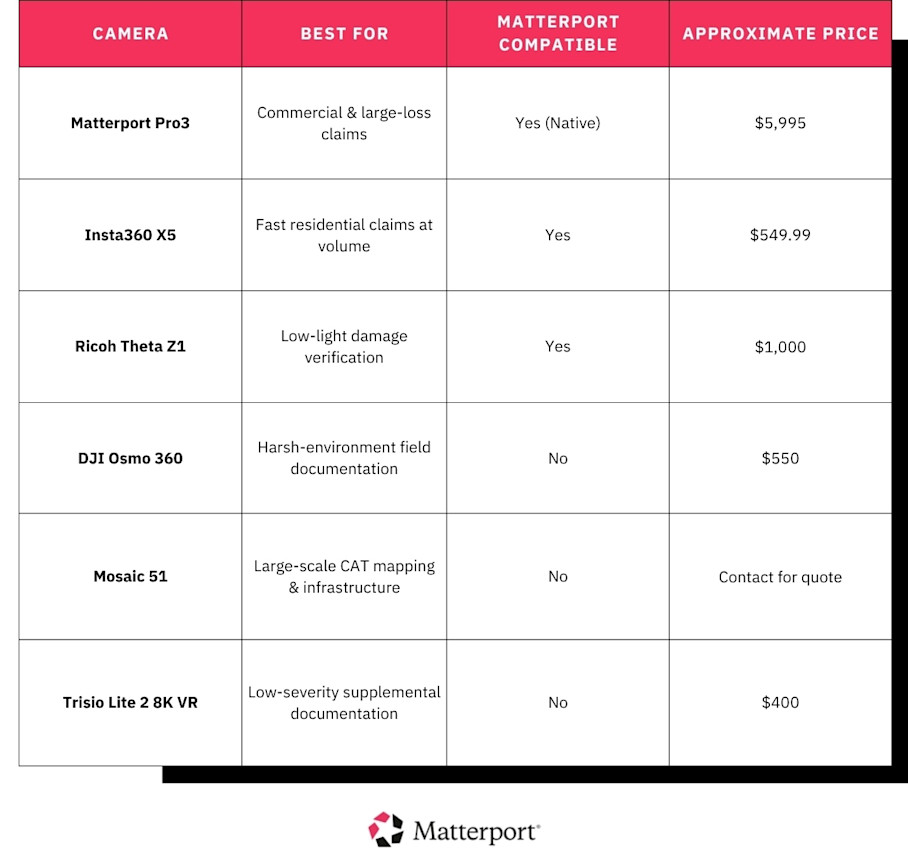
Why 360 cameras produce the strongest property claims documentation
Standard photography is selective by nature, and what gets missed only shows up after the claim is in trouble. Under time pressure, rooms might get partial coverage and damage that falls outside the frame doesn't make it into the file. In unsafe or limited-access conditions, adjusters rush or skip areas entirely.
360 capture changes this on four fronts:
Complete spatial context reduces undocumented damage: A single 360 scan captures every wall, floor, and ceiling surface in a room. Reviewers can see exactly what was present at the time of inspection, including the angles that get skipped when adjusters work under pressure.
Dispute resolution and audit compliance improve: When subrogation teams or fraud investigators need to verify what the adjuster observed, they can walk through the same immersive record rather than relying on a handful of photos with no spatial relationship to each other.
Reinspection costs drop: Enough visual context is captured in one visit for desk adjusters, contractors, and carriers to make decisions remotely. That eliminates the return trips that slow down cycle time and inflate costs.
Defensibility strengthens across legal and regulatory scenarios: Time-stamped, spatially complete records hold up better in policyholder litigation and regulatory audits than selectively angled traditional photography.
Most 360 cameras are designed for travel vloggers and content creators. Their marketing specs don't always map to what matters when photographing a fire-damaged interior. When evaluating hardware, focus on five field-specific criteria:
Image quality in damaged and low-light environments: Can the sensor produce usable images in a boarded-up, power-off structure?
Capture speed and battery life: Can it handle 8–10 properties in a day without constantly swapping batteries?
Durability and portability: Will it survive debris fields, wet conditions, and getting tossed in a field bag?
Ease of use for non-technical staff: Can an adjuster who's never used a 360 camera get a clean scan on day one?
Workflow and platform compatibility: What happens to the data after capture determines its value to the claims process. A beautiful scan that lives on a memory card doesn't accelerate settlement.
6 best 360 cameras for insurance claims processing
Each camera below is evaluated by how its specs perform against the real-world conditions adjusters face during insurance claims processing: damaged interiors, tight timelines, and the need for documentation that holds up through desk review and settlement. The recommendations span a range of budgets and use cases.
Important note: The cameras on this list are organized by use case, not ranked.
1. Matterport® Pro3: Best for accurate documentation in commercial and large-loss claims
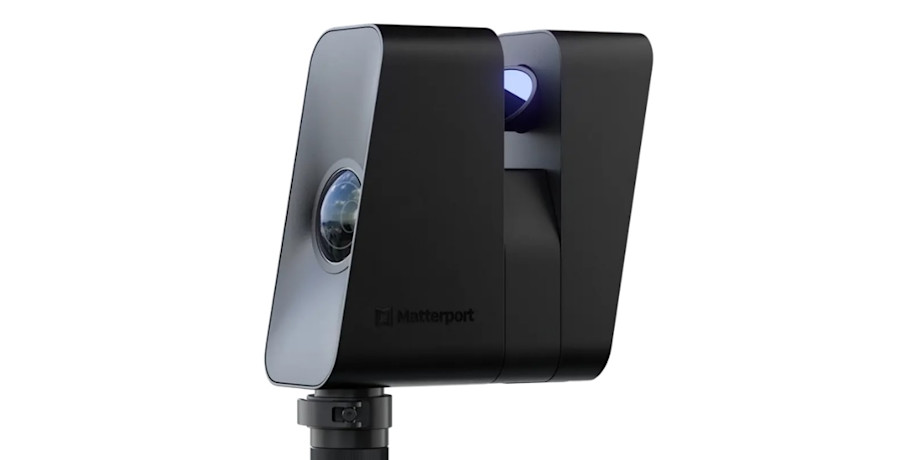
The Matterport Pro3 is Matterport's flagship 3D camera. It pairs LiDAR scanning with high-resolution photogrammetry to produce dimensionally accurate, photorealistic digital twins of a property. For insurance teams, those navigable, 3D virtual models become a single source of truth across the claim file: defensible, measurable, and shareable with every downstream stakeholder.
Price: Approximately $3,995 for the camera, paired with a Matterport Professional or Business subscription plan.
Matterport compatible: Yes (Native)
The Pro3's technical specifications align directly with what adjusters need in the field:
±20mm accuracy at 10 meters: Precision that creates defensible, measurable documentation for carriers, contractors, and courts.
134.2MP panoramic images with 5-exposure HDR: Clear, detailed scans in low-light, power-off interiors and high-contrast damaged environments where bright windows meet blackened walls.
Extended scan range up to 100 meters: Ideal for warehouses, multifamily properties, and large commercial losses where other cameras require significantly more scan positions.
Under 20 seconds per scan: Even large spaces capture quickly, supporting all-day field deployments.
220+ scans per battery charge: Critical for CAT deployments where charging isn't an option.
IP43 rating at 2.2kg: Portable enough for field work, with weather resistance for varied site conditions.
The Pro3's biggest advantage over every other camera on this list is what happens after capture. The Matterport platform turns each scan into a collaborative digital twin where desk adjusters, contractors, and carriers can review the same model remotely. Teams annotate damage with Tags and Notes, verify dimensions with Automated Measuring, and share access through permission-controlled links.
The scan-to-estimate deliverables accelerate the entire claims pipeline:
Schematic floor plans are delivered within 48 hours, with 24-hour and 6-hour express options.
Matterport Sketch for Cotality Estimate and TruePlan Xactimate SKX files eliminate the manual property sketching and measurement that consume hours of adjuster time.
Property Intelligence extracts room dimensions, square footage, and property characteristics directly from each scan, giving desk adjusters enough information to draft initial loss estimates before a detailed field inspection is complete.
The documentation this system produces is defensible and court-admissible through time-stamped, tamper-resistant 3D records.
Teams that don't want to manage hardware internally can also access this workflow through Matterport Capture Services. Certified technicians in hundreds of cities deliver professional scans with 24–48 hour turnaround. That's especially valuable during catastrophe surges when internal teams are stretched thin.
Limitations:
Higher upfront cost compared to consumer 360 cameras
Requires a Matterport subscription for full platform access
Best for: Large insurance operations that need a complete scan-to-estimate workflow with defensible, platform-connected 3D documentation.
2. Insta360 X5: Best for fast 360 capture in residential insurance claims
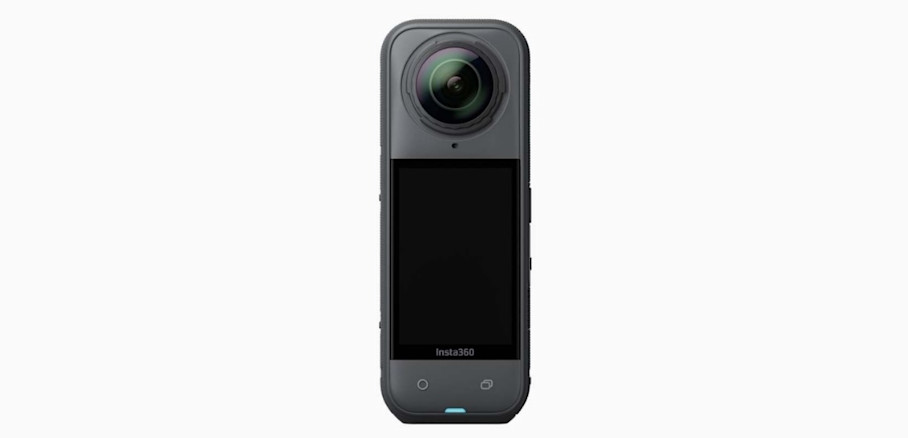
Image source: Insta360
The Insta360 X5 is a compact, high-resolution 360 camera with a significant leap in low-light performance over its predecessor, the X4. Its 1/1.28-inch sensors are 144% larger than the X4's, allowing them to capture far more light.
Price: Approximately $549.99 from the Insta360 store, Amazon, and select retailers. No subscription required for basic use.
Matterport compatible: Yes. Captures can feed directly into the Matterport platform for processing into digital twins.
The X5's specs translate well to residential claims work:
Dual 1/1.28-inch CMOS sensors with f/2.0 aperture: Reliable capture in interiors where power is out or windows are boarded.
72MP 360 photos and 8K30 360 video: Enough resolution for detailed site condition records that hold up under remote review and zoom-in scrutiny.
IP68 waterproof rating to 49ft (15m): Covers wet and debris-heavy loss sites, with tolerance for both extreme heat and freezing temperatures.
198g weight: Fits easily in a field bag alongside moisture meters and other inspection tools.
Battery life up to 208 minutes: Supports multiple property inspections per charge.
2.5-inch touchscreen: On-camera preview and settings adjustment in the field without needing a phone.
The fast capture workflow makes the X5 well-suited for adjusters documenting multiple single-family homes per day with minimal setup time between properties.
Limitations:
No LiDAR depth data, so measurements rely on photogrammetry and are less accurate than the Pro3
Image quality in very low light doesn't match cameras with larger sensors
Not built for large commercial spaces or long-range scanning
Best for: Teams looking for a lower-cost entry point into 360 documentation for standard residential claims where speed and portability take priority over precision spatial data.
3. Ricoh Theta Z1: Best for low-light damage verification
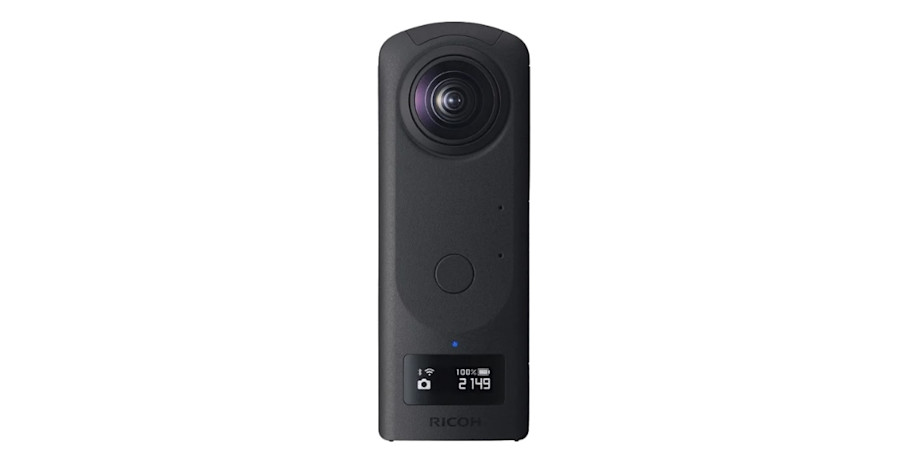
Image source: Ricoh Theta
The Ricoh Theta Z1 is built for demanding image quality in difficult lighting. Its two 1-inch sensors are the largest in the Theta lineup, making it a strong fit for damage verification in compromised interiors.
Price: Approximately $1,000 from Ricoh and select retailers. No subscription required for basic use.
Matterport compatible: Yes. Captures can feed directly into the Matterport platform for processing into digital twins.
The Z1's technical profile makes it stand out in one specific area:
Dual 1.0-inch back-illuminated CMOS sensors at 23MP: A revamped processing algorithm delivers improved noise reduction and low-light performance, alongside 4K video recording.
Selectable aperture (f/2.1, f/3.5, f/5.6): Precise exposure control in challenging field conditions, a level of manual control rarely found in 360 cameras.
4-image composite HDR mode: Handles scenes with extreme contrast between bright and dark areas, common in damaged structures where some windows are intact and others are boarded.
4K 360 video at 30fps with 3-axis stabilization: Smoother walkthroughs in cluttered or debris-strewn interiors.
Magnesium alloy body at 182g: Durable, pocketable, and field-ready.
The Z1's dynamic range and color accuracy make it strong for visual validation of damage severity in interiors where lighting is compromised.
Limitations:
Slower capture speed compared to dedicated LiDAR cameras
No native depth sensing, so depth is only inferred for automated measurements
The image quality advantage is most noticeable in difficult lighting. For standard residential claims in decent light, the performance gap over less expensive cameras may not justify the price
Best for: Early triage of claims involving low-light interiors, providing enough context to determine whether a more detailed field inspection is required.
4. DJI Osmo 360: Best for durable, all-weather field documentation
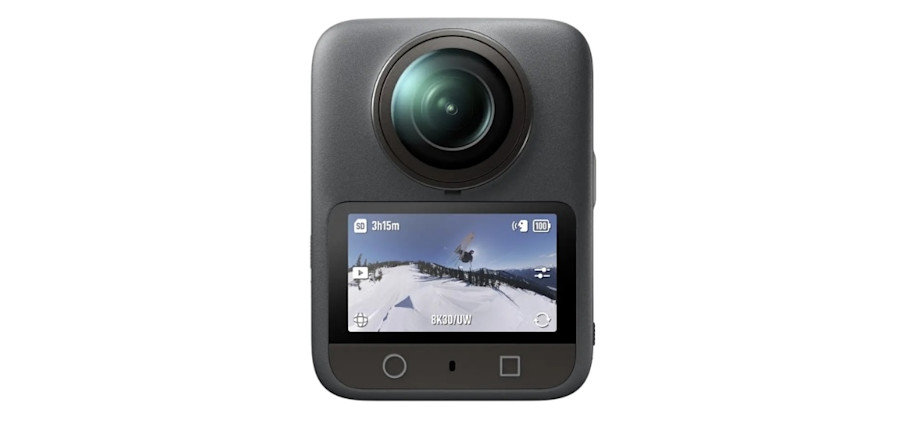
Image source: DJI
The DJI Osmo 360 is DJI's first dedicated 360-degree camera, purpose-built for durability in conditions where other cameras risk damage.
Price: The Standard Combo runs at $549.99.
Matterport compatible: Not compatible
The Osmo 360 brings serious durability and imaging performance to the field:
Dual 1/1.1-inch sensors with 13.5 stops of dynamic range: Sharp, vibrant footage even in high-contrast scenes.
IP68 waterproof rating: Suitable for wet, flooded, or debris-heavy loss sites.
Up to 100 minutes of continuous 8K recording, 190 minutes at 6K: A high-performance imaging chip with advanced cooling enables the long recording windows.
120MP 360 photos: High-resolution still documentation in a single press.
HorizonSteady stabilization: Keeps shots level during handheld walkthroughs in tight or uneven spaces.
Operates at temperatures as low as -20°C (-4°F): Viable for cold-weather CAT deployments.
The high-resolution sensor system and strong stabilization make the Osmo 360 effective for dynamic inspection environments like CAT zones and active damage sites where conditions are unpredictable.
Limitations:
Less mature in insurance-specific workflows; primarily designed as an action and creator camera
Lacks LiDAR accuracy for depth sensing and automated measurement capabilities
Teams would need a separate workflow to convert captures into estimating-ready documentation
Not integrated with the Matterport platform
Best for: Adjusters working in harsh environmental conditions who prioritize image durability and weather resistance, and teams that don’t require direct platform integration for estimation workflows.
5. Mosaic 51: Best for large-scale CAT mapping and infrastructure claims
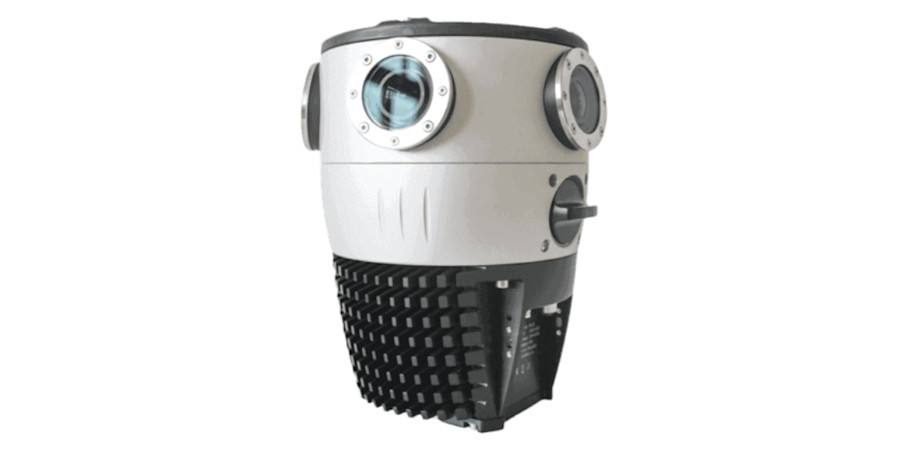
Image source: Mosaic
The Mosaic 51 is a rugged, industrial-grade 360 camera built for mobile mapping at scale: street-view capture, surveying, and infrastructure inspection. It serves a different use case than the cameras above, designed for wide-area exterior documentation rather than interior walkthroughs.
Price: Contact Mosaic directly for a quote. Online information suggests pricing at $40,000+. This is an enterprise-grade system priced significantly higher than consumer or prosumer 360 cameras.
Matterport compatible: Not compatible
The Mosaic 51 fills a niche that no consumer camera can:
12.3K panoramic images at 72MP resolution: Extremely high-fidelity capture of complex environments at scale.
Built-in GNSS receiver: Precise geolocation of damage across large properties and infrastructure.
IP64 rating with operating range of -10°C to 45°C: Reliably operates in harsh weather, with a humidity range of 0–100%. The industrial frame is purpose-built for field punishment.
Built-in computer and large internal storage: All-day capture without a dedicated workstation tethered in the vehicle.
Single-operator capture: One person can drive and operate the camera simultaneously.
This is a specialized tool for large-scale exterior and geospatial capture. Its multi-lens, multi-sensor architecture supports the kind of wide-area documentation needed after hurricanes, tornadoes, and large commercial losses that span city blocks.
Limitations:
Significantly higher price point than consumer or prosumer 360 cameras
Designed primarily for vehicle-mounted mobile mapping, not interior walkthroughs
Not integrated with the Matterport platform or insurance-specific estimation tools
Serves a niche use case, less relevant to the interior walkthrough capture that most adjusters need
Best for: Large-scale commercial or infrastructure claims covering CAT event ground mapping, and organizations that need precise geospatial documentation across wide areas.
6. Trisio Lite 2 8K VR: Best budget 360 camera for low severity insurance claims
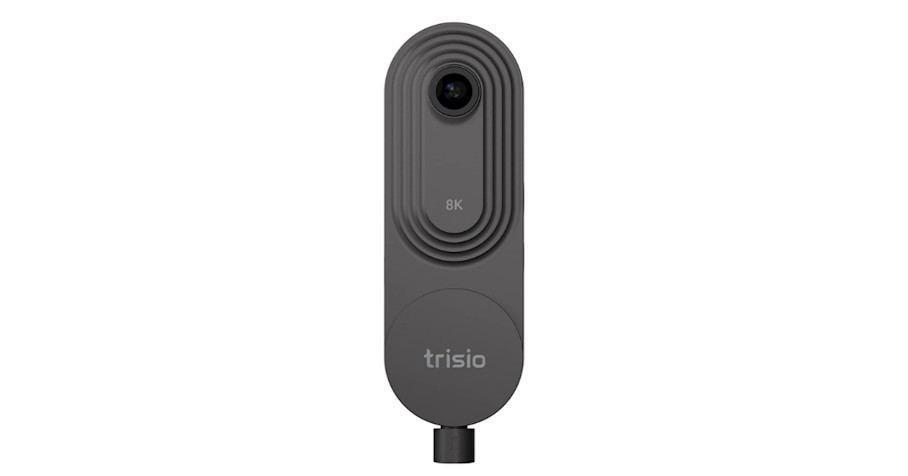
Image source: Amazon
The Trisio Lite 2 is the most affordable dedicated 360 camera on this list. It offers a capable entry point for teams that need basic panoramic documentation without a significant hardware investment.
Price: Approximately $400 from retailers like Pergear and Amazon. No subscription required.
Matterport compatible: Not compatible
Despite its budget price, the Trisio Lite 2 offers several useful features:
Single rotating lens with NodeRotate technology: One lens rotates in a circle to take multiple photos and stitch them automatically, producing 32MP panoramic images.
~30 seconds per panoramic capture: Four shots per capture cycle.
Built-in 8GB storage and ~200 minutes of battery life: Enough for multiple small property inspections per charge.
Bluetooth remote control: Operate via the Trisio 360 app without standing next to the camera.
Ultra-lightweight at 150g: Maximum portability for a camera that slips into any pocket.
The anyScene full-scene adaptive imaging system handles brightness suppression and darkness compensation automatically, which helps in damaged interiors where lighting conditions vary room to room.
Limitations:
The single-lens rotation method means each panoramic capture takes longer than dual-lens or multi-lens cameras
Lower resolution compared to dual-sensor cameras at higher price points
Limited ecosystem with no integration with the Matterport platform or claims estimation tools
The rotating mechanism requires a tripod and is difficult to shoot when there's movement around the camera
Best for: Very low-severity cases like small water leaks, minor staining, or cosmetic damage. Also works as a supplemental backup camera alongside a primary capture device for adjusters who want a low-cost option in their bag.
Consistent capture is the starting point for a faster claims pipeline
When every claim file is grounded in complete, dimensionally accurate spatial documentation, every downstream step (desk review, estimation, subrogation, settlement) inherits that reliability.
The Matterport Pro3 paired with the Matterport platform represents the most complete path from capture to claim file in this evaluation. LiDAR accuracy, long-range scanning, reliable performance in damaged environments, and direct integration with Xactimate and Cotality workflows mean the documentation moves from camera to settlement with minimal manual handling.
Teams with smaller budgets or simpler claims can start with compatible 360 cameras like the Insta360 X5 or Ricoh Theta Z1 and still benefit from Matterport platform features like remote walkthroughs, annotations, and measurements.
Here’s a quick decision matrix based on your primary use case:
Commercial and large-loss claims: Matterport Pro3
Standard residential claims at volume: Insta360 X5
Low-light damage verification and triage: Ricoh Theta Z1
Harsh-environment CAT deployments: DJI Osmo 360
Large-scale infrastructure and geospatial mapping: Mosaic 51
Low-severity supplemental documentation: Trisio Lite 2
Pick based on the claims you handle most and the conditions you work in, and think about what you need the data to do once it's captured.
Get in touch with our team

