


 Sign In
Capital Planning for Student Housing: How to Prioritize and Justify Investments
Every student housing property in a portfolio has a demanding list of capital needs. High turnover, heavy occupancy density, and the relentless pace of academic calendars accelerate wear in ways that conventional multifamily rarely sees. But budgets only stretch so far. Deciding what to fund carries long-term consequences for occupancy rates, resident satisfaction, and overall asset performance.
Capital planning gives student housing owners and operators the framework to forecast replacement needs before they become emergencies, prioritize spending against consistent criteria, and schedule work around academic calendars so disruption stays minimal and asset value stays protected.
This guide covers a structured capital planning process for student housing, from assessing conditions and setting replacement cycles to prioritizing projects and defending your plan to ownership.
Unique factors that drive capital investment decisions for student housing
Capital planning for student housing operates under a distinct set of operational, market, and portfolio-level pressures that make investment decisions more complex than traditional multifamily housing. Understanding these factors helps build a capital plan that accounts for the realities of the asset class.
The following factors set student housing apart from other residential property types:
Compressed project windows and academic calendars. Most capital work must be completed during the 8 to 12 weeks between spring move-out and fall move-in. There is almost no margin for delays or scope changes.
High resident expectations and experience-driven competition. Students compare housing options the way consumers compare hotels. Amenity quality, unit finishes, and technology infrastructure directly influence leasing velocity.
High number of aging assets. Focused growth in student housing development in the early 2000s means that many purpose-built properties are now entering major replacement cycles simultaneously.
Accelerated wear and tear. Higher occupant density per unit and annual turnover cycles put more stress on finishes, fixtures, and building systems than a typical apartment property experiences.
Complex capital prioritization across portfolios. Operators managing properties near multiple universities must weigh different competitive markets, building ages, and enrollment trends when allocating limited capital.
Limited visibility into actual property conditions. Relying on periodic site visits, static photos, and subjective maintenance reports makes it difficult to compare conditions consistently across a dispersed portfolio.
Stakeholder complexity. Capital decisions often require alignment among asset managers, regional directors, facilities teams, capital committees, and ownership groups, each with different priorities and information needs.
These combined pressures make capital planning increasingly dependent on consistent data on property conditions. Asset managers who can standardize how they assess and document conditions across every property are better positioned to allocate capital where it delivers the highest return.
Digital twins have emerged as a common standardization tool in this space. These 3D property models give operators a consistent visual and dimensional record of each space, strengthening how complex assets are assessed before capital is allocated.
How to build a data-driven capital plan for student housing
The following guide breaks down the core disciplines that underpin effective student housing capital planning. Each step builds on the previous one, moving from foundational lifecycle data through forecasting, decision-making, scoping, and execution planning.
1. Establish lifecycle assumptions across the portfolio
Every capital plan starts with a baseline of how long major building components are expected to last. These lifecycle assumptions provide the framework for forecasting when replacements will be needed and how much they will cost.
The table below outlines typical useful life ranges for key capital categories in student housing:
Capital category | Typical useful life |
|---|---|
Roofing | 20 to 30 years |
HVAC systems | 15 to 25 years |
Elevators | 20 to 25 years |
Unit interiors and finishes | 5 to 10 years |
Common area furnishings | 5 to 8 years |
Amenities (fitness, pools, lounges) | 7 to 12 years |
Technology infrastructure | 3 to 5 years |
Exterior facades and parking | 15 to 25 years |
Lifecycle data provides a useful starting framework, but age alone is a poor proxy for condition. Heavy use, deferred maintenance, and inconsistent upkeep mean that two properties of identical vintage can present very differently. A system at year 12 of a 15-year lifecycle may have years of useful life remaining, or it may already be failing.
Operators increasingly pair lifecycle schedules with visual documentation of properties to improve observation of real-world asset conditions. Static photos capture a moment but offer limited context, and rarely cover entire properties consistently. 3D models provide comprehensive and dimensionally accurate records of every space, so condition assessments are grounded in high-quality observable data.
For example, when unit flooring is showing wear, teams can compare current conditions directly against that original record, identify where deterioration is running ahead of the lifecycle schedule, and adjust their forecast accordingly.
2. Build a forward-looking capital forecast
Once lifecycle assumptions are in place, the next step is to translate them into a structured replacement schedule across the portfolio. This forecast maps anticipated capital needs against time, helping operators see when major expenses will cluster and where budget pressure is likely to build.
Most student housing operators organize forecasts into layered planning horizons:
3-year tactical budget. Covers funded projects and near-term commitments that are already scoped or in progress.
5-year strategic plan. Identifies emerging capital needs and aligns them with hold period strategy, lease-up goals, and competitive positioning.
10-year reserve outlook. Projects long-term system replacements and major renovations to ensure reserve funding keeps pace with anticipated needs.
One of the most common challenges in capital forecasting is managing overlapping replacement cycles. HVAC systems, roofing, and technology infrastructure don't reach end-of-life on a convenient schedule — and in any given year, multiple high-cost assets across multiple properties may be competing for the same limited pool of capital. The result is a capital "pressure year" where projected replacement costs spike well above available budget and force difficult trade-offs.
These years are where prioritization decisions become consequential and where a credible forecast earns its value. Identifying potential clusters early allows teams to stagger work, pull forward lower-cost projects, or defer items with more remaining useful life.
Building a forecast with confidence requires more than spreadsheets and assumptions. Forecasting improves when teams can virtually review properties via standardized 3D walkthroughs. This enables better comparison of condition, urgency, and investment timing across campuses without relying on scheduled site visits. Every property in the portfolio is reviewed from the same interface, so the forecast can be interrogated by the whole team.
3. Convert forecasts into capital decisions (refresh, replace, upgrade)
Not every capital need calls for the same response. With a capital forecast in hand, asset managers face a key decision for each project: does a property need a cosmetic refresh, a full replacement, or a strategic upgrade? These three categories represent different levels of investment, disruption, and expected return.
Refreshes involve cosmetic updates such as new paint, updated flooring, fixture swaps, and furniture replacement. They extend the competitive life of a unit or common area without changing the underlying layout or systems.
Replacements address components that have reached the end of their functional life. Replacing an HVAC system, re-roofing a building, or gutting a bathroom down to the studs falls into this category.
Upgrades go beyond restoring current functionality to add new capabilities. Converting a study lounge into a coworking space, adding package lockers, or installing smart home technology are examples of upgrades designed to reposition a property competitively.
Newer purpose-built student housing continuously raises amenity expectations. Older buildings face a persistent choice: invest to compete on product quality, differentiate on price and location, or accept the lease velocity that comes with falling behind the market. The right answer depends on asset age, hold period, competitive positioning, and what the local renter pool actually expects.
Making these decisions consistently across a portfolio requires a shared frame of reference. By comparing current property conditions with previous digital twins captures in Side-by-Side Spaces, asset managers can determine whether a property is still competitive or requires deeper reinvestment. These virtual models provide a high level of detail, making it easy to understand whether cosmetic updates will suffice or a full replacement is warranted before committing to a budget.
4. Scope renovations and budget accurately
Once priorities are identified, accurate scoping is critical to avoid budget overruns and misaligned expectations. The gap between a preliminary estimate and a detailed scope can be significant. Capital plans that rely on rough numbers often face challenges during execution.
Reliable budgets are built at the asset level. Each project should be broken into discrete scope items (e.g., unit interiors, common areas, building systems, exterior work) with costs assigned using standardized unit pricing, vendor benchmarks, and historical data from comparable projects. Granularity makes budgets easier to defend, easier to adjust when scope changes, and easier to reconcile against actuals once work is complete.
Rather than scheduling site visits to take room dimensions or verify quantities before a refresh or replacement, teams can use Automated Measuring tools embedded in a digital twin to pull accurate dimensions of units, corridors, amenity spaces, and mechanical rooms directly from the model. Better inputs produce better estimates, and better estimates reduce the contingency padding that inflates capital budgets and complicates approvals.
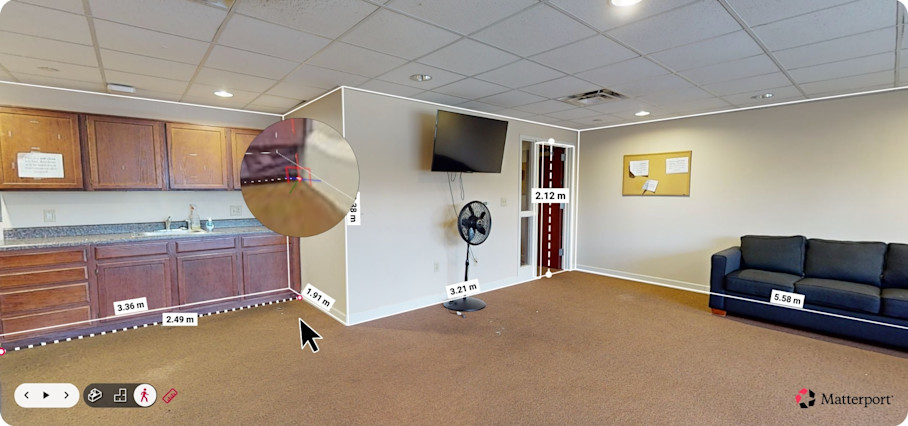
Scoping also requires alignment across teams that don't always share the same frame of reference. Facilities staff, asset managers, and capital committees often review the same project from different vantage points and with different priorities. Notes and Tags allow stakeholders to annotate items and discuss issues directly within the 3D model, adding context to specific reference points and keeping everyone aligned.
Custom Views create audience-specific presentations from the same underlying model, so contractors have the technical detail they need and ownership sees the summary perspective they prefer.
5. Plan work around occupancy constraints
Student housing capital projects operate under some of the tightest execution windows in the real estate industry. Budgets should be structured into phased capital plans that account for these constraints, ensuring work can realistically be delivered without disrupting the resident experience or missing move-in deadlines.
The primary execution window is the 8 to 12 weeks between spring move-out and fall move-in. Project sequencing is critical. Not every project can fit into a single summer, and not every project needs to.
Not every project requires vacancy. Operators can improve execution planning by categorizing projects by disruption level:
Low-disruption work (e.g., painting, fixture swaps) can often be completed during occupied periods with proper scheduling and resident communication, particularly in common areas or units where pre-leasing data identifies temporary availability.
High-disruption work (e.g., HVAC replacements, plumbing risers, structural repairs) should be concentrated in vacancy windows or defined zones, such as one building or wing per summer, to contain disruption and give contractors uninterrupted access.
Once projects are underway, digital twins serve a practical role beyond planning. Captures taken at project completion create a documented record of finished work for warranty claims and future condition assessments. This creates a continuous documentation cycle where each capital project's outcome becomes the baseline for the next planning period.
Visual evidence that wins approval for capital plans
Even the most carefully prioritized capital plan must clear a critical hurdle: leadership approval. Executive teams evaluate capital requests based on the clarity and credibility of the supporting evidence. It’s crucial to structure capital plan documents to reflect how decisions are actually made at the executive level to improve the likelihood of approval.
A well-structured capital plan presentation typically includes four components:
An executive summary of portfolio-wide capital needs
A prioritized project list with a clear scoring rationale
A multi-year funding and phasing schedule aligned to operational constraints
Project-level scope and cost estimates, supported by risk scenarios that highlight the impact of deferring investment across operational, financial, and occupancy dimensions
The quality and consistency of supporting evidence is as important as project ranking in securing approval.
Competing projects must be justified using a consistent evidence framework. The following table maps key scoring factors to the evidence used to support each decision:
Scoring factor | Evidence basis |
|---|---|
Condition | Asset and system state based on documented observations. |
Urgency | Risk of failure, safety concerns, or operational disruption. |
Competitive positioning | Relative quality versus newer or higher-performing assets. |
Execution feasibility | Ability to deliver within the turn season and occupancy constraints. |
Budget clarity | Scope definition and cost basis to support funding requests. |
The challenge with this framework is consistency. Condition assessments gathered through ad hoc site visits, fragmented photo libraries, and informal reporting produce uneven evidence that is difficult to compare across properties and easy to challenge in a review.
Digital twins standardize that evidence base by giving every property in the portfolio a verifiable visual record that stakeholders can access directly. Board members can virtually walk through a property to see the issues being discussed, making capital requests more tangible and reducing the back-and-forth that delays approval.
For operators managing large or geographically dispersed portfolios, Matterport’s Capture Services supports this approach at scale. Professional capture teams document properties in a consistent format across every site, ensuring that the condition evidence underpinning capital decisions is comparable, current, and ready to support approval requests, regardless of how many properties are in the portfolio.
With consistent evidence, the capital planning conversation shifts from debating which campus needs attention to deciding where capital goes first, so portfolios get ahead of the turn season instead of chasing it.
Modernize Student Housing operations with Matterport