


 Sign In
How to Increase Hotel Direct Bookings & Reduce OTA Dependence
Key takeaways
OTAs deliver real top-of-funnel reach, but increasing hotel direct bookings recovers meaningful margin and hands you the guest relationship, contact data, and repeat-stay revenue that platforms otherwise keep.
Direct bookings grow when you remove friction from the booking path, surface reviews and best-rate messaging where the decision happens, and give travelers a visible perk an OTA can't replicate.
Immersive virtual tours let travelers walk the actual room and book with the confidence that keeps them on your site instead of clicking back to an OTA.
Online travel agencies fill hotel rooms you might never be able to on your own. They put your property in front of millions of travelers, which is a reach worth paying for. But the booking journey doesn't always have to end on an OTA listing. A large share of travelers who first spot your hotel on a third-party platform will click through to your own website before they decide where and how to book.
That website visit is a high-intent moment. You can use it to showcase the property, answer practical questions, and reinforce the value of booking direct.
In this guide, we’ll walk through strategies that help increase hotel direct bookings and reduce OTA dependence. The goal is a healthier channel mix, lower commission costs, and more revenue kept from every guest.
How direct bookings benefit hotels
When a guest books through an online travel agency, the hotel doesn't keep the full room rate. Online travel agencies (OTAs) take a commission, typically 15 to 25 percent of the booking value, as the price of the exposure and the transaction. By processing these bookings, the OTA also owns the guest relationship: the contact details, the booking data, the chance to earn a repeat stay all sit with the platform, not with you. Lean too heavily on those channels and your margins and your guest connections are effectively rented from a middleman.
Every direct booking represents profit you can reinvest in the guest experience, but the margin is only the start. When a guest books direct, hotels also benefit from:
Full guest profile and contact data. You own the email, phone number, and stay history, not a third party.
Control over the pre-arrival experience. You decide the messaging, timing, and upsells before the guest arrives.
Upsell and package flexibility. Room upgrades, spa credits, and dining bundles are yours to design and price.
No third-party rate or cancellation rules. You set the policies rather than inheriting a platform's terms.
A relationship you own for repeat stays. The next booking can come straight to you, at almost no acquisition cost.
OTAs are still useful platforms, delivering valuable top-of-funnel visibility that would be nearly impossible to replicate otherwise. The commission funds the enormous advertising spend OTAs use to acquire travelers in the first place. In 2025, the biggest OTAs spent a combined $20 billion on sales and marketing, so zero OTA presence isn’t a good idea.
The ideal scenario is to have a healthy channel mix. If OTAs drive 60 percent of your bookings today, a realistic first target is an even split between direct and third-party bookings. The strategies below will help you increase hotel direct bookings and shift the balance.
Promote the property in a way an OTA listing can't
"Our hotel looks better in person than it does online" is a common complaint in hospitality marketing, and it's usually true. OTA listings cap photo counts, crop images to a template, and force every property into the same rigid layout. Your own website has no such limits, so you can use it to tell a richer story.
Immersive 3D tours of rooms, suites, and amenities
Hotels use 3D virtual tours to market their spaces in a way that OTA listings typically can't match. Instead of scrolling a fixed gallery, a visitor walks through the actual room, steps onto the balcony, and moves from the lobby to the pool at their own pace. It gives them a reason to stay on your site and explore, rather than bounce back to compare thumbnails.
Embed the tour in the spaces where it is most likely to drive a booking:
Room type and suite pages
The room-selection step inside your booking engine
The homepage hero
Weddings and meetings landing pages
Pre-arrival emails
Paid social ads
Your Google Business Profile
With a full view of the space, guests book faster and with more confidence. They can see the real room, the actual view, and the true sense of space, so the uncertainty that makes people hesitate or keep price-shopping falls away.
Lindner Hotels added virtual tours to their website and Google Business Profile using Matterport digital twins, resulting in 25% more online engagement.
Practical room details and accessibility
When a traveler has questions about the practicality of the room and can’t find them online, they might email or call, but they’re just as likely to go searching elsewhere. Some even abandon the booking. Room dimensions, layouts, accessibility, and amenities should be clear in your listings.
Consider the practical and accessibility questions a traveler might ask:
How big is the room, really?
Will a crib fit next to the bed?
Is there clearance for a wheelchair between the bathroom and the closet?
These elements are much easier to confirm with confidence inside a navigable tour where they can see the layout for themselves. Matterport tours even include Measurement Mode that lets guests verify these details without waiting on a reply from your front desk. A guest can accurately check the width of a doorway, confirm a family room fits two extra beds, or verify that a particular configuration works for a relative with mobility needs.
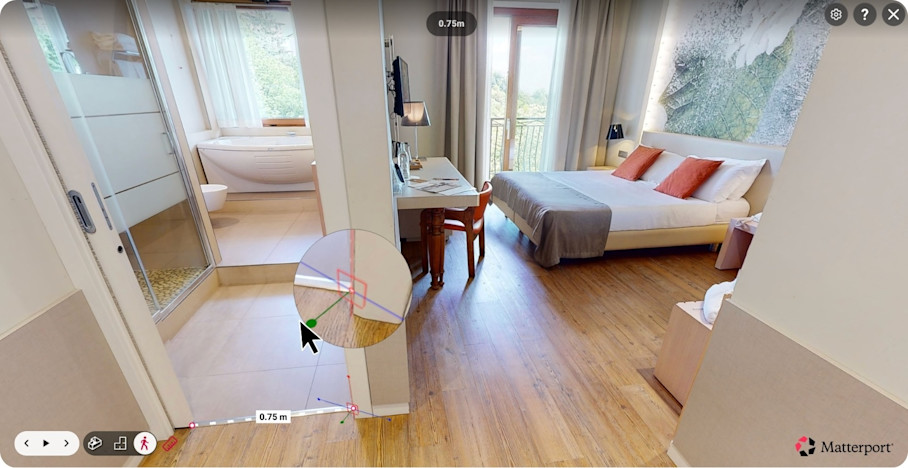
The more questions a guest can answer on the room page, the fewer reasons they have to delay or leave.
Event and group space previews
Meeting and event planners need more than a photo carousel to judge whether a space fits their event. They're thinking about capacity, sightlines, load-in access, and whether a 200-person gala will feel cramped or comfortable. Photos leave too much to the imagination, and a wrong guess is expensive.
Virtual tours let planners explore function rooms remotely. They can pull up floor plans, understand how spaces connect, and picture different setups before they ever pick up the phone. Some tours even help planners decide what seating will work best, defurnish the room to a blank canvas, and reconfigure virtual furniture, all from their browser.
Allseated's hospitality clients have seen sales increases of 30% with digital twin-based virtual venue tours and space planning tools. Giving planners more upfront turns casual research into a qualified inquiry, often without the cost of a site visit for either side.
Remove friction from your direct booking path
Even when demand for direct bookings exists, it’s too easy to lose it to execution problems. A slow page, a confusing checkout, or a lack of social proof all sow doubt. When a traveler is ready to book direct, your hotel’s site should make it just as easy as the OTA does. The three areas below are where the leaks usually hide.
Website speed, mobile experience, and navigation
Speed is a common technical issue. Most booking research happens on mobile, so a slow or cluttered direct booking experience is a conversion problem, not just a design one. A traveler mid-research on a phone won't wait for a heavy page to render. They'll tab back to the listing that already loaded.
Focus on the following fixes first:
Compress and lazy-load large property images so they don't block the first paint
Keep the "Book now" button persistent and visible as the visitor scrolls
Limit primary navigation to a handful of items
Make rates and availability reachable in one tap from any page
Watch out for on-page conversion killers too. Autoplay video in heroes can delay load. Pop-ups that fire before a visitor even sees a room and date pickers that reset when someone taps back are frustrating. All of these push travelers toward the exit. Test your navigation experience on all devices regularly.
Booking engine and checkout flow
A low-friction booking flow keeps that momentum going from the room page to the confirmation screen. The traveler should never wonder what happens next or feel forced to hand over information they don't want to share.
Aim for a flow that includes:
Date and occupancy selection above the fold
Live rates shown without a form submission
Three steps or fewer to confirmation
Guest checkout with no forced account creation
Mobile-native payment options
Design is important too; a jarring shift in fonts, colors, or domain makes travelers wonder whether they've been handed off to a sketchy third party. Match the engine to your main site so the flow feels continuous.
When bookings still drop, diagnose the exact step. Pull your analytics, find the screen where sessions vanish, then test removing one field or one screen at a time. Small, isolated changes will tell you what actually makes a difference.
Reviews and reputation signals
Recent reviews, star ratings, and guest testimonials calm the anxiety that creeps in right before someone commits. 97% of hotel guests check guest reviews before booking a hotel, yet many hotels bury or omit reviews on their room and booking pages, forcing travelers to rely on OTA reviews instead. Once they're back on the OTA, they often book there.
Instead, surface reputation signals on your own room and booking pages, where the decision happens. Embeddable widgets pull live ratings from Google, Tripadvisor, or other review platforms so scores refresh automatically, and place the aggregate star rating and review count right beside the nightly rate and the "Book" button.
Pair that social proof with immersive proof: a virtual tour beside real guest reviews demonstrates that the property matches what other guests describe. You can even shape that experience deliberately by curating a Guided Tour through your property. Instead of leaving visitors to wander, create a walkthrough path that leads them through your best-reviewed spaces in a chosen sequence. Add captions highlighting space-specific quotes and reinforcing what guests already praise.
Give travelers a good reason to book direct
When the same room sells at the same price everywhere, the traveler defaults to the channel they already trust. That channel is usually an OTA. Direct-booking growth requires a stated, visible value difference the traveler can see before they commit.
Rate parity and best-rate messaging
Start by monitoring parity across your OTA channels so you catch undercutting. When a channel manager or wholesaler drops your rate below your own site, the direct-booking pitch collapses instantly. Regular checks will help you correct the discrepancy fast.
Then, communicate your best-rate guarantee where people actually see it, near the rate display and the booking button, not buried in a footer nobody scrolls to. Keep the wording honest and specific to avoid legal overreach. A clear "you won't find this room cheaper elsewhere" beats vague superlatives.
Remember that matching your lowest available rate removes a reason to abandon your site, but it isn't a differentiator on its own. To pull travelers toward direct, you also need to create additional value the OTA can't replicate.
Member rates, perks, and value-added incentives
Direct-only incentives should cost you less than an OTA commission would, while still feeling valuable to the guest. Here are a few common perks and how they stack up against margin:
Closed-user-group member rates typically offer a modest discount that comes in under commission cost.
Free breakfast is a low-cost perk, because food cost is a fraction of the retail price.
Waived parking or resort fees come at a moderate cost but remove a common source of friction for bookers.
Early check-in or late checkout costs nothing when occupancy permits.
Welcome amenities are usually a very low spend that shapes the first impression positively.
Flexible cancellation matches OTA reassurance without the commission.
If your property is sensitive to rate integrity, favor perks over discounts. That will preserve your published rate while still rewarding the direct booker.
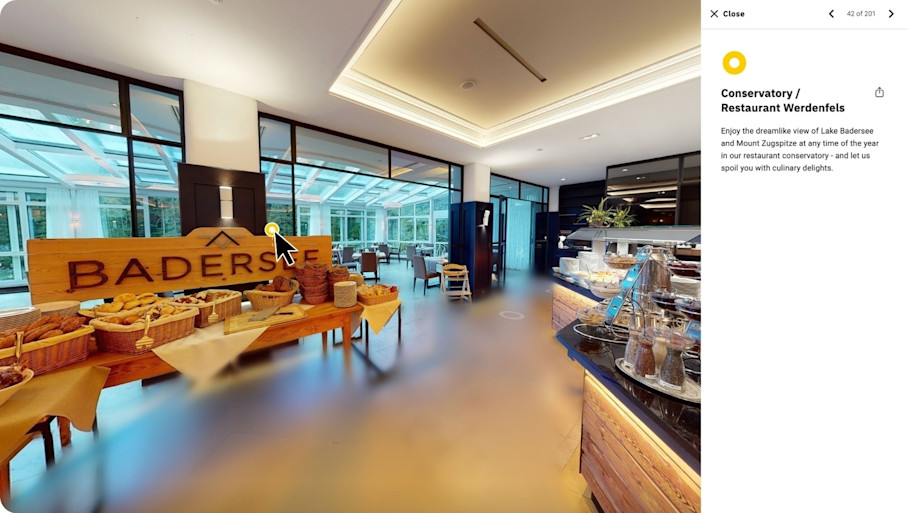
When advertising perks, make sure the value feels real to your guests. Spotlight offers, like the breakfast spread or a welcome amenity waiting in the room, by tagging them in your virtual tour, so bookers can see exactly what they’ll get.
Loyalty programs and repeat-stay campaigns
Any hotel can run a loyalty program, from a small boutique to a flagship brand. A lightweight program works fine: email-based enrollment, a simple points or stay-count reward, and member-only rates visible on your own site. The only goal is to give repeat guests a good reason to come straight to you.
Focus on collecting guest data using the strategies above, and use that to feed segmented offers. Shape different messages for:
Past guests
Your local market
Weekday business travelers
Seasonal repeat visitors
Every direct booking lowers the acquisition cost of the next one, because a guest already in your database can be reached by email at a very low cost. Over a few stays, a loyal direct guest will become dramatically cheaper to serve than a fresh OTA reservation.
Recapture OTA researchers who left without booking
Most travelers now touch several sources before they book. The same person may visit an OTA listing, your brand site, and a review platform in a single session. That fragmented journey gives you more than one chance to win the booking. The following tactics help recapture researchers who didn't reserve.
SEO and content that captures high-intent searches
Defend your branded search first. Your hotel name, your name plus "booking," and your name plus a room type are the highest-converting searches you'll ever see, and OTAs bid on them aggressively. If you don't rank and advertise on your own name, you're paying commission on traffic that was already looking for you.
Next, build content that maps to booking intent. Neighborhood guides, event and venue pages, accessibility information, and honest "what to expect" room descriptions all catch travelers who are close to deciding. These pages pull in searches an OTA listing can't rank for.
Use virtual tours to increase time on page. Embed booking buttons that give a researching visitor a natural reason to move from reading into your booking engine, turning a passive browse into an active reservation.
Retargeting travelers who researched but didn't book
Most people who visit your site leave without booking on that first visit because they're comparing properties, checking dates, or simply not ready to commit. Retargeting ads help you stay in front of those travelers after they go.
Segment your retargeting audiences by behavior, so each group sees messaging best suited to their stage in the journey:
Homepage visitors who barely explored need a broad reminder of the property's appeal.
Room page viewers who studied a specific room type need that room brought back to mind.
Booking abandoners who reached checkout need the smallest possible push, often just a reminder of held dates or a small offer.
Use virtual tour imagery as your retargeting creative. A moving, dimensional shot of an actual suite will stand out sharply against the flat rate promotions cluttering every traveler's feed.
Email marketing touchpoints across the booking journey
Email is your most durable tool for pulling travelers off third-party platforms. Give researchers who aren't ready to reserve a reason to share an address, like a neighborhood guide, a rate alert, or a first-booking offer, so you can nurture them instead of losing them back to the OTA.
From there, email spans the whole booking journey:
An abandoned-booking email should fire within a few hours, recapping held dates, the chosen room, and the direct perks, with a link to that room's virtual tour. One gentle follow-up later is plenty.
Pre-arrival messages open your upsell window: offer upgrades, spa, or dining, each linked to a tour of the actual space so the guest sees what they're buying.
Post-stay, a review request, a loyalty invite, and a return-guest offer seed the next direct booking instead of another trip through an OTA.
Bring your hotel to life and win more direct bookings
OTAs will keep sending you visibility, which is a good thing. But your booking revenue base shouldn’t depend on any single platform's fees, terms, or algorithm changes.
Any traveler who reaches your website has already shown interest, and everything about that visit should feel easier, more informative, and more rewarding than clicking back to a listing.
Immersive tours, honest reviews, a clean booking flow, and a clear reason to book direct help turn the demand you already have into revenue you can keep. That's how you increase direct hotel bookings and reduce OTA dependency without giving up the reach that fills your rooms.
Get started with Matterport for Travel & Hospitality


