


 Sign In
Capturing Tribal Knowledge in Manufacturing: A Plant Leader's Guide
Walk the floor of almost any manufacturing plant and you'll find someone who can diagnose a jammed conveyor by the sound it makes, or who knows that the third press on line two needs an extra thirty seconds of warm-up. None of this is written in a manual. It lives in the minds of people who have spent decades solving the problems, and it's often the reason production keeps running.
That expertise is on a countdown. A significant share of the manufacturing workforce is at or near retirement age, and every departure takes a piece of institutional memory with it. The challenge is that this kind of knowledge doesn't compress well into text. Tribal knowledge in manufacturing is experiential.
This guide walks through structured methods for capturing and passing down manufacturing tribal knowledge. These methods go beyond static documentation to preserve institutional expertise in a form every team member can access, right at the point where they need it.
The importance of tribal knowledge in manufacturing
Tribal knowledge is the undocumented, experience-based know-how held by veteran manufacturing operators, maintenance technicians, supervisors, engineers, and suppliers. It includes everything from the precise feel of a properly tensioned belt to the informal supplier relationships that expedite critical parts during emergencies.
Tribal knowledge is not inherently a problem. It is essential for complex manufacturing operations where conditions vary, equipment ages unpredictably, and no manual can anticipate every scenario. But serious risks emerge when that knowledge concentrates in a small number of people who are approaching the end of their careers.
26% of the existing manufacturing workforce is expected to retire by 2030, leaving more than 1.5 million roles vacant. When a 30-year veteran retires, their replacement inherits only the documented portion of what that person knew. The rest disappears.
Left unaddressed, the knowledge gap shows up on the floor in a number of operational costs.
Unplanned downtime: When the only person who knows how to troubleshoot a legacy CNC controller is unavailable, the line stops until someone figures it out from scratch.
Slower onboarding: New operators take longer to reach full productivity when they must learn by trial and error what a mentor could have demonstrated in an afternoon.
Inconsistent product quality: Process settings that experienced operators adjust instinctively based on material batch, ambient temperature, or equipment wear get missed by less experienced workers.
Safety incidents: Emergency response procedures that live in one person's memory create risk every shift that person is absent.
Reduced organizational resilience: Plants with concentrated expertise are fragile. A single illness, injury, or resignation can disrupt production for weeks.
These consequences accelerate as the workforce turns over, so a solution for preserving tribal knowledge should be a strategic business priority.
6 steps to protect manufacturing tribal knowledge before your experts retire
The following steps outline a practical framework for finding, capturing, and preserving tribal knowledge in manufacturing before a retirement wave removes it permanently. They also cover how to share it in intuitive workflows, so expertise surfaces at the right time and place.
1. Identify workers with production-critical knowledge
The first step is recognizing where undocumented expertise exists. Start by identifying the knowledge holders. These usually include:
The operators everyone calls when something goes wrong
The maintenance techs who can restart legacy equipment without a manual
The supervisors who know workarounds that never made it into a documented procedure
Shift handover notes, maintenance logs, quality deviation reports, and production performance data often point to undocumented expertise. Look for patterns like:
Lines that run better on certain shifts
Equipment that fails less frequently under certain operators
Quality issues that appear only when specific people are absent
Plant floor audits that compare documented SOPs against actual practice reveal gaps quickly. Map "single points of failure" where only one or two people know how to handle a specific piece of equipment, process, or emergency. These are the highest-risk areas.
Structured operator interviews and shadowing sessions with veteran workers provide the richest material. Focus on what they do differently from what the documentation says, and why.
It’s most effective to conduct interviews where the knowledge actually lives: on the floor, in front of the equipment. This way, operators find it much easier to recall their experiences. Digital twins of plants help to avoid disrupting live operations while conducting these sessions. They are used widely across manufacturing operations to capture plants and equipment in dimensionally accurate 3D. Experts can navigate the model remotely and describe knowledge in context.
2. Prioritize knowledge that carries the highest impact
Experienced workers develop several categories of tribal knowledge over their careers. Not all of it can be captured at once, so prioritization matters.
Use a risk-based framework to prioritize knowledge capture:
Start with knowledge tied to safety-critical processes, high-value equipment, and areas with imminent retirements.
Then rank by business impact and how few people currently hold that knowledge. A skill that several operators share is less urgent than one that only a single person possesses.
There are a number of key tribal knowledge categories to document.
Category | Examples |
Equipment quirks | Machines that: - Require specific startup sequences - Run better at non-standard settings - Have failure patterns not covered in OEM manuals |
Troubleshooting expertise | The diagnostic steps experienced techs use before calling in outside help |
Sensory cues | Signals that operators use to catch issues before sensors do, such as: - Sounds - Vibrations - Smells - Temperature |
Timing instincts | Knowing when a process is about to drift out of spec based on subtle environmental changes |
Optimal process settings | Parameters that vary by: - Shift - Material batch - Season - Equipment age |
Maintenance insights | Preventive steps that extend equipment life beyond manufacturer recommendations |
Changeover techniques | Undocumented shortcuts and sequence variations specific to legacy equipment |
Emergency response procedures | Scenarios or intricacies the manual does not cover, such as: - Difficulties with evacuation routes - Shutdown sequences - Containment steps |
Plant layout knowledge | - Where utility shutoffs are located - Which corridors allow forklift access - Which areas flood during heavy rain |
Supplier and vendor expertise | - Relationships with OEM reps - Preferred part sources - Knowledge of which aftermarket components work as substitutes - Custom modifications |
Historical context | - Why a process was designed a certain way - What failed before - Which past modifications changed equipment behavior |
The risk and scarcity criteria apply differently depending on which category of knowledge is in play. Safety-critical urgency usually points toward emergency response procedures and equipment quirks tied to hazardous processes, while scarcity tends to concentrate in categories like troubleshooting know-how and supplier expertise, where a single technician's relationships or diagnostic instincts may not exist elsewhere.
3. Turn tribal knowledge into operational assets
The next step is to capture manufacturing tribal knowledge in a form that actually preserves it. SOPs are designed to record what to do, not how experienced people think when conditions change. Decision logic is often the most valuable part of what they know, and it's exactly what gets lost when documentation only records outcomes.
Text-based documentation also strips away spatial context: the physical location of a valve, the access path to a control panel, the way one machine's exhaust affects a nearby operator's line of sight. Vague, written directions mean little in a complex manufacturing facility.
Documentation formats that preserve decision logic include:
Troubleshooting guides that capture the diagnostic reasoning experienced operators use, not just the final fix
Standard work documents that capture the "best known method" for recurring tasks, informed by veteran operators rather than engineers working from theory
Checklists for routine inspections and shift handoffs that embed tribal knowledge into daily workflows
Decision trees for complex maintenance scenarios where the correct action depends on multiple variables that only experience teaches you to weigh
Much of this tribal knowledge is spatial. Experienced operators know where things are, how to physically access them, and what the surrounding environment looks like around critical equipment. This context is hard to put into words, but instantly clear when you're standing in the right spot.
Manufacturing digital twins preserve the physical context where operator expertise is applied. They are also commonly integrated into other operational systems so that spatial data syncs with maintenance records, asset information, BIM models, and other documentation. This keeps decision logic tied to the exact location it applies to.
Within the twin, Tags, Notes, and Attachments let teams add clickable annotations at the precise location where the knowledge is needed. A tag on a specific valve can hold an equipment quirk, a troubleshooting tip, a safety note, an SOP, a training video, a manual, or vendor documentation, so the knowledge surfaces exactly where and when a worker needs it, instead of requiring them to search for it separately.
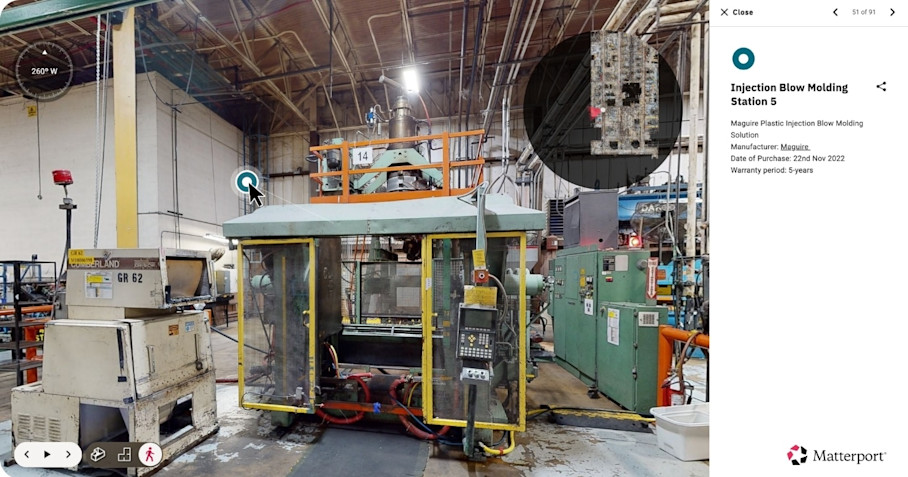
This approach transforms tribal knowledge from something that lives in people's heads into something that lives in the plant's digital record, accessible to anyone who needs it.
4. Transfer knowledge in ways that stick
Knowledge that's been captured needs an effective path to the people who'll use it and the format matters as much as the content. A perfectly documented troubleshooting guide or annotated digital twin does nothing for a new hire who never opens it, or a cross-trained worker who reads it once and forgets it under pressure.
Effective transfer programs combine structured mentoring with immersive, self-paced learning and a culture that encourages sharing. No single method works for all types of knowledge, so a layered approach using the following strategies produces the best results.
Training strategy | Implementation tips |
Mentor-mentee programs | Pair experienced workers with newer employees through real scenarios, not classroom training. Assign specific skills to transfer with clear timelines. |
Extended overlap periods | Schedule retiring operators to work alongside their successors for 3 to 6 months before departure. This costs money upfront but prevents far more expensive knowledge loss. |
Teach-back sessions | Have the learner demonstrate the skill back to the expert. If they cannot, the knowledge has not actually transferred. |
Cross-training across shifts and roles | Rotate workers through critical stations to reduce single-point-of-failure risk. Document what each person learns at each station. |
360° walkthroughs | Use immersive 3D environments to orient new hires, contractors, and remote experts to the facility before they set foot on the floor. |
Rather than letting a new hire wander a map unguided, use Matterport’s Guided Tours feature to turn a facility’s digital twin into a structured, curated walkthrough path with captions. The sequence stops in the correct operational order, so training follows the same logic an experienced worker would use while walking the floor. Auto-Tours speed up creation using AI to generate these training resources up to 10 times faster than building them manually. They make it practical to create tours for far more processes than a plant would otherwise have time to document.
The content lives in the cloud, so it's accessible from any authorized device: on the floor, in a control room, or off-site. Across shifts, locations, and teams, the same knowledge is available, without needing to track down the right person to ask.
5. Encourage experienced workers to participate in knowledge preservation
Veteran operators may resist sharing tribal knowledge for understandable reasons. Concerns about job security top the list. If the knowledge that makes someone indispensable gets documented, some workers worry they will become expendable. Others are reluctant to expose unofficial workarounds that technically violate procedure, even if those workarounds are what keep the line running.
Building trust requires clear communication about intent. Knowledge sharing should be framed as legacy-building, not extraction. Use a recognition program that rewards contributions. It could:
Name documented procedures after the expert who contributed them
Formally acknowledge contributions in team meetings
Provide tangible incentives for knowledge-sharing milestones
It’s also important to involve operators in the documentation process rather than having engineers or managers extract knowledge from them. Veteran operators should walk through their process in a practical and accessible immersive walkthrough, so they can explain their reasoning in their own words. This leads to richer and more accurate knowledge sharing than a third-party interpretation.
Experienced operators often prefer knowledge capture methods that fit into normal operations rather than requiring dedicated sessions away from the floor, since scheduled interviews and shadowing sessions pull other workers off the line to cover for them. Digital twins allow them to contribute knowledge at their own pace, rather than sitting through a formal interview or walking the floor while colleagues cover their station. This keeps the burden of participation low, which makes operators more willing to contribute in the first place.
6. Keep documentation up to date as plants change
Documentation must be updated alongside plant changes; otherwise, it not only becomes less helpful over time, but can actively mislead someone into trusting an incorrect procedure or layout.
Keeping a full facility digital twin current may seem intimidating, and it’s tempting to let a model drift out of date to avoid disrupting production. With Matterport, teams can rescan just portions of a plant and Merge Spaces to sync those updates into the existing master twin, without shutting down production. When a single cell gets reconfigured or a new piece of equipment arrives, only that section needs updating.
Because the twin lives in the cloud, keeping it current isn't a task that falls to a single person walking the floor. Operations, maintenance, engineering, and safety teams, along with off-site experts, can all reference the same up-to-date visual record to review manufacturing process documentation, troubleshoot issues, and record new best practices as they emerge, without needing to be physically present to do it.
Capture tribal knowledge before an emergency proves it is missing
These strategies do not need to be implemented reactively when a facility faces an incoming retirement wave. They produce the best results when used as a foundation for tribal knowledge transfer throughout a plant's lifecycle. The manufacturing plants that start early avoid the scramble of trying to extract 30 years of expertise in someone's final two weeks.
Knowledge capture must fit naturally into existing workflows. Any solution you choose should produce practical, usable documentation rather than creating another system that employees ignore. The tools that succeed are the ones that integrate into how people already work.
Combining structured documentation with spatial digital twins creates a centralized knowledge hub that preserves both procedure and context. The outcome is a living record of how a plant actually operates, accessible to every team member at the point of use, regardless of which shift they work or when they joined the organization.
Get in touch with our team


