


 Sign In
How to Build a Hotel Preventive Maintenance Program That Reduces Cost & Downtime
A leaking HVAC unit in a guest room doesn't just cost you the flat repair fee. It costs you the night you can't sell that room, the comp you'll offer the guest who complained, and the emergency contractor rate you'll inevitably pay. Now multiply that scenario across a portfolio, and reactive maintenance quickly snowballs into one of the fastest ways to burn through your operating budget.
A hotel preventive maintenance program is the structured alternative. It reduces emergency repair costs and extends the life of expensive equipment. It keeps rooms in sellable inventory and creates the documentation trail that holds up during brand inspections and ownership reviews.
This article covers how to build such a program from the ground up. You'll learn how to audit assets, build a schedule, track execution and turn compliance into a measurable ROI story.
What is a hotel preventive maintenance program?
A hotel preventive maintenance program is a scheduled, proactive approach to maintaining equipment and systems before they fail. It's the opposite of reactive maintenance, where work only happens after something breaks.
Preventive maintenance is especially relevant in the hospitality industry for reasons that directly affect the bottom line:
Guest experience. In-stay failures like noisy HVAC or failed locks drive negative reviews and comp requests.
Cost control. Planned service tasks cost a fraction of emergency repairs on the same asset, as the latter often involve emergency rates and expedited shipping.
Room uptime. Every out-of-order night is lost revenue, and preventive maintenance reduces the incidents that pull rooms from inventory.
What a hotel preventive maintenance program needs to cover
A hotel preventive maintenance program spans guestrooms, mechanical systems, and common areas. Each category has different failure consequences and different ownership. That's why a clear program, and not ad hoc work orders, is the only way to ensure nothing falls through.
The major system categories include:
Guest rooms and in-room fixtures: Failures here pull rooms from inventory and generate guest complaints that show up in reviews and brand scores.
Common areas and shared facilities: Lobbies, pools, fitness centers, and meeting spaces affect guest perception and can trigger safety or ADA compliance issues.
HVAC, plumbing, and electrical infrastructure: These systems underpin every aspect of guest comfort and represent the property’s highest capital investment. When they fail, the impact is immediate and wide.
Back-of-house and mechanical spaces: Service areas, including kitchen, laundry, and storage, keep operations running but are easy to neglect until something catastrophic happens.
Health, safety, and compliance systems: Fire suppression, emergency lighting, elevator certification, and pool chemistry are non-negotiable and carry regulatory penalties for non-compliance.
Each of these categories requires a different maintenance cadence and different documentation standards. For a complete overview, head to our hotel preventive maintenance program checklist.
How to build a hotel preventive maintenance program
Building a scalable and efficient preventive maintenance program calls for a structured approach. The five steps below can help you create a foundation that works across single properties and multi-site portfolios.
1. Audit and rank every asset by criticality and lifecycle stage
Assets that aren't in your inventory won't be in your maintenance schedule. Your first order of business is to take stock of what you have, capturing, at minimum, each asset's:
Location
Make and model
Install date
Warranty status
Current condition
Service history
Not every asset carries the same risk if it fails. A criticality framework can guide you when deciding how frequently to inspect each one and how quickly to respond when something goes wrong. For example:
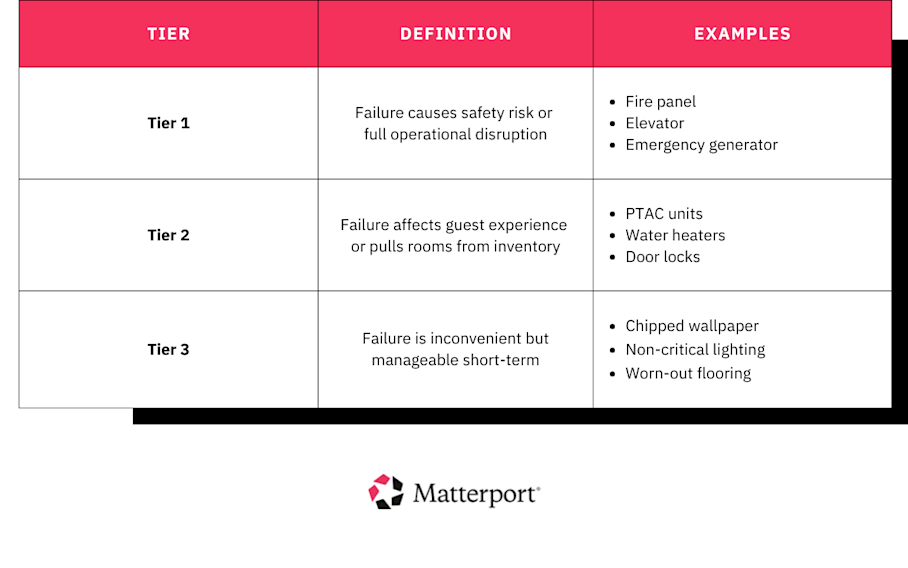
Lifecycle stage steers you on how to refine the schedule further. Newer assets typically follow manufacturer-recommended intervals. Assets approaching end-of-life need shorter inspection cycles and closer monitoring, because failure likelihood increases and lead time on replacements tends to stretch.
The bigger problem is keeping inventory current. Operational knowledge, such as where the shutoff is or which unit has a recurring issue, tends to live outside work order systems. When an experienced engineer leaves, that knowledge goes with them.
Digital twins address this issue. They're dimensionally accurate, navigable 3D models of a physical space, created from a scan of the property. Rather than storing asset information in a document that lives outside the building, a digital twin allows you to attach that information spatially.
With features like Tags and Notes, teams can embed serial numbers, vendor contacts, maintenance records, access paths, and step-by-step service procedures directly in the model at the precise location of each asset. A new engineer or contractor can walk the digital twin before their first day on-site, locate every tagged asset, and review the embedded instructions without shadowing anyone. The program no longer depends on whoever happens to still be around.
2. Build a scheduling structure around occupancy
Maintenance tasks fall into two categories: time-based and usage-based. Time-based tasks run on a fixed calendar interval, while usage-based tasks are triggered by runtime hours, cycle counts, or guest-night volume.
It's an important distinction, because applying a calendar schedule to usage-driven equipment means you're either over-servicing it or missing the actual wear threshold. Laundry equipment is a classic usage-based example: you schedule service based on load count, not the calendar.
For most scheduled tasks, frequency depends on failure consequence and degradation rate. Here's how that maps to standard cadences:
Pre-arrival: A room-level preventive maintenance checklist should be completed before guest occupancy, covering lighting, HVAC, locks, plumbing fixtures.
Daily: Pool chemistry checks, common-area lighting walkthroughs, elevator cab condition.
Weekly: HVAC filter visual inspections, fire exit checks, kitchen equipment condition.
Monthly: Emergency lighting tests, grease trap inspections, water softener checks.
Quarterly: PTAC filter cleaning, water heater flushes, fire extinguisher inspection.
Semi-annual: Boiler and chiller servicing, ductwork inspection, roof drain clearing.
Annual: Elevator certification, fire suppression inspection, roof and façade assessment.
Finding a way to schedule maintenance around occupancy can be a challenge, but there are mechanisms that help keep disruption at bay, chiefly:
Scheduling deep maintenance on Tier 1 systems during shoulder season.
Using room-block rotation strategies coordinated with revenue management.
Documenting a deferral protocol so bumped tasks get rescheduled with a firm date rather than dropped entirely.
3. Track work orders and enforce accountability across shifts
A computerized maintenance management system (CMMS) is the backbone of any scalable hotel preventive maintenance program: it auto-generates recurring tasks on schedule, assigns them to specific technicians, logs completion with timestamps and photos, and surfaces overdue items for review.
In a hotel that runs 24 hours, shift handoffs are a common friction point where tasks slip through. A work order that's open at the end of a day shift needs to be visible to the night team, not buried in a handover note or carried mentally by whoever was on last. A CMSS with end-of-shift status updates and a shared open-item log keeps that from happening. It also creates the completion record you need when ownership or a brand standards team asks about the program performance.
For regional leaders overseeing multiple properties, the challenge shifts from execution to visibility. Traveling to confirm completed work isn't exactly practical at scale. This is another area where digital twins can be of assistance. A current 3D scan of a property lets a regional leader remotely walk a space, review asset conditions, and verify work without getting on a plane. When site visits do happen, they become more targeted because the leader already knows what needs attention before arriving.
For operators who can't staff their own capture, options like Matterport Capture Services are available in over 700 cities worldwide, with deliveries shipped in as little as 24 to 48 hours.
4. Reduce rooms out of order with a tighter repair workflow
Every night a room sits out of order is revenue that can't be recovered. The speed of that recovery depends less on how fast a repair gets done and more on how well the workflow around it is managed.
A room-return workflow has five stages:
Issue discovery and documentation: The faster you learn about a problem, the faster you can mobilize a response.
Scope definition: Clear, complete information reduces back-and-forth and contractor delays.
Vendor dispatch: The right vendor reaching the right room with the right parts keeps downtime short.
Work verification: Confirming the repair meets standards before returning the room to inventory protects the guest experience.
Room return: Final inspection and handoff to housekeeping ensures the room is truly guest-ready.
Scope definition leaves the most room for delays. A contractor who doesn't know the exact asset location, access path, relevant shutoffs, or serial number before they arrive will spend time on-site figuring that out. That time extends the repair cycle and, in some cases, results in a return trip for parts or access. A complete scope package, shared before dispatch, removes that friction.
Here, digital twin and embedded Tags and Notes also carry operational value. When a repair is needed, the person managing the work order can pull the relevant space in the model, confirm the asset location, review the access path, and share that context with the vendor before they arrive.
For teams using Procore for contractor coordination, Matterport's integration allows RFIs to be shared with precise visual and location context directly from the scan.
5. Build an audit-ready documentation trail and connect preventive maintenance compliance to CapEx decisions
Running a good preventive maintenance program and being able to prove it are two different things. Brand inspections, ownership reviews, and PIP negotiations all require documentation, and text-based work order logs are harder to defend than visual evidence.
Periodic digital twin captures create that visual record. Each scan is a dated, dimensionally accurate snapshot of every room, corridor, and mechanical space. Scanned on a regular schedule and compared using a Side-by-Side view, they show asset conditions before and after capital investment, document completed work with spatial context, and give brand standards teams or ownership groups something they can review remotely.
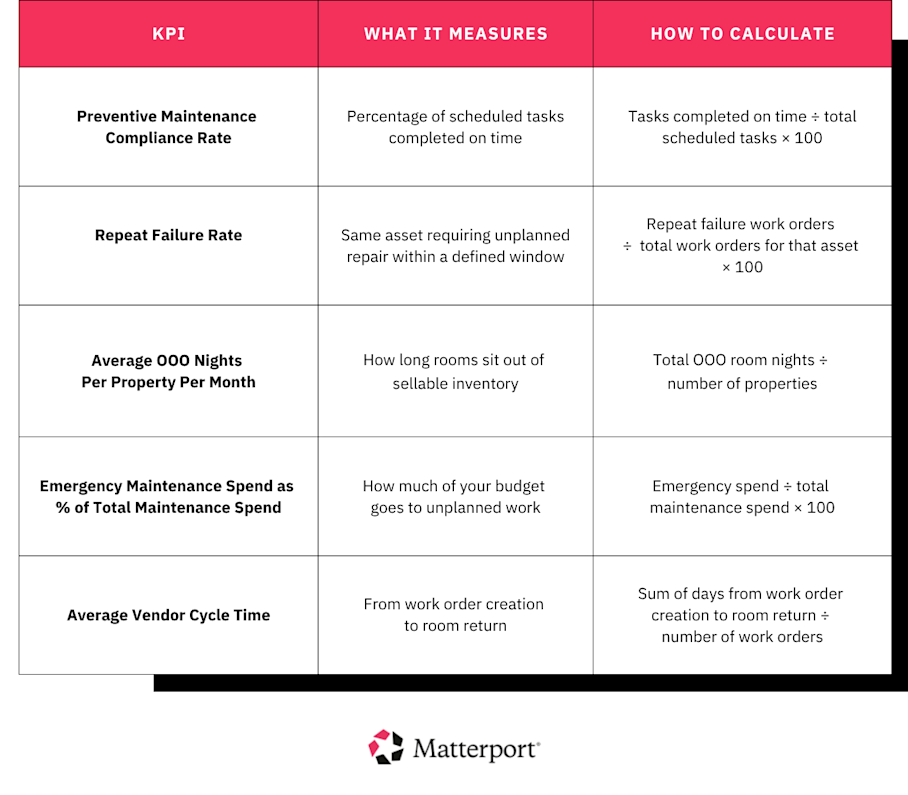
That visual record also supports the quantitative side of the program. The KPIs below tell you where the program is performing and where it isn't:
Tracking these across properties over time is how you make them actionable. A high repeat failure rate on a specific asset class points to a maintenance interval that's too long or a parts issue worth investigating. A rising OOO average at one property but not others suggests an execution problem, not an asset problem. The data doesn't make the decision, but it narrows down where to look.
Build your hotel preventive maintenance program on a stronger foundation
The five steps above work as a connected system. But keeping that system running consistently across a portfolio is a challenge: asset records drift, documentation gaps widen, and regional leaders have limited visibility into what's happening on the ground.
Matterport digital twins address that visibility problem at each stage, from asset documentation to remote compliance verification.
Get started with Matterport for Travel & Hospitality