


 Sign In
6 Steps To Level Up Your Corporate Real Estate Strategy
Offices built for predictable, full-time occupancy no longer reflect how work actually happens. Hybrid schedules, fluctuating attendance, and remote work make space demand harder to forecast, while rising rental costs and sustainability requirements add pressure for corporate real estate teams.
To adapt, CRE teams must move beyond reactive cost cutting. Data gives teams the clarity to understand demand, reduce risk, and plan with confidence.
This guide explains practical ways to predict outcomes, right-size portfolios, and manage risk, including how digital twins help teams move faster—whether you’re optimizing a single building or an entire portfolio.
Core components of a corporate real estate strategy
Corporate real estate (CRE) strategy is how organizations plan, manage, and optimize the physical spaces they own or lease to support business goals. This includes offices, factories, warehouses, and other operational facilities. For most organizations, CRE typically covers 10–25% of total operating expenses including rent, utilities, maintenance, and operations.
An effective CRE strategy can’t rely on static plans. Future demand is increasingly uneven and difficult to predict—some organizations are enforcing return-to-office policies, while McKinsey predicts demand for office space could be 20–26% lower by 2030 in major cities.
As conditions change, CRE teams must treat real estate decisions as ongoing work—not one-time plans. Teams need current data on space, people, costs, and sustainability to adjust the portfolio as demand shifts.
The table below outlines the key components CRE teams use to track performance and manage this complexity.
Component | Strategic focus | Success indicators |
|---|---|---|
Portfolio planning | How the portfolio supports business priorities (growth, innovation, efficiency) | Expand or contract real estate footprint without inhibiting cash flow or growth |
Workforce alignment & culture | How space supports productivity, retention, and collaboration | Offices are used by choice and support employee retention |
Space utilization & right-sizing | How much space is actually needed and where | Supply matches demand with contingencies |
Technology & data | What systems inform space and portfolio decisions | Decisions are based on real usage data, not assumptions |
Financial management | How real estate contributes to financial performance | Cost per square foot and ROI are transparent and defensible |
Customer support (employee experience) | How friction is removed from day-to-day work | Higher satisfaction and fewer workplace or HR complaints |
Lease management & flexibility | How easily the portfolio can adapt to change | Lease terms allow consolidation, expansion, or exit without disruption |
Accessibility | Who space works for across roles and abilities | Inclusive use without retrofits or special accommodations |
Security | How people, assets, and operations are protected | Security is built into access, layout, and workflows |
Environmental, Social, and Governance (ESG) requirements | How environmental impact is measured and reported | ESG data is consistent, auditable, and improving over time |
Governance | Who makes space decisions and how trade-offs are resolved | Faster decisions with clear accountability |
6 steps to strengthen your corporate real estate strategy
The six steps below outline how CRE teams can move from reactive decision-making to a more structured, adaptable approach to portfolio planning.
1. Align real estate utilization to business goals
Clear business goals help CRE teams align space decisions with organizational priorities, workforce needs, and financial targets. Instead of relying on last year’s benchmarks, teams can translate executive priorities—such as growth, retention, or efficiency—into forward-looking decisions about location, capacity, and investment.
Many CRE strategies still rely on broad goals like “support growth” or “enable hybrid work.” When teams don’t translate those goals into specific space requirements, they end up reacting to lease expirations, budget pressure, or short-term fixes.
This gap is usually a coordination problem, not a lack of intent. Leadership sets priorities. CRE teams manage space and performance data. Without a shared way to connect the two, planning stays reactive.
A practical way to close that gap is to translate leadership priorities into clear CRE questions and outcomes:
Business priority | CRE lever | Financial outcome |
|---|---|---|
Growth | Right mix of locations, space types, and expansion timing to support market entry and scaling | Improved speed to market and return on invested capital |
Retention | Workplaces that support collaboration, flexibility, and employee experience | Reduced attrition and lower hiring and onboarding costs |
Productivity | Balanced focus and collaboration spaces with improved adjacencies | Increased output per employee and reduced cost per seat |
Resilience | Portfolio flexibility through lease optionality and redundancy | Reduced operational risk and cost of disruption |
Sustainability | Consolidated underused space and investment in efficient buildings and retrofits | Lower total occupancy costs while meeting ESG targets |
Corporate real estate strategies often fall short because teams don’t share the same view of how space supports business priorities. Digital twins provide a clear, shared view of real spaces, making it easier to review layouts, discuss options, and agree on decisions before changes are made.
Grounding discussions in a digital replica of the real space gives you a shared reference point across teams. You can explain trade-offs clearly, pressure-test assumptions, and connect space decisions back to business goals before capital is committed.
2. Optimize the portfolio with data
Every CRE strategy must balance workforce needs with business growth and profitability. To do that, teams need current data on how space is actually used.If teams right-size portfolios using data that’s two or three years old, decisions are based on outdated conditions.
Here are the requirements to consider when balancing workforce and business needs:
Decision area | Data points |
|---|---|
Workplace suitability | |
Talent access | - Labor market data - Commute times - Future hiring plans |
Customer proximity | - Revenue data - Service coverage - Regional demand |
Incentives and regulation | - Local tax policy - Government incentives - Compliance requirements |
Cost | - Lease terms - Market benchmarks - Total occupancy cost |
Climate and physical risk | - Climate risk models - Insurance exposure - Site resilience data |
Supply chain dependencies | - Operational workflows - Adjacency requirements - Logistics constraints |
Whether you collect data manually or use real-time IIoT sensors, the goal is the same: understand what’s actually happening in your spaces so you can make consistent decisions. That requires clear rules for when to keep space as-is, resize it, exit it, or renegotiate—based on defined triggers like headcount changes, product launches, or upcoming lease events.
Flexibility also needs a shared definition. For some organizations, that means swing space to absorb short-term demand spikes. For others, it may mean serviced offices while validating team size or market entry, flexible lease clauses to limit long-term risk, or a sublease playbook to reduce excess capacity. Each option serves a different scenario, and deciding when to use each one in advance prevents reactive decisions.
Accurate measurements from digital twins make these decisions easier to model and validate. By providing precise layouts and spatial data, digital twins improve utilization analysis, support test-fits and re-stack scenarios, and help teams right-size space with confidence.
To act on this data, CRE teams need clear trigger rules. For example, if you’re seeing utilization data fluctuate, lease costs above market benchmarks, and hiring plans that indicate uncertain growth, here’s how you could take action:
Design swing spaces to absorb short-term demand
Recommend serviced offices while validating team size or market demand
Negotiate flexible lease clauses to reduce financial risk
Activate a sublease playbook that reduces excess capacity and downside risk
Decide in advance which options you'll use and under what conditions.
3. Design workplaces around real people
CRE teams have moved past automation for its own sake. Today, the focus is on designing spaces that support how people actually work.
Flexible policies only succeed when you can validate employee experience using measurable signals that spaces are working as intended.
Utilization data, workspace reservations, employee surveys, and recurring complaints help CRE teams adjust their layouts, services, and policies—before workarounds become the norm.
Companies like Danone use Matterport digital twins and sensors to see how spaces are actually used over time, identify usage patterns, and test layout changes using accurate layouts and measurements.
Within a digital twin of every facility, teams use notes and tags to document workplace standards directly in the space, such as space policies, acoustic treatments, AV requirements, furniture layouts, or maintenance access zones. These in-context annotations give operations, safety, and facilities teams a shared reference, making it easier to communicate policies, review changes remotely, and avoid delays.
When workplaces reflect how people actually work, utilization improves, employee experience improves, and policies better support productivity and business goals.
4. Leverage technology for agility
CRE teams use a wide range of data systems in their day-to-day work, such as:
Integrated Workplace Management Systems (IWMS) for portfolio oversight and space management
Lease administration systems to track obligations, expirations, and risk
Computer-Aided Facility Management (CAFM) and Computerized Maintenance Management Systems (CMMS) for maintenance and asset management
Space planning tools to model layouts and moves
Analytics platforms to track utilization, cost, and performance
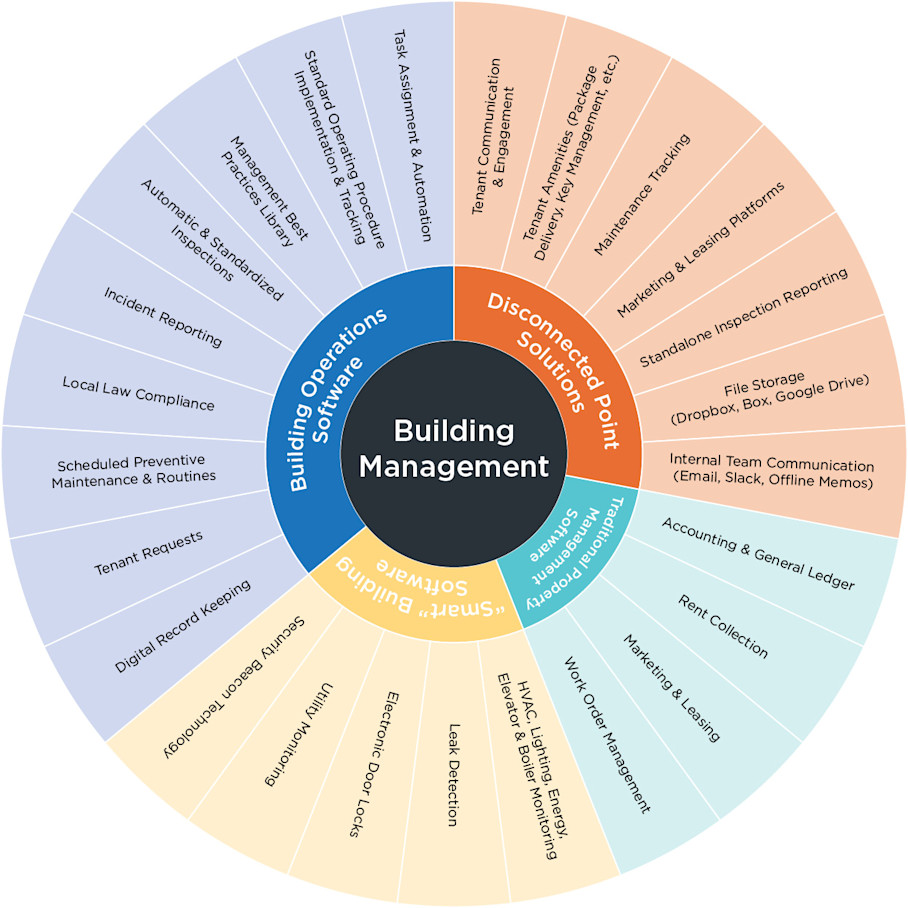
The landscape of available solutions for building operations teams (Source)
Many of these systems operate in isolation. This slows decisions and creates misalignment across teams. When teams connect systems into a shared operational layer, they can review data faster and act with more confidence across the portfolio.
Digital twins provide a shared visual foundation for this work. Teams can review spaces remotely, coordinate changes, and keep context across locations. And integrations can easily communicate that data between all your existing platforms.
For larger portfolios, teams can merge multiple scans into a single model, making it easier to manage multi-floor offices, campuses, or phased projects.
Pro tip: Within a digital twin, teams can navigate sites and virtually proposed changes can be tagged directly in the space, so information stays connected to the physical environment rather than scattered across systems.
5. Integrate sustainability
When environmental, social, and governance (ESG) requirements shape corporate real estate decisions, teams face trade-offs. They must meet carbon reduction targets while still supporting business performance and employee needs.
These trade-offs affect everyday decisions, including which buildings to upgrade or exit, how sustainability changes affect cost and timelines, and where people can work.
Various CRE actions can help companies deliver on some of their decarbonization commitments:
Retrofitting buildings to improve energy efficiency
Consolidating underused space to reduce the overall footprint
Adjusting lease strategy to prioritize efficient, future-ready assets
Planning for electrification and grid readiness
Negotiating green lease clauses to align landlord and tenant goals
Pairing IIoT with digital twins makes ESG decisions easier to execute. Check out the video below to see how Amazon’s Executive Briefing Center integrates environmental data with a Matterport digital twin.
As shown in the video above, combining IIoT data with a digital twin gives CRE teams a clear view of building performance. This visibility helps teams reduce energy use, plan upgrades, lower operating costs, and protect long-term asset value.
6. Standardize portfolio management processes and improve collaboration
Standardized processes help CRE teams stay consistent without slowing down. When strategy varies by site or team, decisions become harder to execute and easier to misalign.
A shared operational layer helps teams stay aligned across sites and decisions. Using 3D documentation software built for CRE teams, clear review cycles, and a common view of each space make it easier to collaborate and reduce rework.
Matterport shared models give teams a single visual reference they can access from anywhere. Notes and tags keep standards, risks, and changes tied directly to the space.
Get in touch with our team