


 Sign In
Hotel Brand Standards Compliance for Furniture: What to Define & Document
Furniture is one of the most heavily inspected and most expensive categories to get wrong in hotel brand standards. Compliance is rarely about whether a piece looks correct — it depends on placement, dimensions, materials, construction quality, condition over time, and regulatory testing, and any one of those layers can fail independently.
The teams that maintain compliance across a portfolio do it through deliberate documentation and verification, not vigilance alone.
This guide covers the furniture, fixture, and equipment categories hotel brands evaluate most closely, the criteria they apply, and how to verify and maintain compliance across every property.
How furniture standards support hotel brand consistency
Across a portfolio of independently operated hotels, consistent furniture standards are one of the primary ways the brand’s promises are visible to guests. It’s one of the first places inspectors look when they suspect a property is drifting.
At portfolio scale, well-defined and well-executed furniture standards deliver measurable benefits:
Brand consistency across locations. Guests who are loyal to a particular flag carry expectations from one property to the next. Furniture that deviates from spec breaks continuity, and guests will register it, even if they can't articulate why.
Guest experience and satisfaction scores. Room comfort, layout functionality, and ergonomics translate directly into post-stay scores.
Audit readiness. Properties that consistently track furniture compliance don't scramble before inspections.
Reduced rework and renovation risk. Non-compliant selections caught during audits are more expensive to remediate and have a heavier administrative burden.
Fewer owner-operator disputes. Clear standards mean less room for disagreement about what was agreed to, reducing friction between ownership groups, operators, and franchise representatives.
These benefits only hold when standards are actively monitored. A specification that exists in a PDF but is never verified in the field offers limited protection against drift.
It starts with knowing what brands actually evaluate.
Common furniture specification criteria for hotel brands
Hotel furniture standards cover far more than aesthetics. They span comfort, convenience, and safety specifications that vary by brand tier, room category, and jurisdiction. These details may seem individually minor, but they are collectively determinative of quality.
Truly compliant pieces should:
Meet the brand's visual standard
Perform under commercial use
Fit the approved layout
Be maintained without specialized workarounds
Every hotel brand defines its own furniture specification criteria based on positioning, guest expectations, and operational requirements. While the details differ between select-service and luxury brands, most programs address the same core categories.
Room layouts and furniture placement
Brand-approved room layouts dictate where each piece of furniture sits relative to other furnishings. This category typically defines:
Bed positioning: Alignment to walls, windows, and light fixtures
Nightstand placement: Symmetry and outlet proximity
TV console orientation: Sightline from bed and other furniture
Desk placement: Position within the work zone and orientation relative to natural light
Circulation clearances: Minimum distances between pieces required for accessibility compliance
These layouts are the spatial blueprint for a consistent guest experience.
Placement affects traffic flow, accessibility compliance, and the overall feel of the room. A desk oriented toward a window creates a different impression than one facing a wall. A bed centered under a light fixture reads as intentional. One shifted six inches to the left does not.
Small deviations from furniture placement are among the most common brand audit findings for hotels. They are easy to overlook during installation and difficult to catch without a visual record of the approved layout. Many hotels now use digital twins, immersive 3D models of spaces, to compare as-built furniture placement against approved layouts without traveling to each property. They provide a navigable reference that stakeholders can review from anywhere.
Dimensions, spacing, and clearances
Hotel brands specify exact furniture dimensions and required spacing. Defined standards include:
Bed-to-wall clearance: Minimum distance from the side of the bed to the nearest wall or obstruction
Walkway widths: Required passage between the bed, dresser, and other furnishings
Bathroom vanity clearance: Spacing that satisfies both comfort and ADA requirements
Furniture footprint dimensions: Exact size tolerances for each approved piece by room category
Fixture-to-fixture spacing: Required distances between seating, tables, and case goods in multi-use areas
These specifications contribute to visual consistency across properties and guest comfort during routine use. Most importantly, they ensure compliance with accessibility standards that mandate minimum clearance dimensions.
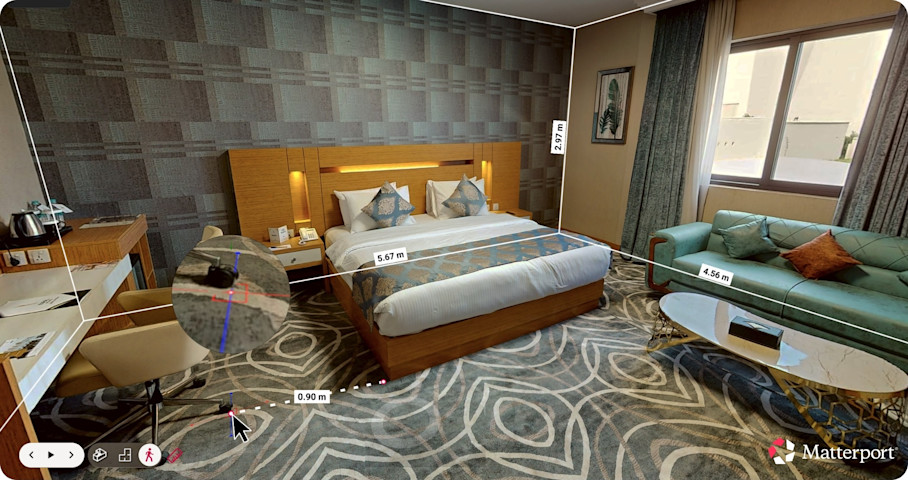
When assessing compliance, manual measurement is time-consuming and introduces human error, especially across large portfolios. Matterport digital twins offer Automated Measuring tools that accurately verify dimensions and clearances down to the centimeter. Users maintain verification rigor without the need for on-site measurement visits.
Materials, finishes, and construction quality
Brands approve specific materials and finishes to maintain visual consistency across properties. Scope typically includes:
Upholstery specifications: Approved fabrics, grades, and colorways by room category
Wood finishes: Stain colors, grain patterns, veneer thickness, and coating durability from approved suppliers
Metal hardware finishes: Pull, handle, and fixture finishes matched to brand palette
Laminate and surface materials: Approved options for case goods, desktops, and millwork
Construction standards: Drawer glide type, joint construction, weight-bearing capacity, and fastener specifications
Supplier certification requirements: Documentation confirming materials meet brand and safety thresholds
Construction quality standards are often stricter than appearance standards because they determine useful life. A piece that looks correct but uses residential-grade hardware can fail within months of high-occupancy service.
Substitutions in this category may void compliance even when a replacement looks similar. For example, unapproved veneer finishes may match color but differ in grain pattern, thickness, or coating durability. Spec sheets and material samples are typically required before procurement approval is granted.
Complete documentation, including supplier certifications, material test results, and finish samples, ensures traceability from specification through installation. These references can be pinned to specific assets as Tags in a digital twin, so they are easy to search and view in context.
Condition, wear, and commercial-grade durability
Compliance does not end at installation. Furniture must continue to meet brand standards throughout its service life. Ongoing performance monitoring is part of the program.
Durability expectations include:
Abrasion resistance ratings: Minimum Wyzenbeek or Martindale counts for upholstery by room category
Mechanical component cycles: Minimum performance thresholds for drawer slides, folding mechanisms, and other moving parts
Manufacturer warranty requirements: Coverage terms brands accept as evidence of commercial suitability
Finish wear thresholds: Acceptable degradation limits before a piece requires refinishing or replacement
Replacement scheduling: Expected lifecycle under commercial occupancy levels, with requirements for consistency across adjacent rooms and areas
Condition monitoring requires regular assessment for damage, staining, looseness, and finish degradation. Visible discrepancies between pieces of different age across adjacent rooms register with guests even when they can't identify the cause. Comparing periodic 3D models Side-by-Side creates a visual timeline that tracks condition changes across properties and over time.
Ongoing monitoring supports a hotel’s preventive maintenance program so teams can address wear before it triggers a formal audit finding.
Fire safety and ADA standards hotel furniture needs to meet
Regulatory requirements for hotel furniture apply regardless of brand. They carry real human risk and real legal liability, making them non-negotiable elements of any compliance program.
The following regulatory categories affect hotel furniture.
Requirement Category | Regulations | What It Covers |
Fire Performance | - Federal and state flammability regulations - Industry fire testing protocols | - Flammability of upholstered furniture - Mattress fire barriers - Drapery and fabric flame resistance |
Structural Safety | Furniture durability and stability testing standards | - Load capacity - Stability testing - Cycle testing for desks, chairs, tables, and casegoods |
Accessibility/ADA | - Federal accessibility requirements - Building code accessibility provisions | - Furniture height ranges - Clear floor space - Knee and toe clearance - Reach range requirements |
Guidance varies by local jurisdiction, so staff responsible for hotel brand standards management should review relevant guidelines and keep track of changes.
Hotels face dual exposure on accessibility. Non-compliance can trigger findings during a brand audit and separately result in regulatory penalties under the ADA. Both carry financial and reputational consequences.
Providing a navigable virtual replica where fire certificates, test reports, and ADA documentation can be attached directly to the relevant spaces supports regulatory compliance. The virtual environment creates a single reference point where compliance records live alongside the visual evidence of the space itself.
How to build a compliance program for hotel brand furniture standards
Maintaining brand consistency gets harder as a portfolio grows, but furniture is particularly prone to discrepancies. Renovations and replacement cycles can’t always meet specifications across purchasing generations, so substitutions are hastily introduced and drift compounds quickly. What was compliant three years ago may not reflect current brand requirements.
Traditional verification relies on scheduled site visits, which are expensive and limited in frequency. A more effective approach combines centralized compliance records with remote spatial verification. This gives teams the ability to confirm standards between visits.
Organized documentation proves compliance to auditors, owners, and franchise groups. Without it, even a fully compliant property can struggle to demonstrate that status during a review. Digital twins act as a centralized hub that connects documentation to the physical space.
The following five steps outline a practical compliance program built around this approach.
Plan specifications and replacements proactively. Use the Defurnish tool to digitally remove existing furniture from a 3D model and evaluate empty-room configurations. Generate schematic floor plans from scans to confirm that proposed furniture arrangements fit within approved layouts before procurement begins.
Validate dimensions and clearances remotely. Capture measurements directly inside the digital twin to verify spacing requirements from any device. Brand standards teams can confirm spacing in a single session without dispatching anyone to the property.
Attach compliance records directly to the space. Use Tags and Attachments to link spec sheets, maintenance logs, replacement schedules, and brand sign-off documents to specific locations within the 3D model. Every record lives in context, not in a disconnected folder.
Compare before-and-after conditions. Use Side-by-Side synchronized viewing to place two scans of the same space next to each other. This proves that flagged issues were resolved and provides visual evidence for audit closeout.
Scale across the portfolio. Cloud-hosted models give every stakeholder access to every property. Customized Views control what each audience sees, so stakeholders review only what is relevant to them.
This approach transforms furniture compliance from a reactive audit response into a proactive management discipline. Teams catch issues earlier, resolve them faster, and maintain documentation that is always current.
Get started with Matterport for Travel & Hospitality


