


 Sign In
Hotel Preventive Maintenance: A Guide to Protecting Assets & Guest Satisfaction
Hotel maintenance problems don't always start as emergencies. They might start as something small that nobody documented: a slow drain that housekeeping flagged once or an HVAC filter that rolled past its change date during a busy stretch. By the time a guest complains, the window for low-cost intervention has already closed.
What's worse, guests read physical failures as evidence of broader neglect, and that impression is difficult to reverse once formed.
Preventive maintenance gives teams a way to catch those problems before guests have a chance to. Here, we'll cover a frequency-based framework organized by area, from guestrooms to back-of-house, including what to inspect and how often.
If you're ready to build the program itself, we cover that in our hotel preventive maintenance program guide. For task-level checklists by area and frequency, see our ready-made templates:
What is hotel preventive maintenance?
Hotel preventive maintenance is the practice of servicing building systems, equipment, and finishes to stave off failures before they affect guests. It's the opposite of reactive maintenance, where teams wait for something to break and then scramble to fix it.
The cost difference between the two approaches comes down to timing:
Preventive maintenance uses scheduled labor and stocked parts, which keeps costs predictable and avoids the premium that comes with unplanned work.
Reactive maintenance demands emergency rates, expedited shipping, and revenue lost while rooms sit out of service.
Where hotel preventive maintenance decisions carry the highest stakes
Not every square foot of a hotel bears the same risk. In the sections below, we break down each major hotel area by the failure points that most directly cause out-of-order rooms, guest complaints, and unplanned costs.
Guestrooms and in-room fixtures
Rooms are the highest-volume maintenance touchpoint in any hotel. According to J.D. Power's 2025 North America Hotel Guest Satisfaction Index, while facility problems affect just 12% of hotel stays, they can significantly impact satisfaction scores when they do occur.
The most common guestroom maintenance failures that trigger negative reviews include:
HVAC inconsistency – Air conditioning that's too weak or heating that doesn't work properly
Bathroom fixture leaks –Dripping faucets and running toilets signal neglect
Worn soft goods – Stained carpet, pilled bedding, and threadbare towels erode the perception of cleanliness
Stained surfaces – Ceiling tiles, grout lines, and wallcoverings that show water damage or discoloration
Dead outlets or USB ports – Broken lights, non-working TVs or appliances, and outlet issues are all sources of discomfort
Cosmetic and functional deterioration happens gradually, which makes it easy to overlook during rushed turnover inspections. But if teams have a documented baseline to compare against, they can find and solve those issues before guest satisfaction erodes.
As a navigable 3D model of a physical space, the digital twin of each room type gives engineering teams and general managers a precise visual reference; one that makes it easier to spot drift during walkthroughs and standardize expectations across housekeeping and maintenance.
With features like Tags and Notes, teams can embed asset details in the fixture location inside the digital twin. Staff is also able to pull up context, such as install dates or manufacturer specs, without leaving the room or contacting corporate. For the task-level room inspection framework that works alongside this documentation approach, see our hotel room inspection checklist.
Common areas and shared facilities
Lobbies, fitness centers, pool areas, restaurants, and event spaces carry a lot of brand-impression weight. For one, guests form opinions about a property within minutes of arrival. And public-area maintenance failures are visible to every visitor, not just one room's occupant.
Common deferred maintenance issues in public areas include:
Worn flooring – Carpet buckling and tile cracks in lobbies and corridors
Damaged wall finishes – Scuffs, peeling paint, and dented drywall at luggage-cart height
Malfunctioning elevators – Slow or faulty elevators can inconvenience guests, especially in taller buildings
Outdated signage – Faded directional signs and peeling adhesive lettering
Stained ceiling tiles – A universal indicator of water infiltration and deferred repairs
Broken furniture – Wobbly chairs and chipped tabletops in restaurants and lounges
Just like guest room deterioration, a lot of public-area decay is gradual. Managers can ensure nothing slips through the cracks by recapturing the space with 3D technology on a regular basis. This gives them a time-sequenced visual record of each area, so progressive wear is visible in Side-by-Side comparisons.
If managers ever need to justify refresh decisions to ownership, condition evidence from a digital twin is far more persuasive than a verbal description or a spreadsheet line item.
HVAC, plumbing, and electrical systems
Nearly every aspect of guest comfort depends on building systems. Guests don't register HVAC, plumbing, or electrical when they're working, but when they fail, the impact is immediate, property-wide, and rather unpleasant.
The main preventive tasks operators should prioritize here are:
Filter changes on monthly cycles
Coil cleaning each quarter to maintain airflow and heat transfer
Thermostat calibration to prevent the guest complaints that stem from inconsistent temperatures
Condensate drain clearing to prevent water damage and mold in the ceilings below
Refrigerant checks to catch slow leaks before compressors fail
HVAC issues often develop in spaces like mechanical penthouses, drop ceilings, and rooftops. Given how hard to access these areas are, visual inspection is infrequent and condition changes easily go unnoticed between service visits.
This is another domain where digital twins can have a great impact. Periodic 3D captures of mechanical rooms create a time-sequenced visual record that lets engineering leadership spot changes like corrosion, leaks, or insulation failure between visits.
Digital twins can also connect with CMMS platforms and serve as a spatial foundation for overlaying sensor data, which gives operators both visual and performance context in a single view.
Back-of-house (BOH) and mechanical spaces
Kitchens, laundry rooms, loading docks, storage areas, and mechanical rooms sit outside the guest experience but run a significant portion of it. Failures here create service delays guests feel directly, even when they never see the source.
These spaces also carry compliance burdens: commercial kitchen equipment, exhaust systems, and laundry infrastructure are all subject to health code requirements, and deferred maintenance in any of them is a liability.
Key BOH preventive maintenance priorities include:
Commercial kitchen equipment servicing – Hood systems, walk-in coolers, and cooking lines
Laundry equipment upkeep – Lint trap cleaning, bearing inspections, and water-hose replacement
Fire suppression system checks – Kitchen hood suppression, sprinkler systems, and extinguishers
Generator testing – Load tests and annual full-load verification
Boiler inspections – Pressure relief valves, combustion efficiency, and water treatment
Capturing back-of-house spaces in a digital twin gives regional directors access to areas they rarely see during property visits. Teams can document compliance-related conditions in a format that's dated, photorealistic, and shareable with contractors, auditors, and ownership groups without a site visit.
Health and safety systems
Fire suppression, emergency lighting, smoke and carbon monoxide detection, AEDs, and egress infrastructure shoulder more regulatory and legal weight than any other maintenance category in a hotel. Missed inspections here create direct safety risk and regulatory liability, and the penalties for non-compliance, including failed certification, voided insurance coverage, or worse, are severe.
Key preventive focus areas include:
Fire sprinkler system inspections per NFPA 25 schedules
Smoke and CO detector testing in every guestroom and common area
Emergency lighting verification on monthly and annual cycles
AED maintenance and placement checks to confirm battery life and pad expiration
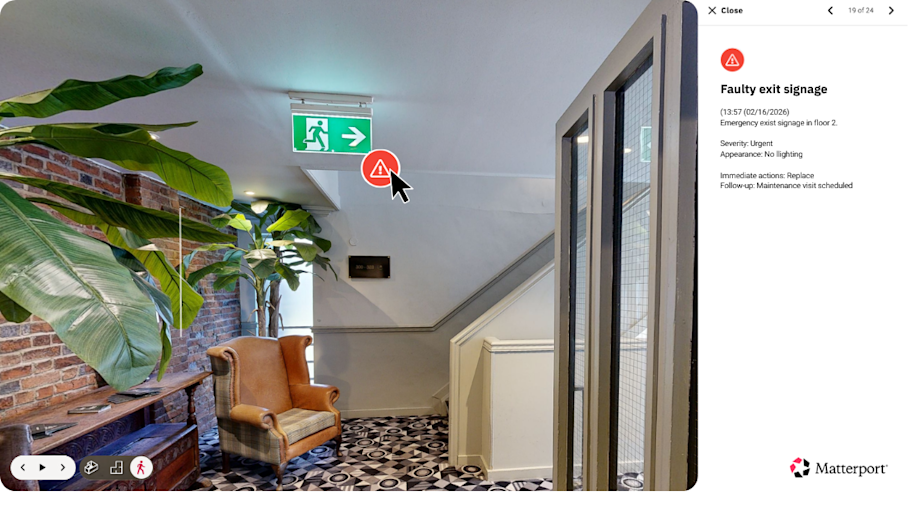
Egress route and exit signage audits to verify clear paths and illuminated signs
Fire extinguisher inspection and recharge cycles tracked by location
Inspectors and insurers need records that show when inspections occurred, what was found, and where equipment is located across the property. Completed tasks without documentation don't satisfy that requirement.
Capturing a property in a digital twin gives maintenance teams and safety inspectors a navigable reference for locating safety equipment without walking every floor. Tags and Notes let teams attach inspection records and service dates directly to each asset's location in the model, so the audit trail is tied to the physical space rather than sitting in a separate folder that may or may not reflect current conditions.
Electrical systems and lighting
A dead outlet beside a nightstand or a flickering hallway sconce are among the cheapest fixes on a maintenance list. The impression of neglect they leave, however, far outweighs that cost.
To keep these issues from taking root, focus on:
Panel inspections to check for signs of overheating, loose connections, and corrosion
Outlet and USB port testing across all guestrooms on rotation
Emergency lighting verification coordinated with life-safety checks
Ballast and LED driver replacement cycles tracked by installation date
Exterior lighting schedules to address bulb replacement, timer recalibration, and photocell function
Many electrical preventive maintenance tasks involve tracking component age and replacement cycles across hundreds of rooms. Without centralized documentation, deferred replacements accumulate quietly until an entire floor is plagued by malfunctioning USB ports or half the parking lot is dark.
Property Intelligence generates room-by-room area and dimension data from the digital twin. That gives operators concrete scope inputs for budgeting electrical retrofits or lighting upgrades across a property.
How to prioritize hotel preventive maintenance decisions
Teams with limited labor hours need a clear method for deciding where to focus first. Below is a simple prioritization framework to help general managers and regional directors rank tasks by the risk they mitigate:
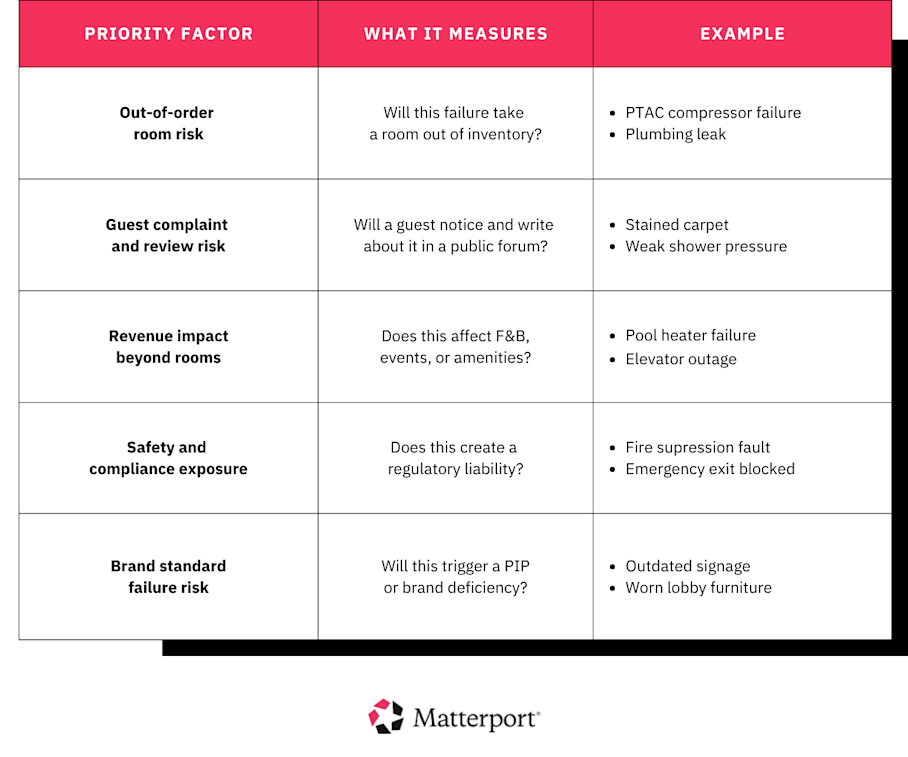
Prioritization only holds up if teams can verify the work is getting done. Periodic digital twin captures create a time-stamped, navigable visual record that supplements CMMS data, giving operators a means to verify property status.
When issues can't be resolved immediately, Notes keep the problem linked to its exact location until it's addressed. Pairing CMMS tracking with the digital twin also gives portfolio leaders the evidence they need for ownership reporting, PIP reviews, and vendor scoping.
Build a hotel preventive maintenance strategy that holds up across every property
The properties with the strongest review scores and lowest OOO rates have two things in common: one, they document conditions consistently and verify work visually. Two, they give regional leadership remote access to the current asset status. That combination ensures they catch problems before they can hit reviews.
At the portfolio level, this discipline compounds. A regional director overseeing 12 properties can't physically walk every mechanical room and guestroom floor each quarter. But with Matterport digital twins as the visual layer, they don't need to. From a single platform, they can access:
Remote walkthroughs of guestrooms and mechanical spaces
Time-sequenced condition records that support brand inspections and ownership reviews
Visual training resources that survive staff turnover