


 Sign In
Hotel Room Inspection Checklist: A Guide for Housekeeping & Maintenance
A stained duvet, a flickering lamp, a slow drain. These are the room condition issues that show up in post-stay reviews, and often, they’re present before check-in. They go unnoticed because there’s no consistent standard to inspect against.
A structured hotel room inspection checklist gives housekeeping managers and rooms division leads a repeatable framework for pinpointing those issues before a guest ever opens the door.
Here, we share a complete, area-by-area checklist organized by inspection type, with guidance on how to document findings in a way that builds a verifiable condition record over time. This guide works for a single property or a multi-property portfolio, and it's built so you can put it into practice immediately.
Why a standardized hotel room inspection checklist matters
Inspection consistency directly affects guest satisfaction and repeat booking rates. A room that passes one attendant's check but fails another's creates an unpredictable guest experience, and that inconsistency shows up in reviews before it shows up in a maintenance log.
A standardized checklist removes individual judgment from the equation. Every room gets inspected against the same criteria, regardless of who cleaned it or which shift they were on. That consistency produces:
Faster room turnaround, with less back-and-forth between housekeeping and supervisors.
Fewer service recovery incidents, because issues are caught before guests check in.
Clear accountability when something is missed, because the checklist creates a record.
Documented inspections also protect the property. A time-stamped condition record at turnover holds up during damage disputes, satisfies brand auditors, and supports insurance claims with evidence rather than personal, subjective accounts.
Hotel room inspection checklist by area
The checklist below covers tasks organized by area, with each task assigned to a responsible party and an inspection type:
Turn inspections: Completed after every checkout. These focus on cleanliness, restocking, and functional readiness before the next guest arrives.
Periodic deep inspections: Scheduled monthly or quarterly. These cover fixture condition, cosmetic wear, and items that fall outside a fast turn.
Hotel brand standard audits: Conducted by general managers (GMs) or regional directors. These verify that room conditions meet brand or franchise requirements across the property.
Each completed task should be logged against the relevant room or area as it’s finished, not reconstructed from memory at the end of a shift. Wherever possible, that record should include visual evidence alongside text.
Each room type can be captured as a digital twin: a navigable 3D model that mirrors the real space to check against. Every surface, fixture, and corner is captured at full scale. Housekeeping staff can walk through the model on any device and compare what they see in the room to what the standard looks like, while regional directors can pull up any room type across any property without traveling to the site. With such technology available, pass/fail judgments on cleanliness, presentation, and condition don’t have to be a matter of individual memory or verbal description.
Cleanliness and high-touch surfaces
Cleanliness is the first thing a guest registers. Before they check the bed or test the shower, they read the room's overall condition as a measure of property standards. A smudge on the bathroom mirror or dust on the nightstand communicates something more damaging than a minor lapse: it signals a property that doesn't look closely. That impression, once formed, colors everything else about the stay.
Task | Inspection Type | Responsible Party |
- Vacuum and mop all floors - Check under beds and furniture for debris | Turn | Housekeeping |
- Wipe and sanitize all surfaces – desk, nightstand, dresser, windowsills | Turn | Housekeeping |
- Clean mirrors - Ensure windows are streak-free | Turn | Housekeeping |
- Sanitize high-touch points – door handles, light switches, TV remote, thermostat, phone | Turn | Housekeeping |
- Empty and reline all trash and recycling bins | Turn | Housekeeping |
- Confirm room odor is neutral (no mustiness, chemical residue, or smoke) | Turn | Housekeeping |
- Deep clean vents, baseboards, and behind all furniture | Deep | Housekeeping |
- Inspect ceiling corners, light fixtures, and inside lampshades for dust | Deep | Housekeeping |
- Verify sanitization protocols meet brand standards | Audit | Supervisor/GM |
Housekeeping staff enter every guest room more frequently than any other team, making them the first line of detection for developing issues. But their knowledge only travels if it's documented at the time of discovery.
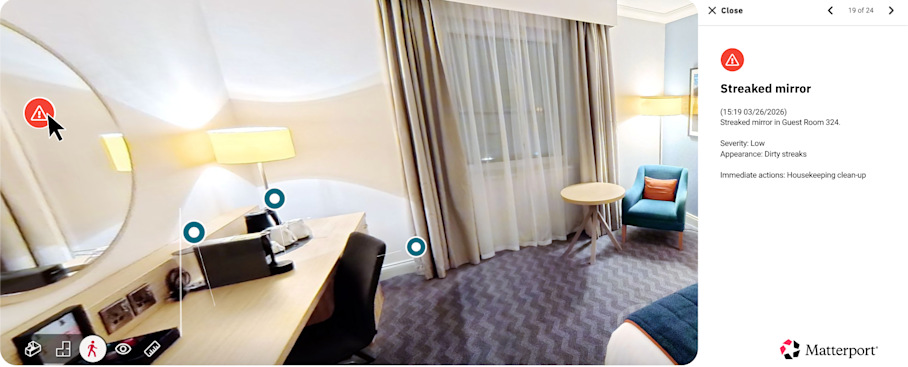
Time-stamped 3D model captures create a verifiable pre-arrival condition record for each room. When a guest disputes damage at checkout, or a brand auditor asks for evidence of conditions on a specific date, that record is already there: photorealistic, navigable, and tied to the precise state of the room at the time of arrival. Issues flagged during inspection can be pinned to their exact location in the model using Tags and Notes, giving supervisors and vendors full context without a return visit to the room.
Bedding and linens
According to J.D. Power, cleanliness has been the biggest driver of guest room satisfaction for 28 consecutive years. Bedding is where that scrutiny tends to land first. A neatly made bed can conceal a stained fitted sheet, a worn mattress protector, or a duvet with uneven fill; inspectors must pull back the top layer on every turn to verify sheet condition directly rather than assessing presentation from the doorway.
Task | Inspection Type | Responsible Party |
- Verify sheets are fresh, wrinkle-free, stain-free, and fully tucked. | Turn | Housekeeping |
- Check blanket and duvet for stains, odor and even layering | Turn | Housekeeping |
- Confirm pillow arrangement is symmetrical and aligned per brand standard | Turn | Housekeeping |
- Pull back top layer to inspect mattress protector condition | Turn | Housekeeping |
- Check bed skirt alignment - Confirm no visible storage underneath | Turn | Housekeeping |
- Inspect mattress for stains, sagging, and wear beneath protector | Deep | Housekeeping |
- Verify mattress flip/rotation schedule compliance | Deep | Maintenance |
- Confirm bedding meets brand standard (thread count, fold style, pillow count) | Audit | Supervisor/GM |
Turn-by-turn checklists confirm whether a room passed inspection on a given day, but they don't explain why the same room keeps failing. A recurring bedding complaint could point to a mattress approaching the end of its life, a linen batch with a quality issue, or an attendant consistently skipping the pull-back check under time pressure. Each of those requires a different response, and without a condition record that spans multiple inspection cycles, there's no way to distinguish between them.
Side-by-Side Spaces lets supervisors place captures from previous turns next to each other and step through them in sync. Is the stain new, or has it been there for three weeks? Did it show up after a specific linen delivery? Does it only appear on the days a particular attendant was assigned to the floor? That comparison turns a recurring complaint from a judgment call into a documented pattern tied to a specific date, shift, and condition.
Bathroom
The bathroom carries more scrutiny per square foot than any other area in the room. Guests assess it immediately on arrival and use it multiple times per stay. Water spots, mildew, and missing toiletries register within seconds.
Task | Inspection Type | Responsible Party |
- Clean and sanitize toilet inside and out - Confirm seat is secure | Turn | Housekeeping |
- Wipe sink and countertop spotless - Check for water marks and soap residue | Turn | Housekeeping |
- Scrub shower and tub free of soap residue, mildew, hair | Turn | Housekeeping |
- Clean mirror streak-free | Turn | Housekeeping |
- Replace and fold towels per brand standard - Position towels correctly | Turn | Housekeeping |
- Restock full toiletry set in correct positions per brand standard | Turn | Housekeeping |
- Test water pressure and temperature in shower and sink | Turn | Maintenance |
- Inspect caulking around tub and shower for cracks and discoloration | Deep | Maintenance |
- Check all drains for flow speed and odor | Deep | Maintenance |
- Test exhaust fan operation - Confirm no noise or obstruction | Deep | Maintenance |
- Verify bathroom fixtures meet brand specifications | Audit | Supervisor/GM |
Caulking condition around the tub and shower is a common brand audit failure point. Deterioration here is gradual, which means it rarely triggers an urgent work order until it's already a compliance issue or a mold problem. Once again, by virtue of their role, housekeeping staff are best positioned to catch these issues early. Any caulking concern should be flagged immediately, even during a turn.
Still, problems like these are easy to miss without a visual record to compare against. Teams can circumvent them by documenting bathroom conditions directly within the digital twin using Tags and Notes, pinning deteriorating caulk, slow drains, or fixture faults to their exact location in the model.
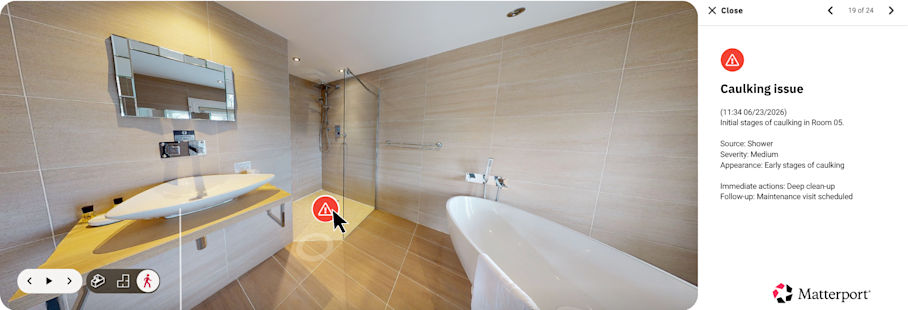
A maintenance tech or vendor reviewing the tag gets precise visual context before arriving on site, so there’s no need for a return visit, and no ambiguity about which corner of the shower is affected.
Furniture, fixtures, and room presentation
Presentation checks serve two functions: confirming structural integrity and verifying that the room matches the defined setup, including furniture compliant with hotel brand standards. Both matter, and neither substitutes for the other. A stable desk with a missing guest directory is still a brand gap.
Task | Inspection Type | Responsible Party |
- Verify chairs, desk, and table are stable with no visible surface damage | Turn | Housekeeping |
- Check all lamps for working bulbs and intact, undamaged shades | Turn | Housekeeping |
- Inspect curtains and drapes for even hanging, smooth operation, and blackout function | Turn | Housekeeping |
- Confirm artwork is straight, clean, securely mounted | Turn | Housekeeping |
- Check closet for correct hanger count, luggage rack, any damages. | Turn | Housekeeping |
- Open all drawers to verify they are empty and slide freely | Turn | Housekeeping |
- Position collateral and welcome materials per room setup guide | Turn | Housekeeping |
- Full furniture and fixture condition audit – structural wear, loose fittings, replacement needs | Deep | Maintenance |
- Confirm room layout matches brand presentation standard | Audit | Supervisor/GM |
Presentation items must be checked against a defined room setup guide or photo reference on every turn, as leaving placement to individual judgment produces inconsistency across rooms and shifts.
A 3D model of each room type gives inspectors a photorealistic reference to check staging and furniture placement against. Rather than relying on memory or a written description of where items belong, inspectors can pull up the model and compare directly. This is particularly valuable for onboarding new housekeeping staff and maintaining brand standard compliance across a multi-property portfolio.
Amenities and in-room equipment
Equipment failures are the most operationally disruptive inspection finding. A malfunctioning HVAC unit or a dead TV can’t be resolved during a turn and require a facility maintenance handoff. If that handoff isn’t documented immediately, the room risks being released to a guest with a known fault.
Task | Inspection Type | Responsible Party |
- Turn on the TV - Verify correct input and channel guide display | Turn | Housekeeping |
- Test remote control functionality and battery level | Turn | Housekeeping |
- Confirm phone is operational with correct extension directory | Turn | Housekeeping |
- Test all lighting circuits | Turn | Housekeeping |
- Verify accessible power outlets and USB ports are functional | Turn | Housekeeping |
- Set HVAC to default arrival temperature - Confirm quiet operation | Turn | Housekeeping |
- Open, reset, and test in-room safe | Turn | Housekeeping |
- Clean coffee maker and restock supplies | Turn | Housekeeping |
- Inspect refrigerator/minibar for correct temperature and proper stocking per standard | Turn | Housekeeping |
- Verify iron and ironing board are present, clean, and cord is undamaged | Turn | Housekeeping |
- Confirm guest directory or digital compendium is current | Turn | Housekeeping |
- Full HVAC performance check for temperature accuracy, airflow, and filter condition | Deep | Maintenance |
- Test every outlet for electrical safety | Deep | Maintenance |
- Verify all equipment meets brand specifications | Audit | Supervisor/GM |
Equipment faults flagged during a turn can be documented within the digital twin at the exact fixture location and linked to a maintenance work order. This way, maintenance teams get precise visual context before they arrive without back-and-forth about which outlet, which circuit, or which unit.
At the same time, managers get a record of when the fault was identified, assigned, and resolved, which supports both brand audit documentation and any guest dispute about conditions at the time of check-in.
From inspection to resolution: How to close the loop on hotel room findings
A completed checklist only creates accountability if findings are recorded in a way that links issues to a specific location, a specific time, and a specific responsible party. A checkbox marked without documentation is a gap, not a record. When issues recur, undocumented inspections make it nearly impossible to identify patterns.
There are three documentation practices separating properties that merely inspect from those that improve:
Assign clear ownership per inspection type. Define who checks, who signs off, and who follows up. "Needs repair" isn’t a work order. "Replace caulking in Room 308 bathroom by Friday, assigned to maintenance lead" is.
Log findings at the fixture or asset level. Room-level notes ("bathroom needs attention") force someone to revisit and interpret. Fixture-level notes ("shower drain slow, hair trap may need replacement") give maintenance teams context to act without a follow-up visit.
Create a visual condition record that ties findings to a specific location and state of condition at a point in time. Photos and 3D captures provide context and detail that text logs can’t match.
Matterport digital twins are what that third practice looks like in operation. Each room type gets a photorealistic, navigable 3D model that serves as the visual baseline every person on the team inspects against: housekeeping, maintenance, GMs, and brand auditors all working from the same reference rather than building separate documentation for each.
Views within the model let each role see what's relevant to them, from cleanliness and presentation for housekeeping, to fixtures and HVAC for maintenance, and compliance checkpoints for brand auditors.
The baseline is built once per room type, not once per room, which means the documentation investment scales as the portfolio grows rather than multiplying with it. For properties without in-house capture capacity, Capture Services deliver professional-grade digital twins within 48 hours across hundreds of cities.
Get started with Matterport for Travel & Hospitality


