


 Sign In
How to Handle a Security Deposit Dispute: Building Evidence That Withstands Tenant Claims
Key takeaways
Even a completely fair security deposit deduction can lose a dispute if the evidence package is insufficient. In most states, the landlord carries the burden of proof, and the record they provide, not the merits of the charge, decides the outcome.
Deposit caps, return deadlines, and withholding penalties vary by state, and sometimes city, and improper withholding can expose a landlord to damages worth several times the deposit amount.
A Matterport digital twin captures a dated, navigable 3D record of the entire unit at move-in and move-out and anchors invoices and measurements to the exact spot of each damage, making deductions far harder for a tenant to dispute.
When a tenant challenges a security deposit deduction, even if the deductions were fair, you still might lose. Not because you were wrong, but because the record of documentation is insufficient evidence of the damage.
In most states, the landlord or property manager carries the burden of proving every deduction is valid. A thin record not only means you may forfeit the contested amount, but also exposes you to additional statutory penalties that dwarf your expenses.
This is a tactical guide for property managers and landlords handling an active or anticipated security deposit dispute. It will show you how to handle one fairly by building documentation that survives scrutiny, and how to protect your deductions while giving the tenant a clear, honest record.
Why security deposit disputes escalate
Deposit disputes tend to escalate when deductions feel arbitrary to the tenant and the landlord can't show what changed between move-in and move-out. Some of the most common objections are related to:
Wear and tear versus damage: Carpet, paint, and fixtures age with normal use, and tenants push back when aging gets billed as damage.
Cleaning charges: A tenant who left the unit tidy may see a professional cleaning fee as excessive.
Missing or late itemized statements: In New York, a late statement forfeits the right to keep any of the deposit.
Pre-existing conditions: The tenant says a stain, chip, or scuff was already there on move-in day.
Each flashpoint is an evidence problem at its core. California, New York, Texas, and Massachusetts all bar deductions for ordinary wear and tear. The argument usually comes down to whether the landlord can show the change.
A disagreement can escalate to a formal challenge if there's no baseline record, if the line items are vague ("general repairs"), or if replies are slow or defensive. Correcting those processes gives a tenant fewer reasons to escalate a dispute.
What does a strong condition record look like?
Courts and adjusters weigh evidence by how easy it is to trust. A condition record must meet several conditions in order to pass:
Dated: Every image and report tied to a specific inspection date
Complete: Every room, closet, and surface covered, including floors and ceilings
Consistent: Same checklist, route, and rating terms used at move-in and move-out
Easy to authenticate: Original files kept, with a clear record of who captured them
Organized: Filed by property, unit, and inspection date
Evidence breaks down wherever you leave room for a "he said, she said" exchange with no baseline to anchor the comparison. A tenant's attorney knows exactly where to probe, and they will look for:
Undated or loosely dated photos, or files that lost their metadata in transit
Selective angles and missing rooms
No way to show a photo wasn't taken months earlier or edited
Handwritten notes with vague terms such as "fair" or "some wear"
Different inspectors applying different standards across properties
Photos sent as standard images through chat apps typically lose metadata such as timestamps and location, while that information tends to persist with files sent as documents. Teams should always keep the original files for every inspection.
A thorough visual record of the whole unit also prevents information or context from being lost, and a navigable 3D model like digital twin captures every room and surface, so nothing falls out of frame. Dated scans captured at move-in and move-out give teams an objective, consistent record that is hard to dispute.
Matterport digital twins captured with a Pro3 camera pair LiDAR with 4K HDR imagery and accuracy of ±20mm at 10 meters. The level of detail makes it easy for any inspector to distinguish damage from ordinary wear, even when cross-checking remotely. Images are fine enough to show a gouge, burn, or stain clearly, so you can confidently draw the line between tenant damage and the normal aging a court won't let you charge for.
With a reliable record in hand, the next step is to assemble an evidence package.
Building an evidence package for a security deposit dispute
An evidence package is a comprehensive file a property manager hands to a tenant, mediator, judge, or adjuster. Any reviewer should be able to follow the unit's story across the tenancy without asking for more.
What to include in the package
The documents included in an evidence package to handle a security deposit dispute should establish the tenancy, the condition change, and the cost. Each one is designed to answer a specific question the reviewer will ask:
A signed lease defines the deposit amount, cleaning terms, and condition clauses
Signed move-in and move-out reports establish the starting and ending condition of the unit, and should have inspection checklists attached
A side-by-side comparison shows the changes in each room, viewed from matching positions
An itemized deductions statement lists every charge, its location, and the deduction amount
Repair invoices and cleaning receipts demonstrate the actual or estimated cost behind each charge
A forwarding address request shows when and how the tenant provided a mailing address
Delivery confirmation records when the deposit letter went out and how it arrived
The itemized statement is a particularly important part of the evidence package and must include a high level of detail. Build each line on the statement as a small, self-contained case, with the relevant reports, comparison, and receipts attached, so that a reviewer can read one charge and find everything that supports it without flipping through the whole file.
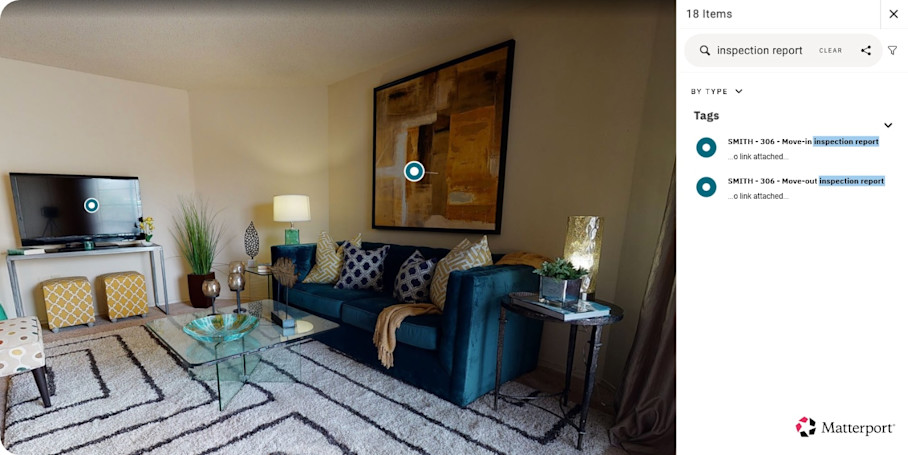
That connection can be made inside a digital twin by using Tags. Attach notes, photos, video, and files such as invoices or cleaning receipts to the exact spot where the damage sits. Anchoring the evidence package to its physical location means a reviewer can see the charge, the proof, and the place it refers to in a single view, removing any doubt that the invoice and the damage describe the same spot.
How to build each deduction so it holds up
In order to justify deductions, you must prove five things for every single line on the itemized statement:
Damage observed: What is wrong, in plain terms
Location: The room and surface where it sits
Move-in baseline: Evidence the damage wasn't present at move-in
Cost: The amount to repair, replace, or clean
Cost support: The invoice or estimate behind that amount
For example, take a carpet burn in a bedroom. The move-in scan should demonstrate that the carpet was clean and undamaged on the date before the tenant moved in. The move-out scan should show exactly the same space, with the burn clearly marked, assessed, and evidence attached. Matterport scans of the same location can be compared directly Side-by-Side (public beta), making the damage impossible to miss.
Charging full replacement costs for items like carpets often invites pushback because they can make the whole statement look opportunistic. It's typically recommended to prorate the cost based on the item's remaining useful life. Counsel or the local court can confirm local practice. Capturing the specific size of damage can also be done inside the digital twin using Measurement Mode, so a reviewer can work from that single resource. They can source quotes for a repair and gather the full evidence required to justify the exact deduction cost without revisiting the site.
Precise charges signal that you're being fair, which makes the rest of your numbers easier to trust. Plus, an honest statement often ends the dispute before it ever escalates, because the tenant can see they'd lose.
Deadlines and limits for security deposits
Note: This section provides general information, not legal advice, and statutes change, so make sure to examine and stay on top of local regulations that apply to your own properties.
State law sets rules for how to handle security deposit disputes and return timelines, and some cities add their own. All property managers should be aware of the variables for the unit's location.
Teams should check the following guidance before requesting any deduction, then recheck it once a dispute starts.
Guidance | Covers | Purpose | Where to verify |
|---|---|---|---|
Deposit limits | A cap often tied to a number of months' rent, which in some states varies by landlord size or whether the unit is furnished | Limits protect tenants from large upfront costs | - State's landlord-tenant statute - State legislature website |
Return deadlines | A set number of days after move-out, or after receiving a forwarding address, to return the deposit or send a statement | Deadlines help keep landlords from holding a tenant's money indefinitely | - State's landlord-tenant statute - State attorney general's tenant guide |
Itemized statement requirements | A written list of each deduction, sometimes with receipts or estimates attached, often delivered by a set method | Itemized statements let tenants see, and challenge, each charge | - State's landlord-tenant statute - State attorney general's consumer guide |
Permitted deductions | Often unpaid rent, damage beyond normal wear and tear, and cleaning to return the unit to move-in condition | These rules help separate ordinary aging from tenant-caused harm | - State law library - Local landlord association |
Penalties for improper withholding | May include forfeiting the right to withhold, interest, multiples of the deposit, and attorney's fees | Penalties aim to discourage bad-faith withholding | - State's statute - A court's small claims self-help pages - Local landlord-tenant attorneys |
Inspection requirements | May include move-in condition checklists or, in some states, a tenant's right to a pre-move-out walkthrough | Inspections create a shared record and a chance to fix issues before move-out | - State's statute - City or county housing code |
In the majority of cases, the burden of showing that deductions were reasonable sits with the landlord or property manager, not the tenant. That means it is crucial that your evidence package is well-prepared.
If you are found to be improperly withholding a security deposit, the exposure can add up very quickly. A $1,500 deposit might carry several thousand dollars of risk once penalties and fees apply, depending on where the property is located. Certain regulations trigger automatic compensation for a deposit that isn't returned in a timely manner or is kept in bad faith. Others allow tenants to sue for a multiple of the deposit amount.
Penalty rules change, so confirm current law with counsel before relying on any figure.
How to resolve a security deposit dispute before and in court
Resolving a dispute over a security deposit typically moves in three stages:
A written reply
Mediation if required
Small claims court as a final measure
The evidence package you build will carry the case across all three. Build it once, and build it well to save rework at every stage. Here's how to do that.
1. Respond to the tenant and any demand letter
Always reply to any pushback against security deposit deductions in writing, even if the tenant has called or texted first. Acknowledge the dispute, restate the statutory timeline that applied, and attach the itemized statement with its supporting evidence. Keep the tone factual and brief.
A demand letter calls for a point-by-point response. Address each disputed charge in the order the tenant raised it and cite the evidence behind it, including evidence of the state before move-in. Note any charge being adjusted, but don't concede charges the record supports or match an aggressive tone.
You can share a digital twin being used for evidence through a secure link instead of a stack of attachments. A Matterport space opens in a web browser with no software to install, so the tenant, an attorney, or an adjuster can review the unit remotely without visiting it, which keeps the conversation focused on one, shared point of reference.
2. Consider mediation
Mediation is a useful resource when the disputed amount is small, the evidence is mixed, and the landlord wants to preserve a working relationship with the tenant. A neutral mediator can help both sides reach a settlement without a hearing.
The local small claims clerk can confirm whether the court offers a mediation program. Community mediation centers are another option. The NAFCM directory lists local centers that often help for free or reduced fees, though services vary by center.
A clear record strengthens a property owner's position at the table. With a location, measurement, and invoice for every single charge, the conversation can be more efficient and directly address the few items genuinely in question. That narrower scope makes a fair settlement easier to reach.
3. Prepare for small claims court
If the case reaches a hearing, come prepared to prove your case cleanly. Bring:
Printed and digital copies of the full evidence package
The lease
A one-page timeline of key dates
Witness contact details
Check the court's limits too. Some states and courts will list monetary limits for small claims.
Property owners should be able to explain the damages in a clear sequence:
Condition at move-in
Condition at move-out
The exact cost to restore
Expect a possible counterclaim, since a tenant may also seek statutory damages beyond the deposit amount.
Where the court accepts digital exhibits, a Guided Tour in a digital twin can walk the court through the unit in a set order. Outline a short, professional written narrative in the tour's captions that matches the itemized statement charge by charge. The result of a hearing often reflects how clearly the evidence package tells the unit's story.
Build security deposit deduction evidence that withstands scrutiny
Handling a dispute over a security deposit requires documentation that is dated, complete, consistent, and mapped line by line to each deduction. Property managers who build comprehensive move-in/move-out documentation for every turnover start each dispute with a significant portion of the file already assembled and will ultimately be proactively reducing security deposit disputes.
Matterport is used for multifamily properties to capture precise visual data on unit condition before and after each tenancy. With a comprehensive record behind every line item, a deduction is based on a clear comparison rather than a contest of memories. Strong evidence helps most disputes end at the first email instead of escalating to small claims.
Get started with Matterport for Multifamily


