


 Sign In
Multifamily NOI Playbook for a Low-Growth Market
Key takeaways
In a low-rent-growth environment, NOI gains increasingly come from efficient operations: especially reducing vacancy, shortening unit turns, and eliminating avoidable operating costs.
A repeatable NOI improvement assessment turns operational inefficiencies into measurable opportunities by establishing a baseline, quantifying the dollar impact of each problem, and prioritizing actions by potential return.
Matterport helps multifamily teams improve NOI by shortening leasing cycles, tightening unit turns, and reducing avoidable site visits through access to digital twins and property data.
Rent growth has flattened across most markets. CoStar data shows annual rent growth slipped to 0.4% in February 2026, down from 0.6% in January, and a significant drop from the 1.5% recorded in February 2025. But the cost of running a building hasn't followed it down. Labor, maintenance, insurance, and utilities show no sign of receding. Buildings simply cost more to operate now than they did a few years ago.
That combination squeezes net operating income (NOI) from both sides, and the usual response, to raise rents, isn't viable. When the market won't support higher rents, pushing them anyway risks stable occupancy. Income has to come from the operating side instead: running the same buildings with less friction and filling units faster.
This playbook breaks down how to increase NOI in a low-growth market and lays out a repeatable way to run a multifamily NOI improvement assessment, so teams can find out where the best gains will come from in their portfolio.
NOI and moving property value
NOI is effective gross income minus operating expenses, before debt service and capital expenditures. It's the cleanest measure of what a property earns from operations, stripped of financing choices and one-time capital projects.
That single number does heavy lifting across the capital stack. NOI sets the asset's appraised value when divided by the market cap rate. It shapes the terms a lender will offer at refinancing, sets the distributions investors receive, and determines what the property clears at disposition.
A building's operating performance and its market worth are closely linked. At a 5.5% cap rate, a dollar of annual NOI carries roughly eighteen dollars of value, so even modest wins can compound into large swings in asset value.
Let’s look at an example: a multifamily property earning $2 million in NOI at a 5.5% cap rate is worth roughly $36.4 million. Lift NOI by just 3%, or $60,000, and that value climbs by about $1.09 million.
Why NOI growth looks different when rent growth flattens
NOI growth comes from three levers:
Grow revenue
Reduce expenses
Improve operational efficiency
In a healthy rent-growth market, the first lever typically does most of the work, and the other two get treated as housekeeping. The common instinct is to improve NOI by raising rents. However, while rental demand is high, the market just absorbed its largest wave of apartment supply since the 1980s, stunting rent-growth for existing properties as a result.
But revenue has two parts: the rate a unit charges and the time it spends occupied. The fastest NOI improvement available to the average portfolio is more days of the same units filled with paying residents. Current national vacancy rates of 8.5% are expected to persist through 2026, with the average extended vacancy working out to an additional $275 per unit per unit in expenses and turnover costs. Efficient leasing and turnover operations reduce vacancies.
When rent growth flattens, expense discipline is another strategy most property owners turn to. Unfortunately, most of the operating expenses squeezing margins today exist outside the property and don't yield to the usual belt-tightening.
Insurance renewals: Premiums are set by carriers pricing catastrophe risk, not by your budget discipline, so you can't negotiate them back to prior levels.
On-site labor and turnover: Wages have reset higher, and every departure adds hiring and training cost before a new hire is productive.
Maintenance and materials: Sustained inflation in labor and materials has driven up repair and maintenance costs.
Utilities: Consumption is largely baked into the physical infrastructure rather than into daily usage, and rate increases hit whether or not consumption changes.
Third-party vendor rates: Contract renewal resets costs across landscaping, cleaning, and trades, re-bidding takes time, and switching vendors carries its own coordination cost.
These are all external forces and even excellent management can’t reduce them significantly. But an expense line is also impacted by how much work the building generates. Insurance costs are essential, but a documented, well-maintained property fields fewer claims. A vendor's hourly rate is fixed at contract, but a repair diagnosed correctly the first time uses fewer of those hours. Operators still have control of volume and efficiency.
NOI performance is increasingly determined by how efficiently properties are operated, not how aggressively they are priced. Operational efficiency impacts both revenue growth and property expenses. Friction leaves units empty longer and drives cost into the building when repairs and turns drag, disrupting tenants or stalling the leasing process. Reduce operational friction and occupied time goes up while expense comes down.
3 ways to increase NOI in multifamily properties without increasing rent
With rent increases off the table, NOI can still grow. The three strategies below cut operational friction across a unit’s lifecycle, speeding up leasing, tightening turns, and supporting expense discipline, so you can take advantage of all three NOI growth levers available.
1. Shorten the leasing cycle with self-qualified prospects
Every day a unit sits unleased is revenue the property never gets back. Too often, vacant days aren’t down to the property itself, but to poor marketing. If your property marketing strategy attracts the wrong traffic, agents can burn hours touring prospects who were never going to sign. Other common problems include slow lead response, which sends ready renters elsewhere, and scheduling friction, which stalls tours that could have happened earlier.
Most renters screen units before they tour: reading photos, measuring rooms in their heads, ruling places out on layout alone. But wide-angle shots can feel deceptive, and flat floor plans say nothing about where the light lands or how the rooms actually connect. 3D virtual tours allow prospects to walk the actual unit themselves, remotely and at any hour, judging layout, light, and flow before they book. The ones the unit doesn't suit drop out early, so every in-person tour is with a renter who has seen the space and wants it.
Virtual tours are always on, 24/7, so they also capture demand the office misses. The renter browsing at 11 p.m. can tour. So can the one relocating from out of market who can't visit in person. Matterport’s digital twins seamlessly capture and transform properties into immersive 3D tours available online, so any prospect can self-qualify and apply without an agent ever opening a door.
Pair a tour with specific details a renter can use to rule a place in or out: accurate dimensions, a clear floor plan, pet and parking policies, real availability dates, and honest pricing. The more a renter can answer for themselves up front, the faster you’ll find a fit. Matterport generates all of the spatial information in the form of a Property Report and Schematic Floor Plans, so there’s no need for manual measuring or drawing. Property Intelligence even automates property descriptions and measurements based on tour data, so you have more time for the work that actually closes a lease: answering questions, following up fast, and moving renters to signing.
At portfolio scale, teams can capture one high-quality digital twin per floor plan, rather than scanning every unit, and reuse it across the ILS, property website, and paid listings. Marketing will stay consistent as physical inventory rotates, saving staff time that is better spent with prospects. This is especially beneficial for centralized or hybrid leasing models. One leasing agent covering several communities can run marketing without spreading themselves too thin.
PlanOmatic clients generate 101% more leads, see 38% more rental applications, and rent properties 30 days faster using Matterport virtual tours.
2. Tighten unit turn operations and make-ready execution
Every unit that goes vacant has to be inspected, scoped, repaired, cleaned, and re-leased, and each of those steps can extend vacancy. Tighten turns and the unit gets back to producing income sooner, for less, which is the closest thing to found money a flat-rent market offers.
Most turn inefficiency comes down to whether everyone working the turn agrees on the unit's condition. When they don't, the turn stalls in handoffs. Maintenance guesses at scope, the vendor shows up under-briefed, and managers are forced to reopen closed tasks.
Capture a digital twin of the unit the day a resident leaves and planning can start immediately, based on exact conditions. Maintenance crews, contractors, and managers all have a remote view of the work to be done and tools for measuring scope, so work orders are clear and materials ordered right before they even step foot on site.
In a digital twin, scope information can be attached to the unit rather than scattered across inboxes. Damage, appliance model numbers, warranty documents, punch items, renovation specs, and an apartment turnover checklist can all be tagged directly onto the model in relevant locations. Nothing lives in one person's email, and nothing gets lost in the handoff.
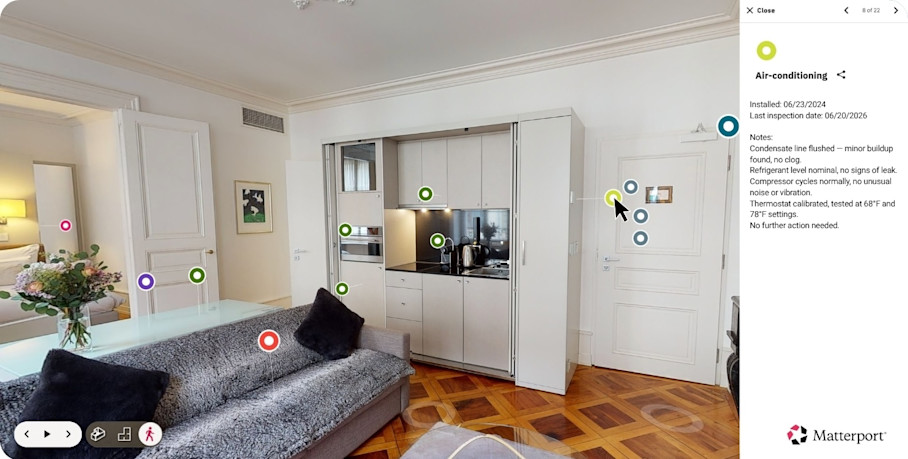
Disputes over resident-caused damage also lose their heat when the evidence is a dated, navigable 3D scan rather than vague written claims and photos. Compare the move-out condition Side-by-Side (public beta) with a dedicated move-in baseline, and the changes surface immediately. This shortens damage assessment, settles deposit disputes before they escalate, and leaves a dated record for insurance claims and contractor accountability.
By documenting turns thoroughly every time, vendor performance also becomes comparable across the portfolio. You can see who came in on scope, who padded the bid, who needed a second trip. Leverage that record at contract renewal to make sure you're partnering with the vendors most likely to increase your NOI.
3. Cut avoidable operating expenses across the portfolio
While external rates and premiums aren’t yours to cut, a second category of costs hides inside daily operations and is entirely avoidable. Travel, repeat inspections, rework, and coordination time all pile up when work is disorganized. Most flat-rent portfolios find a significant portion of savings when they reduce multifamily operating expenses.
Most avoidable operating expenses trace to functions that work out of sync. Leasing, maintenance, operations, and ownership all need information on the same unit, but each has historically gotten that knowledge the same way: by sending a team member to investigate.
Re-observation carries costs that have nothing to do with the physical work:
Repeat site visits and the windshield time between properties, paid in hours and mileage.
Vendors return trips after mis-scoped work.
Re-inspections to resolve a dispute that couldn't be settled by photos.
Staff hours spent re-photographing units when the last set of images didn't answer new questions.
Approvals delayed while a decision-maker finds time to drive out and look.
A digital twin removes the thing all of these have in common: the need to be physically present to observe. Capture a digital twin once and leasing, maintenance, facilities, and ownership can all work from the same cloud-hosted, accurate version, viewable from anywhere. Whether they’re working on a turnover, a mid-lease repair, a capital review, or a claim, everyone can open one model on their own schedule.
The savings scale with distance. When a regional manager oversees communities three hours apart, every avoided drive is half a day recovered. Mid-market and institutional operators running geographically scattered assets carry the heaviest coordination burden, so they have the most to gain from cutting the trips out.
Capturing the units doesn't require building an in-house scanning operation either. Capture Services deploys a trained technician on demand across hundreds of cities, with digital twins delivered in 24 to 48 hours. The scan often pays for itself the first time it prevents a round of trips.
Every hour an accessible, remote model saves is an hour redirected to higher-value work. On-site staff freed from re-photographing units and escorting walkthroughs spend that time on leasing and resident relationships instead, and maintenance crews spend their time on site actually carrying out repairs, rather than simply assessing the work to be done. Attentive service also improves resident satisfaction and retention, and every renewal a property keeps is a turn it doesn't have to pay for. Documentation that started as a way to cut coordination cost ends up protecting the income the whole portfolio runs on.
How to run a multifamily NOI improvement assessment
Every property leaks NOI somewhere, but rarely in the same place. One might lose it to slow turns. Another bleeds days while leasing waits on a walkthrough. A third burns cash on avoidable maintenance trips across a wide footprint.
The three levers we discussed for increasing multifamily NOI are generic. Run an NOI improvement assessment to find out which one is costing your property the most, by how many dollars, and which fixes to prioritize for the highest return. Here’s how.
Establish a baseline for revenue, expenses, and unit condition
Start by pulling the current NOI drivers into one view. Look at:
Rent roll
Effective occupancy
Average days vacant
Turn time
Turn cost
Operating expense lines for labor, maintenance, utilities, and administration
Those figures should be available in your property management and accounting systems, and they tell you where NOI is leaking.
What they don't show is why. A unit turning slowly reads the same on a report whether it needs paint or a full renovation. Pair operating data with a digital twin of the unit so the condition side of the baseline is also concrete and comparable across the portfolio.
Score each driver and quantify the opportunity
Now, rate each driver on how well it’s performing. A simple high, medium, or low is enough to start. For every driver that scores low, apply a dollar figure. If units sit vacant ten days longer than they should, multiply those extra days by the daily rent to see what the delay costs. If staff make repeat trips to the same unit, multiply the trips by what an hour of their labor costs.
This turns "leasing feels slow" into a number ownership can weigh. Line the opportunities up from biggest dollar payoff to smallest, and note which ones are easy versus hard to fix, so the cheap, high-return wins go first.
Prioritize actions and set a measurable plan
Turn the scored opportunities into a prioritized action list, each item with an owner, a timeline, and a target metric. Note how each driver points to the strategies we explored above: a slow leasing cycle signals that you should look at how you're marketing to prospects, high vacancy days and turn cost suggest that turnovers need tightening, and inflated operating expenses imply that more efficient working systems will help. Map these elements to turn the assessment into a to-do list.
Keep consistent, standardized records so teams can benchmark communities against each other and repeat the assessment on a regular cadence. That way, the plan will become a habit instead of a one-time exercise. Those same records will also inform capex planning and value-add decisions, because you're allocating capital against documented conditions rather than guesses.
More occupied days, fewer repeat trips, same buildings
In a low-growth market, NOI comes from removing the inefficiencies built into unit operations. Strip out the days a unit sits idle while someone drives over to look at it, and the days lost to rework and re-inspection, and the same portfolio will produce more rent-paying time at lower recurring cost.
Digital twins give leasing, maintenance, and ownership teams the tools they need to increase NOI operationally. No rent increase required. No new buildings. Just less friction around the ones you already own.
Get started with Matterport for Multifamily


