


 Sign In
How to Increase Vacation Rental Bookings in a Crowded Market
Key takeaways
In a crowded market, increase vacation rental bookings by building guest confidence and proving your property’s value first and foremost, before simply competing on listing price.
Rich, immersive visuals remove the uncertainty that stalls decisions, turning browsers into confident bookers before they ever message you.
A single Matterport digital twin delivers a strong set of visual assets, including a virtual tour, photos, and videos, that can be distributed across owned, third-party, and social channels. This keeps the booking calendar full without rebuilding content for each platform.
Book a hotel room and you know almost exactly what you're getting. Vacation rentals don't work that way. Every property is one of a kind, with quirks and character that guests typically have to pay for in full before they ever walk through the door. If a browser isn’t immediately confident that a stay at your property will live up to their expectations, there are plenty of others to explore.
The market is crowded with near-identical options. To win reservations, you have to make your property feel demonstrably more premium than the listings sitting right beside it in search.
Here, we’ll show you how to increase vacation rental bookings by optimizing your listing to earn trust at a glance, pricing strategically to stay competitive without underselling, and marketing in ways that will consistently fill your calendar.
Why vacation rental bookings stall in a crowded market
Most rentals stall for the same reason: they look interchangeable. When dozens of units in the same ZIP code share the same amenity checklist and similar photos, guests have nothing left to compare except price. Your listing becomes a commodity, and commodities compete in a race to the bottom.
And the market keeps expanding, which means more competition every season. The vacation rental market is projected to grow by $22 billion between 2024 and 2029. More inventory makes it harder for any listing to stand out.
Even if guests engage with your property, you have to quickly turn them into confident bookers. When met with any of the following barriers, most guests will click away to other options:
Flat photo grids hide layout and room-to-room flow, and it’s difficult to tell how the spaces actually connect.
Wide-angle shots stretch a room to look bigger and often raise suspicion instead of building trust.
Missing context on bedroom configuration, bathroom access, stair counts, and workspace setups leaves guests guessing about whether the place fits their trip.
Pre-booking question threads slow the decision down, and many go unanswered long enough that the guest books elsewhere.
Expectation gaps surface later as cancellations, refund requests, and three-star reviews that drag down your ranking.
Confidence tracks directly with understanding. The more completely a guest can picture a space before booking, the less risk they feel, and the more willing they are to commit at a higher rate. The rest of this guide shows how to build that confidence across every channel you use.
How to build a vacation rental listing that converts browsers into bookers
Most vacation rental hosts pour their energy into discovery, tweaking keywords and chasing the algorithm, then stop. Ranking in search gets you the click, but it does nothing to close the reservation. The sections below cover the listing elements that turn a click into a booking.
Prioritize a strong visual package
Visuals are the first thing a potential booker looks at, and they carry more weight than any other part of your listing. Guests decide within seconds whether a property feels worth exploring, and that judgment rests almost entirely on what they see.
Include a complete set of visual media on your listing, including:
Professional photography with accurate lighting and color
Video walkthroughs that show movement through the home
Panoramas for wide interior and exterior views
Floor plans that map the layout at a glance
Immersive 3D tours guests can explore on their own
Matterport scans real spaces in 3D, producing this full set of assets from a single model called a digital twin. Instead of coordinating and paying for a number of separate shoots, you can simply export the assets you need or embed them in your online listing.
A flat gallery doesn’t come close to the depth of a virtual tour where a guest walks the entire property at their own pace. Instead of being restricted to a handful of still photos shot from the angles a host chose to show, prospective bookers can examine how the property flows from every angle using 2D floor plans or a dollhouse view.
That extra exploration time also helps guests answer questions specific to their needs. They’ll instantly know whether it’s suitable for their trip. A family might check whether the stairs are a concern for a toddler, while a guest with mobility needs assesses whether the layout works for them, and a group confirms that there's truly enough space to spread out. Rather than messaging the host and waiting for a reply, or simply guessing and moving on, browsers resolve their specific doubts on the spot.
Vacation rental platform Vacasa found that listings with a Matterport 3D tour were browsed 3x longer and saw a nearly 12% increase in rental bookings.
Write titles and descriptions that answer questions up front
Your title and description do the work your photos can't. Use this reliable title formula so a browser instantly knows what makes the place special and who it's for:
Defining Feature + Location Benefit + Guest Fit
For example, "Oceanfront Cottage with Private Deck — 2 Blocks to the Boardwalk — Sleeps 6, Family-Friendly"
Next, structure the description the same way you'd pitch the home in person. Lead with the one thing no competing listing can claim. Then cover layout, location logistics, and house rules.
It’s also a good idea to use this space to answer the most common questions and objections, including:
Parking and whether it's free
Accessibility and stair counts
Noise and neighborhood feel
Distance to the main attractions
How the sleeping arrangements actually work
Here’s an example of a vacation rental description that’s enticing and functional:
"Wake up to unobstructed ocean views from the only cottage on the street with a private beachfront deck. Inside, an open-plan living and kitchen area opens onto the deck, with two bedrooms downstairs and a loft bedroom that sleeps two more. You're a five-minute walk to the boardwalk and restaurants, with free off-street parking for two cars and a grocery store around the corner. We ask that guests note the home is non-smoking, but pets are allowed."
If writing the description is the part you'd rather skip, Matterport's Property Intelligence can auto-generate a property description from a scanned space, giving you an editable first draft instead of a blank page. You adjust the tone and length, then refine from there.
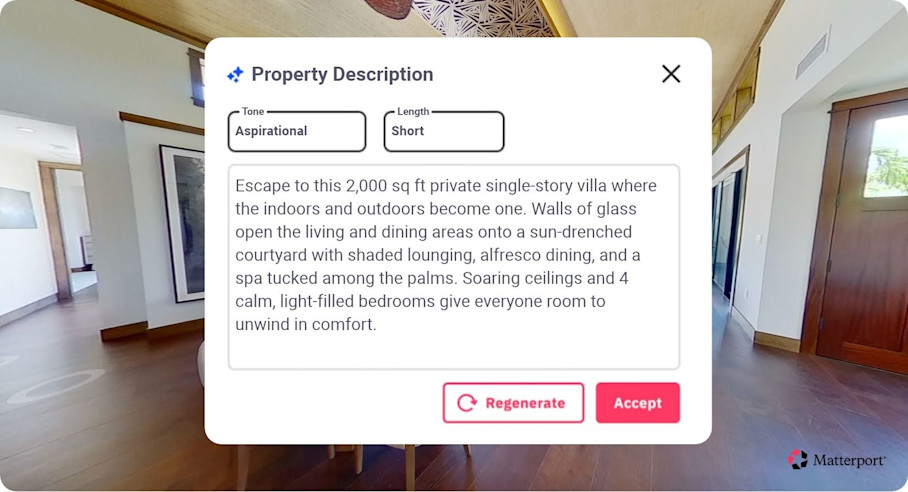
If you manage several properties, you’ll save hours of repetitive listing admin. Simply generate a first draft for each listing from its digital twin, then adjust the details that make each one distinct rather than starting every description from scratch.
Highlight details that secure bookings
Trust grows when you proactively surface the specifics that make a space appealing. Don't wait for a guest to ask about the most important factors of your property; show them off.
Highlight these features in the space so browsers can find them as they’re exploring the tour. Add Tags with clickable info so you can point out features in context instead of burying them in a long bullet list.
Details worth tagging fall into two groups. The first are the exciting selling points or features that make a guest want the place, such as:
A hot tub or pool, with the information showing how to use it
A chef's kitchen with premium appliances
A dedicated game room, home theater, or entertainment space
Standout views, worth a tag pointing out the best spot to enjoy them
A curated local guide to nearby restaurants, trails, and hidden gems
Then, address these practical reassurances that guests will always screen for before they'll book:
Wi-Fi network and speed
A workspace with a desk, monitor, and reliable connection for remote work
EV charger and where to plug in
Crib, high chair, or other family essentials
Thermostat controls, appliance instructions, and house rules
Tags also cut your workload. When the tour answers questions before booking, you field fewer inquiries and fewer post-arrival messages, which frees you up to focus on turnovers and guest care.
How to price for value instead of cutting rates
Competing on price alone erodes already-thin margins and trains your market to wait for discounts. There's a better way to grow revenue and bookings at the same time.
Start by establishing a base rate anchored to comparable listings in your area.
From there, adjust for demand periods, local events, and the gap between weekday and weekend patterns. Your rate should move with the market rather than sit flat all year.
Use stay rules as a quieter revenue tool. Minimum-night requirements, gap-night pricing, and lead-time discounts protect occupancy without cutting the rate every guest sees.
Use targeted discounts with intent, not as a habit. An early-bird rate or a gap-night deal fills specific holes in the calendar. A permanent discount just resets what guests expect to pay.
After implementing this pricing structure, you may find yourself sitting next to a cheaper competitor. Resist the urge to match them. Compete on demonstrated value instead; a lower price is easy to copy, but an experience that’s obviously of high-quality is not.
Guests pay more when quality is visible before they book. Strong visuals, amenity storytelling, and a detailed preview justify a higher rate far better than a paragraph of adjectives, so show the value visually.
Curate a Guided Tour through your property, steering viewers past your best selling points, from the renovated kitchen to the view off the deck. A set sequence lets you build a case the way a good pitch does: a browser meets your strongest selling points first and in context, building a cumulative impression as the tour goes on instead of depending on where they happen to click. When a guest fully understands what your property offers, the cheaper listing next door starts to look like the riskier choice.
Key marketing channels for vacation rentals
No single marketing channel fills a calendar on its own. Keeping your vacation rental booked year-round means spreading your reach across owned, third-party, and social channels so a slow week on one doesn't sink your month.
Conveniently, one quality set of visual assets can be repurposed for every channel. One capture gives you a Matterport tour, photos, floor plan, and video everywhere your guests look.
Direct bookings: A channel that you control
Direct and third-party platform bookings are equally important. Direct bookings are made via your website, reducing your dependence on changeable platform algorithms. A direct-booking website also protects your margin against platform commissions that often run 15 to 25% per reservation.
To make sure your website can be found easily, start by optimizing your Google Business Profile. Fill out every field, add current photos, keep your contact details accurate, and gather reviews so you show up when travelers search your area.
Local partnerships and packaged experiences also help to give your direct offering an edge a listing platform can't replicate. Surface those extras by tagging them inside your virtual tour, so a guest sees the partner coffee shop or the included kayak rental while they explore the space.
Booking platforms: Where most guests are looking
Most travelers still start their search on the big marketplaces, and these platforms extend your reach to guests who would never find you otherwise. List across Airbnb, Vrbo, Booking.com, and any strong local platform. Each one rewards slightly different behavior, and you can tailor the same assets to fit without rebuilding them channel by channel. Lead with lifestyle imagery where a platform favors it, and lean on layout clarity where guests filter by configuration.
Be sure to keep your visual media consistent across every listing. When a property looks identical wherever a guest finds it, it ranks and converts better on each, and searchers don't lose trust over mismatched photos.
Where a platform allows it, embed your virtual tour or link out to it as well. In a crowded results page full of flat photo grids, a walkable 3D preview will make a traveler stop scrolling and click yours.
Social media: A discovery engine
Social platforms have become a genuine discovery engine for travel, surfacing properties to people who weren't even searching yet. Beyond reach, a steady social presence builds familiarity and confidence, so a guest who later spots your listing already recognizes it.
Popular formats that will drive engagement include:
Short-form video that captures the feel of the space in under 30 seconds
Behind-the-scenes content showing turnover, upgrades, or the story behind the property
Local-experience highlights that sell the destination, not just the unit
Guest-generated content reshared (with permission) as authentic social proof
Clip the most striking parts of your space into short, polished video ready for social feeds and paid ads. Matterport’s Teasers will do this for you automatically, so you can feed the algorithm without booking a videographer every month.
Why guest experience is your best long-term marketing strategy (and how to earn repeat bookings)
Every great stay lowers your future marketing costs. Strong guest experiences build the reviews, referrals, and repeat visits that reduce your dependence on paid placement over time.
The habits below can turn one great visit into future bookings:
Improve the on-the-ground experience by setting accurate expectations up front. A virtual tour should match what guests find at the door, and is often a better way to showcase reality than traditional, static visuals.
Encourage reviews proactively by prompting happy guests at the right moment, right after a smooth checkout.
Highlight social proof for future guests, including review quotes surfaced inside your virtual tour.
Enable word-of-mouth by giving guests shareable tour links they can send to friends and family.
Repeat guests are one of the most underused revenue channels in short-term rentals, and they cost almost nothing to win back. Follow up with past guests by email a few weeks after checkout, then again before their travel season returns. Offer a returning-guest incentive like a modest discount or an early booking window. A guest who already trusts your property is far cheaper to convert than a stranger scrolling a marketplace.
Fewer doubts, more confirmed bookings with virtual tours
In a crowded market, the winners aren't the hosts with the lowest rate. They're the ones who build confidence and prove value before a guest commits. Undercutting price is a race that erodes your margin and trains travelers to expect less. Instead, demonstrate quality to drive more engagement.
Every lever in this guide pulls in that direction:
Sharper listings answer objections
Value-based pricing defends your rate
Multi-channel distribution widens your reach
Immersive visuals remove doubt
Great guest experience earns repeat stays
Immersive 3D tours fill your listing with proof, justify your pricing with transparency, travel across every channel from one capture, and set the accurate expectations that produce great reviews.
Get started with Matterport for Travel & Hospitality


