


 Sign In
Off-Season Vacation Rental Strategy: How to Drive Bookings When Demand Drops
Key takeaways
To increase off-season vacation rental bookings, target guests who already travel when demand drops, reposition the listing around off-season strengths, set rates above a break-even floor, and partner with other local businesses.
Off-season guests book around practical needs, so listings convert better when they show proof, like posted WiFi speeds, step-free entry, and multi-week livability.
A 3D virtual tour gives guests booking from a distance or for weeks at a time a full view of the home before they commit, and helps owners spotlight off-season amenities and refresh listing copy for each season.
Many vacation rental owners count on peak months to carry the whole year, which leaves cash flow uneven and low seasons a long stretch of lost revenue. When the beach closes or the ski lifts stop running, and the calendar empties, mortgage, insurance, utilities, and upkeep don’t stop billing.
The most reliable way to increase off-season vacation rental bookings is repositioning your property for guests who travel when demand drops.
This guide covers how to find the guests who book off-peak, reposition your listing to convert them, and give them more reasons to visit.
5 vacation rental guest segments to target in the off-season
The guests who fill your peak weeks usually aren’t traveling in the slow months, so building off-season occupancy depends on finding travelers whose reason for visiting isn’t connected to the seasonal draw.
Each of the five visitor segments below travels for its own reasons and screens for specific features before booking. Start by exploring how you can build those requirements into your marketing and give each group a clear reason to choose your property.
1. Remote workers and digital nomads
Remote workers often choose to book off-peak because they are location independent. They can travel at any time and the slow season offers lower rates, quieter properties, and easier availability for long stays.
Before they book, remote workers and digital nomads screen for a short list of non-negotiables:
Posted internet speeds: Actual download and upload numbers from a recent speed test, not just “fast WiFi”
A real workspace: A proper desk and ergonomic chair, not a kitchen stool
Reliable connectivity: Stable power and a backup internet option for outages
Privacy for calls: A room that closes off for video meetings, plus a second workspace for couples
You can reach these travelers on monthly-stay platforms and nomad channels, like Airbnb’s monthly filters, furnished-rental sites, remote-work newsletters, and coworking and coliving networks.
Convert them by providing proof that your rental has what they’re looking for, like a speed-test screenshot, a photo of the desk setup, and a shot showing outlets within reach.
2. Snowbirds and seasonal long-stay guests
Snowbirds and other seasonal long-stay guests typically book multi-month stays far in advance, usually sight-unseen from another region or country. Sometimes they want to escape winter at home (typically from November through March), while others are away for a seasonal work or study term, or a family situation that keeps them from home for months.
Before booking, these guests look closely at comfort and everyday practicality:
Accessibility: Step-free entry, single-level layouts, grab bars, and non-slip surfaces, especially for older guests
Everyday livability: In-unit laundry and a kitchen set up for real cooking
Convenient parking: Covered or assigned parking, close to the entrance
Nearby essentials: Groceries and healthcare within easy reach
Clear pet policies: Any fees, size or breed limits
You can reach them through snowbird groups, regional associations, and extended-stay platforms. Then convert them with strong proof of condition and a clear monthly rate. Once you’ve hosted a few, repeat and referral incentives can keep them coming back, since snowbirds often return to places they like.
A single booking from this segment can cover an entire low season, which makes it a high-consideration decision. The bigger the commitment, the more these guests need to see that the home works for them before they pay a deposit.
3. Relocating travelers, insurance placements, and project-based stays
Travelers between homes, displaced by a renovation or insurance claim, assigned as traveling medical staff, or in town for a project book year-round. What unites them is the need for a furnished home for weeks or months, not a weekend getaway.
These guests need a place to live, not a vacation rental, so they look for:
Storage space: Room for a family's belongings
Long-term livability: A quiet place to work or study, reliable WiFi, and space for kids to settle into a routine
Flexible check-in: Availability on short notice
Right-sized bedrooms: Enough space to fit a displaced household, since insurers and relocation services place families in homes that match their size
You can reach them directly through relocation services, local employers, and insurance or restoration companies, rather than waiting for them to find you. Then convert them with fast response times, flexible terms, and clear proof that the home works for a multi-week stay.
4. Local and regional weekend travelers
Local and regional travelers take quick trips year-round because a short drive is low-cost and low-commitment. They don’t need a flight or a week off work, which makes them ideal for filling off-season weekends.
Their checklist is simple and driven by convenience:
An easy drive: Close enough to feel spontaneous rather than planned
Weekend value: Clear savings at off-peak prices
A reason to come now: Something to do nearby in the slow months
Target metro areas within a two- to three-hour drive and attract them with locals-only off-season rates and weekend packages. These guests aren’t coming for the seasonal draw, so sell them on an easy break close to home.
5. Pet owners, couples, and other niche travelers
Pet owners, couples, and small groups plan trips around a personal occasion rather than a season. A getaway with the dog, an anniversary trip, or a small family gathering gives them flexibility on timing. That way, the off-season’s lower rates, better availability, and quieter surroundings become a selling point.
Their screening criteria depend on the occasion:
Pet owners: A fenced or secure yard, clear pet fees, and nearby trails or green space
Couples: Privacy, ambiance, and features like a hot tub or fireplace
Small groups: The right sleeping and gathering layout for the occasion
You can find them through pet-friendly directories, niche platform filters, and targeted social posts. Stand out with specific positioning, such as a shoulder-season “quiet retreat,” holiday-ready interiors for a family gathering, or an off-peak anniversary package.
Each of these groups is already traveling in your slow months. Your job is to make the listing speak directly to the ones you want.
How to reposition your property around off-season strengths
Peak-season marketing sells the beach, the slopes, or the lake. When that draw goes dormant, your listing needs a different story, built around what the property offers on its own.
Here’s how to rebuild it so off-season guests can picture themselves settled in.
Clearly showcase the property's year-round appeal
Off-season guests book from a distance, often for longer stays. A gallery of peak-season photos can't always answer their questions sufficiently: Is the desk usable? Do the bedrooms fit a family? Does the place work for a month?
With a 3D virtual tour, guests can walk through the space and judge comfort, size, and flow for themselves. Every segment can focus on its priorities:
Remote workers inspect the desk, the chair, and the WiFi setup
Snowbirds check accessibility, laundry, and overall comfort
Families and groups confirm sleeping arrangements and gathering spaces
Extended-stay guests evaluate whether they can really live there
Longer stays raise the bar for what guests need to see. Caleb Donegan, VP of Digital at Vacasa, notes that guests booking month-long stays need far more information than weekend visitors.
After adding digital twins, 3D replicas of each property, to its listings, Vacasa raised its booking conversion rate by nearly 12%. Guests also spent three times as long browsing those homes. For a month-long booking, guests want proof before they pay, and a walkthrough can provide it.
Write listing copy that sells off-season value
Update your title, description, and lead photos to feature what the property offers in the slow months. Highlight cozy interiors, a fireplace, a hot tub, a dedicated workspace, fast WiFi, board games, and holiday-ready rooms.
Refreshing your listing each season is easier when you don’t have to start from scratch. If your property is scanned with Matterport, Property Intelligence can automatically generate an engaging description from the scan, which you can then rework for each season’s guests.
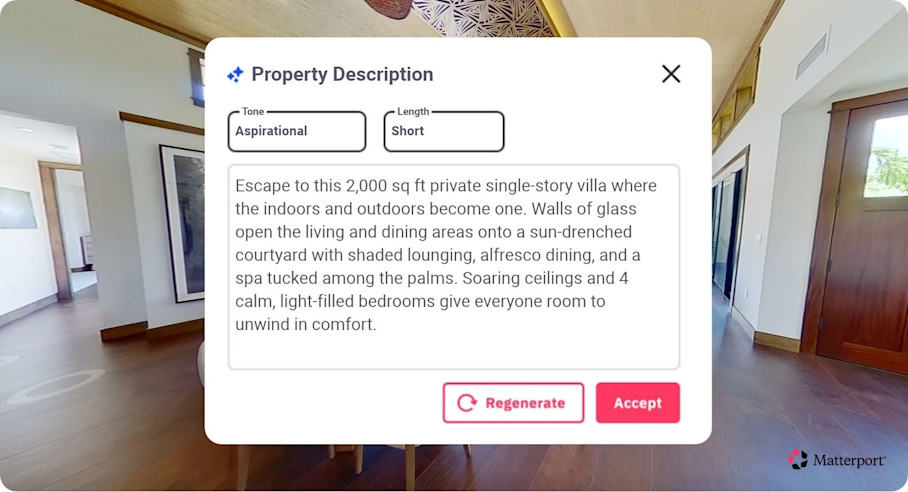
Here's how a headline might change from one season to the next:
Summer version: "Steps From the Sand: Sun-Soaked Beach Escape With Ocean Views"
Off-season rewrite: "Quiet Coastal Base for Remote Work: Fiber WiFi, Dedicated Desk, Cozy Fireplace"
The rewrite names the exact features a remote worker screens for, so the listing reads as built for them.
Highlight off-season-ready features
Once guests are inside the tour, point them to the features that make the slow season worth booking. You can pin a short note to a specific spot in the 3D space using Tags, and emphasize the fireplace, the heated bathroom floors, or the working desk. Properties with a summer off-season can do the same with the AC, a shaded patio, or the pool.
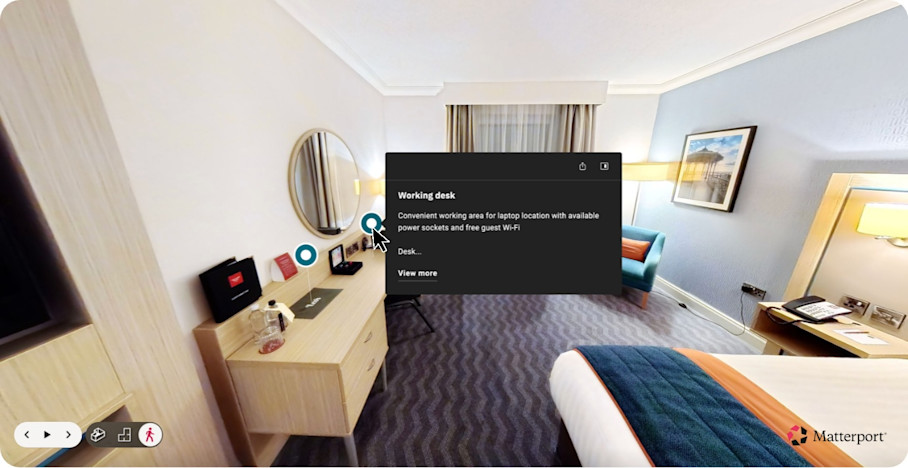
A Guided Tour takes this further by leading guests along a set path through the property, so they see the off-season amenities first instead of missing them. Auto-Tours use AI to suggest Guided Tour highlights automatically, giving you a starting route you can adjust.
For extended-stay guests and remote workers, Defurnish clears the furniture from a room with one click. That helps them judge whether a spare bedroom could become a home office, or whether the living space works for a few months of daily life.
Each of these features gives off-season guests one more reason to book a home they can’t visit in person.
Pricing strategies that protect margin year-round
When a whole market goes quiet at once, most owners cut rates at the same time, but the hard part is knowing how far to go. If your discount is too high, you’re risking leaving money on the table. And if you hold firm, your calendar may stay empty.
A property that shows its value clearly has more room to hold rates. A strong virtual tour that showcases interior comfort gives guests a reason to book beyond the price, so the property competes on what it offers instead of just how cheap it is.
Before setting off-season rates, review four inputs:
Occupancy trends in your submarket
Rates for comparable listings nearby
Your own historical booking pace
The property's monthly operating costs
Use those costs to calculate a break-even nightly floor, so no discount takes the price below what it costs you to host. With that floor in place, these four levers give you room to fill the calendar without racing competitors to the bottom:
Strategy | What it is | Pros | Cons |
|---|---|---|---|
Dynamic pricing | Rates that adjust automatically to demand, seasonality, lead time, and local events | Responds to demand shifts faster than manual pricing, including short-notice event spikes | Needs monitoring; poorly tuned rules can underprice good dates |
Minimum-stay adjustments | Longer minimums in deep off-season, shorter ones for shoulder weekends | Longer minimums cut turnover; shorter ones capture quick trips that would otherwise go to competitors | The wrong setting can block bookings or leave unbookable gaps |
Discounts and value-adds | Early-bird offers, last-minute gap-night deals, midweek rates, or extras like free late checkout, firewood, or local passes | Last-minute deals fill nights that would otherwise earn nothing, and value-adds keep the nightly rate intact | Repeated deep discounts can make the property look like a bargain option |
Weekly and monthly discounts | Reduced rates stays of 7+ and 30+ nights | Fewer turnovers mean lower cleaning and laundry costs, and Airbnb highlights discounts of 10% or more in search results | Lower nightly rate, and it only pays off if you land the long booking |
Weekly and monthly discounts only pay off if you land the long stays they’re designed for. Those guests are most likely to want a full look at the home before committing a month’s rent, and a detailed virtual tour gives them that.
Events, attractions, and local partnerships that generate off-season demand
In the deep off-season, there often isn't enough demand to capture, so owners might want to help create a reason to visit. Partnerships and event-based marketing cost little, and they give the listing fresh content at the same time.
Start by looking at what’s already happening locally. Attractions worth building a calendar around include:
Indoor and culture: Museums, theaters, and markets
Food and drinks: Breweries, tasting rooms, cooking classes, and seasonal food scenes
Wellness and activity: Spas and indoor climbing
Events: Festivals and shoulder-season races
Outdoor seasons: Hunting and fishing seasons, and storm watching on the coast
Professional and academic: Off-peak conferences and university calendars
Map the relevant events onto an off-season calendar and plan your promotions around those dates. Then gather what you’ve found into a dedicated off-season local guide that lives inside the listing, in the welcome book, and inside the virtual tour within Tags.
Next, reach out to the organizers and business owners behind those activities. A partnership can lead to:
Cross-referrals
Placement on their websites or in their newsletters
Bundled packages
Shared social media promotion
To support those promotions with visuals, Matterport can automatically create Teaser Videos from your 3D tour. These clips pull the best views of the property and are ready to share on social media and in email alongside your partner posts.
Make the off-season a season of its own
To increase off-season vacation rental bookings, focus on the guests who already travel when demand drops. Market the property to those segments by giving them reasons to visit your area and stay in your property.
Each segment books around their specific needs. A remote worker looks for a usable desk and fast internet connection, while a relocating family wants a home that works for their daily life. Either way, bookings arrive when guests can confirm the space matches what they’re looking for. Show them the space up front, and the off-season can earn its share of the year’s revenue.
Get started with Matterport for Travel & Hospitality


