


 Sign In
2026 LNG Export Growth: How to Expand Terminals & Midstream Infrastructure Without Losing Control
In December 2025, Energy Transfer suspended development of the Lake Charles LNG project, a proposed 16.5-million-tonne-per-year facility in Louisiana. The company cited a poor risk-return profile and anticipated global oversupply, redirecting capital toward its pipeline infrastructure backlog. The decision underscores a growing reality across the industry: demand alone does not justify a build.
U.S. LNG export capacity now exceeds 19 Bcf/d, with several new trains coming online in 2026 and 2027. In this market, capital discipline is one of the main markers of a viable project. Execution certainty matters as much as offtake agreements.
Here, we’ll explore the operational and strategic challenges shaping LNG project viability in an increasingly competitive market, and provide a practical readiness framework for evaluating whether an announced expansion is actually executable.
The state of LNG growth in 2026
The U.S. LNG buildout continues at scale:
Both Corpus Christi Stage 3 and Golden Pass LNG are actively progressing through their commissioning and final production stages.
Port Arthur LNG Phase 1 and Rio Grande LNG target 2027 startups.
Additional projects are expected to reach final investment decisions in 2026, adding roughly 25 bcm/yr of nameplate capacity to the pipeline.
Yet not every project survives contact with economic reality. Energy Transfer’s Lake Charles LNG project was one of the most-watched in the pipeline. Its suspension, despite continued investment in LNG growth, exposes a gap between announced capacity and executable capacity. Operators face cost overruns on active projects, a tight skilled labor market, rising material costs from tariffs on steel and aluminum, and growing scrutiny on capital allocation. An FID does not guarantee that a project will reach commercial operation on schedule.
The projects most likely to succeed share common traits:
They keep clear documentation of existing conditions. Accurate as-built records let engineering teams design against reality, not assumptions.
They pursue brownfield expansions at existing terminals. Shared utilities, existing permits, and proven infrastructure remove some of the challenges that greenfield projects face.
They maintain strong coordination between owners and EPCs. Aligned scope and sequencing prevent the rework cycles that derail schedules and inflate budgets.
They demonstrate proven safety and turnaround management. Operators with established shutdown procedures can compress outage windows and keep expansion work on track.
These execution fundamentals matter as much as market conditions. In a strong market, they determine which projects capture upside on schedule. In a tight market, they determine which projects survive. When considered in advance, they form a picture of execution readiness: the organizational, operational, and facility-level conditions that support successful project delivery.
From announced growth to buildable capacity: A 4-step LNG execution readiness framework
LNG expansions that fail at the final hurdle can often trace their mistakes back to one of the four operational dimensions mentioned previously: condition accuracy, physical feasibility, stakeholder coordination, and regulatory discipline.
This framework gives operators a structured way to evaluate execution readiness across these dimensions before breaking ground.
1. Existing-condition accuracy
Every expansion starts with a fundamental assumption: the engineering team knows what currently exists at the facility. In practice, that assumption often fails. As-built drawings from original construction may not reflect decades of modifications, retrofits, and temporary installations. P&IDs often fall out of sync. Equipment moves without updated documentation.
The complexity multiplies for LNG terminals. Cryogenic systems, flare networks, loading arms, pipe racks, and control buildings create dense, layered environments where small documentation errors translate into major field conflicts. A pipe support that does not match drawings can delay steel erection by weeks.
The most reliable solution is to verify conditions before detailed design begins. Assumption-based design inputs are now commonly replaced by 3D digital twins that replicate facilities and sites exactly. Point clouds and other dimensionally accurate data can be exported from these models and incorporated into design and engineering workflows.
Capturing that spatial data at scale presents its own challenges for LNG terminals. These facilities are hazardous, complex, and often remote. Operations teams are not always equipped to scan sites themselves. Matterport’s Capture Services provide professional technicians in hundreds of cities globally, equipped to capture complex sites without disrupting live operations.
With a verified spatial baseline in place, engineering teams can move into design with confidence.
2. Physical constraints and operational feasibility
LNG growth rarely happens on fresh ground. Brownfield expansions at existing terminals offer significant cost and schedule advantages due to existing infrastructure. However, they come with physical constraints that greenfield sites do not. New liquefaction trains, storage tanks, and transfer lines must fit within existing site boundaries, connect to active systems, and meet safety codes. Physical bottlenecks that look manageable on a plot plan often prove unworkable when measured against actual field conditions.
Turnaround planning adds another layer of complexity. Every expansion must account for planned shutdowns, tie-in windows, and the operational constraints of a live facility. Misjudging a turnaround window can extend outages and cost millions per day in lost production.
Digital twins help turnaround managers to pre-plan shutdowns and physical work using the actual facility layout. Automated Measurements can be captured directly within the 3D model, without dispatching field crews for preliminary assessments like clearance and equipment spacing verification. This reduces reliance on site visits that cause disruption to active LNG terminals.
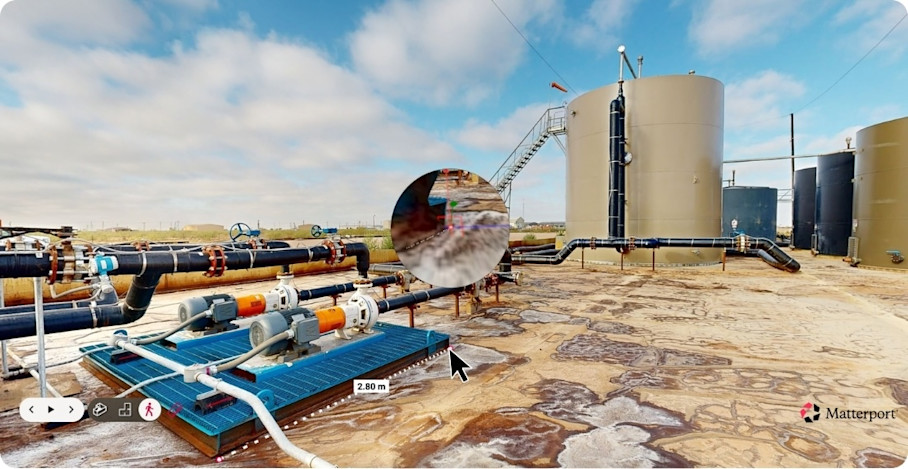
Assessing physical feasibility against real-world conditions is essential to realize the inherent advantages of brownfield expansions.
3. Stakeholder alignment across owners, EPCs, and contractors
LNG expansion projects involve a large number of stakeholders, including asset owners, EPC contractors, specialty subcontractors, regulatory agencies, and operations teams. Each group works from its own set of documents and assumptions. If no single stakeholder has a complete picture, reconciling the gaps during construction is expensive.
Misalignment between an owner's operational priorities and a contractor's construction sequence is one of the most common sources of LNG project delays.
A shared point of reference for all parties reduces friction. Matterport Views of digital twins can be shared to give stakeholders access to the same facility, with information curated to their own workflows. Inside the model, Notes mark specific locations with comments and conversations between different departments, so decisions are recorded in context. This is especially valuable for joint ventures where decision-makers span multiple regions or continents.
When every party can point to the same spatial reference to resolve a scope question, decisions happen faster and with fewer revision cycles.
4. Documentation maturity and regulatory readiness
LNG facilities operate under a dense regulatory framework. When expansion projects begin, regulatory agencies expect operators to demonstrate that new construction integrates safely with existing systems and that all work is compliant. Records scattered across filing cabinets, shared drives, and individual laptops create audit risk and slow permitting.
Digital twins act as a centralized hub that consolidates oil and gas facility documentation into a single, audit-ready record. Operators can use Tags to pin safety data sheets, operating procedures, and inspection records directly to equipment locations within the 3D model. Inspectors can navigate an immersive walkthrough of the site, accessing maintenance history, last inspection dates, and operating parameters without needing to request files from multiple departments. Compliance reviews move faster and permitting timelines shrink with these spatially-organized records in place.
Internal operators also gain the ability to assess regulatory readiness on demand rather than assembling documentation under pressure. Different versions of sites can be archived together and compared in Side-by-Side Spaces to maintain a visual record of evolving infrastructure throughout expansion and maintenance activities.
Together, these four dimensions form a practical test: Is this expansion actually executable? Market conditions shift. But operators that can demonstrate strong execution fundamentals are far better positioned to deliver.
Preparing people and operations for LNG infrastructure expansion
LNG expansion is not purely an engineering challenge. It is a human and operational scaling problem. As terminals grow and throughput increases, pressure mounts on daily operations, shift handoffs, safety protocols, and emergency response plans. These pressures might not show up on a project schedule, but they determine whether an expanded terminal reaches steady-state operations on time.
When operational readiness lags behind construction progress, the same failure points tend to emerge:
Underestimation of change management needs, where the organizational side of expansion receives less investment than the engineering side.
Insufficient workforce capacity for the scale-up phase, where staffing requirements spike before new hires are fully trained.
Inadequate ramp-up training for new systems, leaving crews underprepared for equipment and procedures they haven't operated before.
Loss of operational continuity during transition, as construction disrupts established routines and handoff points.
Misalignment between updated infrastructure and legacy operating practices, where crews default to procedures that no longer reflect the facility layout.
Communication gaps during early operations, when ownership of systems is still transferring between construction and operations teams.
Leadership turnover during long project cycles, which erodes institutional knowledge at critical delivery points.
Addressing these challenges requires deliberate training and knowledge management procedures. Below are tactics that support alignment and operational continuity as expansions go into production.
Failure point | Tactics |
Underestimation of change management | - Budget for organizational readiness with the same rigor applied to engineering deliverables, including scope, timeline, and resourcing. |
Insufficient workforce capacity | - Conduct a staffing gap analysis against the planned expansion scope before construction begins. - Map new system requirements to existing crew competencies early enough to influence hiring and training timelines. |
Inadequate ramp-up training | - Build training programs around the expansion scope before new systems go live. - Use digital twins to create Guided Tours that facilitate site-specific familiarity with equipment and layouts before they operate them for the first time. |
Loss of operational continuity | - Document established routines, access routes, and handoff points before construction disrupts them. - Maintain an accurate digital twin with linked documentation to replace mental maps. |
Misalignment between updated infrastructure and legacy practices | - Update operating procedures in parallel with construction progress. - Compare previous and current digital twin scans as a reference for what has changed on site. |
Communication gaps during early operations | - Establish clear system ownership protocols before handover begins. - Share access to a digital twin as a common reference point during the transition period. |
Leadership turnover during long project cycles | - Use Tags to capture anecdotal facility knowledge in a format that transfers easily to incoming leaders. |
Treating workforce readiness as a parallel workstream, not a post-construction task, helps expanded terminals reach steady-state operations faster and with fewer early-operations incidents.
Turn LNG expansion plans into operational reality
U.S. LNG export growth depends on more than market conditions and offtake agreements. It depends on whether operators can answer four fundamental questions before committing capital:
Do the teams have an accurate picture of what exists at the facility today?
Have physical constraints been validated against actual field conditions?
Are all stakeholders aligned on scope, sequence, and operational constraints?
Is the documentation mature enough to support regulatory review and commissioning?
Digital twins give operators a practical tool for answering each of these questions. They reduce the gap between what teams assume about a facility and what actually exists. For midstream infrastructure and LNG terminal expansions, that visibility translates directly into fewer change orders and more predictable capital outcomes.
The same digital twin continues to serve as the operational baseline for ongoing maintenance, future turnarounds, and workforce training after restart. Integration with asset management systems connects spatial data to work orders, inspection schedules, and compliance records. This creates a single operational thread from expansion planning through steady-state operations.
The LNG export growth projects that finish are the ones planned for execution, not just approval.
Explore Matterport for Oil & Gas teams

