


 Sign In
How to Standardize Operations Across Multi-Site Assisted Living Portfolios
Managing a single senior living facility is already a complex enough operation. Add more buildings, more residents, and more distributed services into the mix, and the administrative burden can be overwhelming. The margin for error shrinks while the number of people depending on you grows.
Most multi-site operators have SOPs, maintenance schedules, and compliance checklists, but each community develops its own rhythm, its own workarounds, its own version of "how we do things here." What should be a unified portfolio can quickly fragment into a collection of independent operations, each interpreting standards differently.
Here, we’ll examine common challenges in multi-site assisted living operations and outline four practical strategies that improve visibility, helping facility management leaders standardize and scale quality care delivery without living on the road.
Common operational challenges across multi-site assisted living networks
While it may feel like a failure of leadership or staff competence, operational drift is almost inevitable when managing multiple assisted living communities. It's the natural consequence of managing physical spaces you can't constantly monitor. Facilities that are spread across different cities, states, or time zones will inevitably see small variations compound quickly.
The first objective leaders must accomplish is to understand the specific pressure points that break down consistency. The following challenges represent the most common points of friction that prevent multi-site assisted living portfolios from operating as a controlled system:
Inconsistent standards and documentation across communities
Every assisted living community in your portfolio probably started with the same corporate standards. But over time, each location develops its own informal processes that feel more practical than the official playbook. When you need to compare properties or enforce standards, you're forced to reconcile incompatible information systems.
Limited real-time visibility into facility conditions
Most regional leaders manage their portfolios through a combination of periodic site visits, emailed photos, and verbal reports from on-site staff. These methods are often incomplete or outdated. This visibility gap forces reactive decision-making and you're constantly playing catch-up, addressing problems that could have been prevented with earlier visibility.
Communication silos between HQ, regional, and on-site teams
Information flow breaks down across multi-site portfolios because it travels through a lengthy chain of stakeholders: from HQ-issued directives, to regional managers who translate them into field-level guidance, and on-site administrators who interpret based on their property's specific context. By the time the message gets to the end, it has been altered.
Compliance complexity across locations and jurisdictions
Assisted living regulations vary significantly by state and sometimes by county. Maintaining consistent audit readiness across these varying requirements demands tracking multiple regulatory frameworks simultaneously. Meanwhile, a single compliance gap at one property can create risk for your entire portfolio and reputation damage will quickly spread beyond the specific location where problems occurred.
The common thread across these challenges is that leadership and teams at different locations work from fragmented, outdated, or inconsistent facility information. If there isn’t a shared understanding of each property’s condition and operational procedures, every standardization effort is built on unstable ground.
4 strategies for standardizing multi-site assisted living operations
Standardizing operations across multi-site assisted living facilities requires infrastructure that makes consistency easy. Systems should naturally guide teams toward uniform practices rather than requiring constant enforcement.
The following strategies work together to create that infrastructure. They combine process consistency with shared documentation and feedback mechanisms that function reliably across every community in your portfolio.
1. Standardize documentation for every assisted living facility
Every community should maintain the same baseline of facility documentation. This includes comprehensive records of:
Floor plans
Room-level data
Accurate measurements
Assets and mechanical systems
Existing conditions
These should all be captured in formats that allow for direct comparison across properties. Without a strong baseline, you're asking teams to follow the same procedures while looking at completely different information about their facilities.
Most portfolios struggle because documentation traditionally exists in formats that are scattered across multiple systems. One property might have PDFs of floor plans from the original construction, while another holds photos organized by date in someone's email. These fragments can't be reconciled into a coherent view of your portfolio, and they certainly can't support standardized operations.
Digital documentation methods are a more efficient way to organize facility records, especially when paired with visual resources that help provide spatial context. Immersive models like digital twins have become a common solution for improved facility management and operational efficiency. 3D scans produce navigable digital environments that serve as a consistent record of each community space and a hub for centralized documentation at the same time.
With an up-to-date digital twin of each assisted living facility, all leaders and operators share a foundational understanding of the space. This eliminates the interpretation gaps that undermine standardization efforts.
Digital twins are easy to produce at scale, requiring minimal technical expertise to capture scans. For very large-scale communities, Matterport’s Capture Services are available to systematically and consistently document entire portfolios. This ensures that SOP alignment is built on uniform data from the start. Whether you're integrating a newly acquired property or updating records for a legacy facility, the capture process follows the same standards, producing comparable documentation for every space.
Schematic floor plans can be generated automatically from digital twins to deliver dimensionally accurate space planning tools without requiring separate site visits or manual measurement. If you're integrating acquisitions or working with older assisted living facilities that have inconsistent or missing drawings, you can ensure every property is documented to the same standard, regardless of its history.
2. Centralize SOPs and operational playbooks
Standard Operating Procedures (SOPs) are useful assets, governing everything from maintenance protocols to safety procedures, resident care standards to vendor coordination. But documentation alone doesn't drive consistency. Your SOPs should exist as a single set of accessible procedures, so teams actually use them in daily operations rather than letting them gather dust in shared drives or training manuals.
SOPs become significantly more effective when they're anchored in real facility context. Generic instructions like "inspect mechanical room monthly" leave too much room for interpretation. The following questions also need to be answered:
What and how exactly should staff inspect assets?
Where are the critical systems located?
What does normal operation look like versus early warning signs?
By using cloud-hosted, remotely accessible platforms like digital twins to centralize building data, you can link SOPs directly to real spaces. Tags can be pinned to exact locations and assets, with procedural documents, instruction manuals, service history, maintenance checklists, and even informational videos included in attachments. Procedures that are connected to specific spaces and systems are easier to interpret correctly, regardless of a staff member’s location or experience level.
Centralized version control becomes critical as your portfolio evolves. When there are regulatory changes, acquisitions, or renovations, those updates need to reflect consistently across all communities. Matterport’s digital twins are time-stamped and consistently archived, creating a centralized system that every team member, from on-site to headquarters, can access and update easily.
3. Conduct audits and QA programs remotely
Compliance requirements and inspection processes vary across jurisdictions, but leaders still need to implement a standardized audit framework across all communities. This ensures consistent evaluation for every facility.
Audit quality is significantly improved when using an accurate visual model. Facility condition assessments that include time-stamped, evidence-based records rather than written reports alone are far more defensible and easier to action.
Digital twins document resident areas, mechanical systems, and safety-critical infrastructure in sufficient detail to support thorough audits. This is particularly valuable for routine inspections that don't require hands-on testing but do need visual verification of conditions. Instead of physically visiting properties, auditors can conduct reviews remotely in immersive 3D walkthroughs and use Automated Measuring tools to verify dimensions, clearances, and spatial compliance.
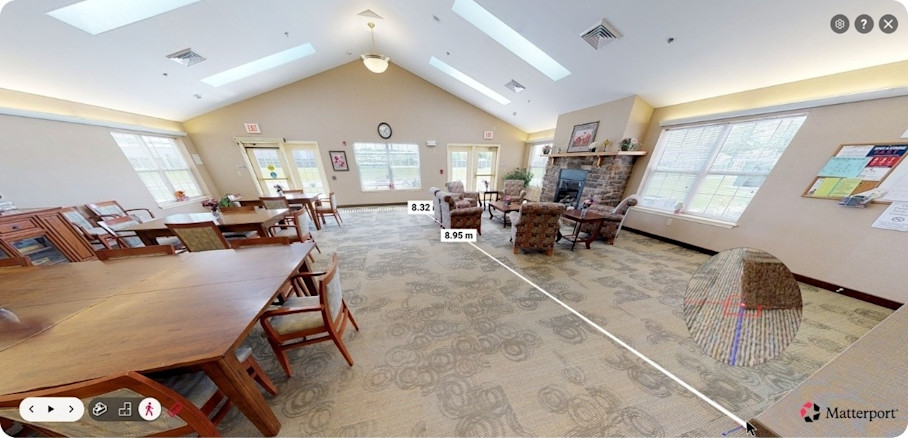
Notes provide a standardized method for flagging, discussing, and tracking issues directly within each digital twin. Instead of audit findings scattered across email threads and separate tracking systems, all observations tie to specific rooms or assets in a centralized platform. When maintenance teams address flagged issues, the resolution documentation lives in the same spatial context where the problem was identified.
Integrations with CMMS platforms connect digital twin context with work orders, maintenance schedules, and asset tracking. Portfolio-scale maintenance coordination is easier to oversee, with corporate leadership able to monitor compliance and completion rates across all properties from a unified dashboard.
The remote QA workflow cuts unnecessary site visits and contributes to better preventive maintenance initiatives, enabling more frequent inspections that catch problems earlier. Operational burden and disruption are also reduced. This is especially impactful in active care environments, where residents often rely on stability and routine.
4. Enable feedback loops and performance reporting
Standardization requires a closed-loop system to connect site execution, centralized reporting, and leadership feedback. Implement mechanisms that let corporate leadership see what’s actually happening at each property, compare operational performance across communities, and provide guidance that reaches on-site teams in actionable formats. Otherwise, standardization efforts are just one-way mandates that don't adapt to operational reality.
The key is to ensure all communities are evaluated consistently. Performance data can be anchored in a digital twin of each facility, so comparisons are meaningful. Rather than attempting to reconcile reports that describe different properties in different formats, leaders can see multiple sites documented the same way across the portfolio.
Consistent documentation improves cross-site comparison, trend identification, and operational benchmarking. You can:
Identify which communities excel at specific aspects of operations and investigate what they're doing differently.
Spot emerging maintenance patterns that suggest equipment across multiple properties will need attention soon.
Allocate resources based on actual facility conditions rather than whoever makes the most compelling verbal case for investment.
Maintaining a versioned visual record of each facility over time supports compliance, safety audits, insurance claims, and incident investigations. When questions arise about facility conditions at a specific point in time, side-by-side comparisons of the same space over time provide objective documentation. Historical records are especially important for multi-site operators managing consistent reporting standards across jurisdictions where regulatory expectations vary, but documentation must remain uniform.
Make standardized operations a care quality advantage
The cumulative effect of standardizing operational documentation, oversight, and communication across a multi-site assisted living portfolio extends beyond process improvement. Operational gains translate directly into measurable business advantages that improve the care environment you provide to residents and strengthen your competitive position.
Reducing travel dependency through remote visibility tools shortens decision timelines significantly. When regional leaders can assess facility conditions, scope vendor projects, and approve capital investments without scheduling site visits, projects move from proposal to execution in days rather than weeks. This velocity frees leadership to focus on strategic priorities like improving care protocols, developing staff, and expanding services, instead of spending half their time managing logistics and travel schedules.
A shared visual source of truth accelerates collaboration across your entire organization. When headquarters, regional teams, on-site staff, and external vendors all work from the same accurate facility data, approvals accelerate, miscommunication decreases, and project timelines compress. A renovation that previously required multiple site visits and endless back-and-forth clarifications now moves forward with everyone aligned from the first conversation.
Consistent facility documentation across your portfolio enables smarter, data-informed capital allocation. Instead of relying on subjective assessments or whoever makes the most urgent case, you can compare actual conditions across communities and direct investment where it will have the greatest impact on quality and compliance. This disciplined approach to capital planning for assisted living protects both resident care quality and your financial performance.
Deliver better Assisted Living experiences with Matterport