

 Sign In
Knowledge Management in the Oil & Gas Industry: How to Capture & Preserve Field Expertise
Every offshore platform, refinery, and pipeline corridor depends on two foundational elements: resilient physical infrastructure and the hard-won knowledge of the people who operate it. When experienced workers move on or retire, they take with them years of judgment calls, failure-mode awareness, and undocumented workarounds. This knowledge prevents incidents, optimizes processes, and keeps facilities running. It can't be easily replaced.
Nearly 50% of the workforce in the oil and gas industry is expected to retire within the next decade, adding to an estimated 231,000 years of knowledge already lost. Without proper strategies put in place to preserve their field expertise, this could constitute an institutional knowledge crisis.
This guide explores where traditional knowledge management in the oil and gas industry falls short, and explains how to build an effective program for capturing expertise, tie it to physical facility context, and transfer it across distributed operations.
The cost of knowledge loss in oil and gas
Oil and gas operations carry a risk profile that makes knowledge loss uniquely dangerous. A misidentified valve, a forgotten isolation point, or an undocumented equipment modification can lead to catastrophic outcomes.
Particular operational characteristics amplify these risks:
Safety-critical operating environments: Hazardous materials, high pressures, and complex equipment mean that even small mistakes can have severe safety consequences. Losing procedural knowledge can directly increase the likelihood of safety incidents.
High cost of unplanned downtime: Equipment failures or production disruptions carry steep financial and operational penalties. Lack of field insights, such as missing troubleshooting procedures or historical lessons learned, amplifies downtime risk and makes recovery slower and more expensive.
Complex multi-site asset portfolios: Upstream, midstream, and downstream operations span vast geographies. Distributed operations increase the likelihood that critical knowledge is fragmented or siloed. Without standardized procedures or centralized knowledge, inconsistencies between sites lead to errors, inefficiencies, and operational delays.
Heavy reliance on contractors and rotating personnel: Frequent personnel changes and reliance on temporary or specialized workers make operational knowledge particularly transient. When expertise leaves with staff, gaps in understanding can propagate quickly across teams.
Because of these factors, oil and gas organizations are particularly vulnerable to the consequences of knowledge loss. This drives a cascade of negative outcomes:
Increased rework where teams solve the same problems repeatedly without access to previous solutions.
Repeated incidents because lessons from past near-misses or failures aren't captured and shared.
Slower decision-making by teams who have no expertise to draw on, delaying critical calls or leading to unnecessary escalations.
Extended onboarding cycles where new hires take longer to reach competency without structured knowledge transfer.
Inflated maintenance costs with inefficient maintenance practices caused by lost troubleshooting knowledge, undocumented repair procedures, and missing historical records.
Risks to worker safety with incidents traced to procedural errors and knowledge gaps.
Compliance gaps that can’t meet increasing regulator expectations for documented, auditable operational knowledge.
In such environments, knowledge is a critical safeguard of operational efficiency in the oil and gas industry. Yet despite its importance, many oil and gas organizations struggle to capture and preserve it effectively.
Common reasons knowledge management programs fail
Most oil and gas companies recognize the importance of knowledge management, but still follow predictable patterns that don’t sufficiently address the root cause of knowledge loss. Most knowledge management programs fail because of structural design choices that prevent captured knowledge from being effectively distributed and used.
Here are the patterns that repeat across the industry:
Knowledge is captured but not tied to physical context: SOPs and procedures exist in a file system, but workers can't relate them to the actual piece of equipment, valve, or area they apply to. This creates a mental gap between oil and gas documentation and reality.
Information is scattered across disconnected systems: Critical knowledge lives in a DMS, shared drives, email threads, personal notebooks, and individual expertise, with no unified point of access.
Tacit knowledge is ignored: Companies have traditional ways of transferring knowledge, like portals, lessons learned databases, and communities of practice. But these methods focus on long-term knowledge transfer. There is a lack of retention focused on anecdotal knowledge of departing employees. Informal judgment calls and informal checks that experienced operators rely on daily rarely make it into any system.
Knowledge is captured once and never updated: A procedure written during commissioning decades ago may bear little resemblance to how the facility actually operates today. Many companies focus on present requirements, so documentation grows stale after turnarounds, modifications, or operational changes.
Tools sit outside daily workflows: Employees may consider new techniques as time-consuming, cumbersome, and harder to use than simply asking a colleague or using a system workaround. If knowledge tools aren't embedded in the way people already work, adoption collapses.
These failures explain why knowledge retention activities tend to be inconsistent in the majority of oil and gas companies, even among firms that recognize the problem.
How to build a knowledge management system that preserves expertise
The common thread in those failure modes is disconnection. Knowledge gets separated from the physical world it describes, scattered across tools no one uses daily, and frozen in time. Solving this requires a fundamentally different approach.
Instead of treating knowledge capture as a file cabinet or database, organizations should approach it as a living visual repository. Digital twins provide a powerful foundation for this approach. These navigable, photorealistic 3D models replicate real-world facilities in a virtual environment, allowing operational knowledge to be embedded directly within the spaces where work actually occurs. SOPs, safety procedures, annotations, and expert guidance can be anchored to the exact equipment, locations, and assets they reference. Instead of searching a file tree or asking around, workers can easily locate everything they need in a centralized, contextual hub.
The following steps outline how to build an effective, actionable oil and gas industry knowledge repository that can be used in the field and truly preserves expertise.
1. Capture and codify knowledge in context
The first step in building a durable knowledge base is defining what to capture. In oil and gas environments, this typically includes:
Standard operating procedures (SOPs) and checklists
Lessons learned and after-action reviews
Emergency procedures and muster plans
Equipment histories and failure mode documentation
Playbooks for refinery turnaround planning, startup, and shutdown sequences
Not all knowledge is equally easy to capture.
Explicit knowledge, like written procedures, P&IDs, and equipment datasheets, is relatively straightforward to capture and transfer. These documents are essential but often insufficient alone.
Tacit knowledge is experiential expertise. It includes failure-mode awareness honed over decades, site-specific operating quirks, and workarounds that keep aging equipment running. This knowledge is harder to capture because much of it is anecdotal and lives in the heads of workers.
Both types matter. Explicit knowledge tells you what to do. Tacit knowledge tells you what to watch for.
Tacit knowledge capture can seem hard to track or internalize because much of it is transient, existing in instinct, experience, and subtle judgment. However, there are some structured methods that make tacit knowledge capture more observable and quantifiable. For example:
SME interviews tied to specific assets: Walk an experienced operator through the facility and record what they point out at each piece of equipment.
Critical-task debriefs: After a complex or non-routine job, document the decision logic while it's still fresh.
Job-shadow-to-walkthrough sessions: Pair a newer employee with a veteran, then have the veteran narrate their thinking at each step.
Short video recordings at the point of work: A two-minute video of an experienced operator explaining why they check a particular drain valve before startup captures context that a written checklist never will.
Matterport digital twins give these captured insights a permanent home. Teams can use anchored Tags inside the 3D model to attach both explicit and tacit knowledge directly to precise locations: an isolation procedure gets pinned to the actual isolation valve, a troubleshooting guide attaches to the pump it references, and emergency shutdown instructions appear at the shutdown station.
Knowledge is never separated from the physical context it applies to. When a technician navigates to a piece of equipment in the digital twin, all relevant information appears right there.
2. Transfer knowledge across sites with shared facility views
Captured knowledge has no value if it stays locked on one person's hard drive or in one site's filing cabinet. It must flow between shifts, disciplines, and geographically distributed sites to remain effective.
Here are some practical transfer mechanisms to implement:
Standardized shift handovers: Structured templates ensure outgoing crews brief incoming teams on active issues, deferred tasks, abnormal conditions, and operational context before the next shift begins.
Distributing lessons learned across facilities: A governed process to package insights from incidents, maintenance events, or operational improvements at one facility and distribute them to other relevant sites.
Digital repositories with controlled access: Cloud-hosted knowledge systems provide employees and contractors with role-appropriate visibility into documentation, ensuring critical information is accessible without compromising governance.
Matterport’s cloud-hosted digital twins remove the geographic barriers that traditionally limit access to facility knowledge. Remote collaboration capabilities enhance the operability of the digital twin across sites. Notes with @mentions and comments pinned to specific locations centralize operational discussions within the spatial context where decisions happen.
Organizations can also build step-by-step Guided Tours that familiarize new employees or contractors with equipment layouts, safety zones, and emergency routes before they set foot on-site. This compresses onboarding timelines and reduces the risk of disorientation.
Transfer isn't one-directional. Field teams generate insights every day: a better valve alignment sequence, a faster way to verify a lineup, a near-miss that reveals a gap in the procedure. Field tags can be created during scans, in the Matterport Cloud, or from mobile devices so that these observations flow back to engineering and planning functions immediately.
This is especially beneficial for remote or hard-to-access sites, such as offshore platforms, pipelines, or isolated processing facilities. With operational knowledge accessible virtually, teams can make critical decisions without the cost and safety risks associated with frequent on-site visits.
3. Enable in-field knowledge retrieval with a searchable facility model
The best knowledge repository is useless if people can't find what they need when they need it. Modern knowledge management systems must support real-time retrieval in field environments, not just office settings.
Regulators also want to see evidence that knowledge exists not just as a policy manual on a shelf, but that the right information reaches the right people at the right time. Accessibility often determines whether a job gets done safely or not.
The following capabilities represent the foundational requirements that any effective knowledge management system must meet to ensure critical information is accessible:
Searchable repositories: Users should be able to search by equipment tag, location, procedure type, or keyword and get relevant results instantly.
Enterprise search across silos: Breaking down information barriers between CMMS, EAM, document management, learning management, permit-to-work, and incident management systems.
Role-based access controls: Ensuring sensitive information reaches authorized users while maintaining security.
Mobile and field-friendly usability: Technicians need access on tablets and smartphones, not just desktop computers.
Integration with existing systems: Knowledge management can't be another silo—it must connect to the tools teams already use.
Matterport’s Space Search helps users to locate keywords across Tags, labels, Notes, measurements, and attachments within a model. Instead of navigating a folder structure, a technician can search for "PSV-2401" and land directly on the relief valve, with every associated SOP and inspection record attached. This reduces time spent hunting for information and puts context front and center.
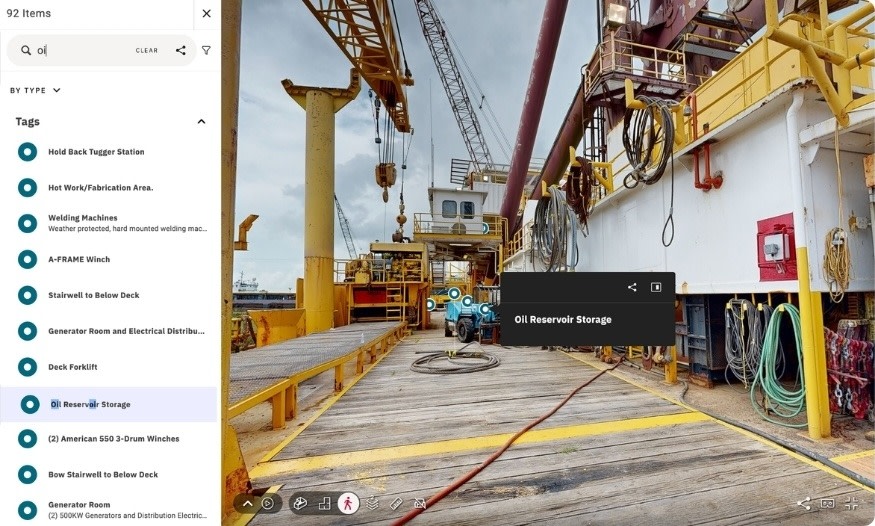
Integrations connect insights to project management tools, including CMMS, DMS, and EAM. Teams can also export point clouds, schematic floor plans, and BIM files to support engineering analysis, maintenance planning, and project design. This allows spatial knowledge to flow into existing workflows rather than creating another silo.
4. Protect compliance with regular, controlled updates
Knowledge management isn't a one-time project. Facilities change, equipment gets replaced, and incidents reveal new failure modes and regulations evolve. A governance layer is required to prevent any knowledge bases from drifting out of alignment with reality.
Effective governance includes:
Version control on all documents and procedures
Ownership models that define who updates what, when, and how changes are validated
Approval workflows that route updates through appropriate review before publication
Formal processes for retiring outdated content so users aren't misled by obsolete information
Security and enterprise readiness matter too. Secure access, audit trails, and risk management controls protect sensitive operational data and are critical for regulatory compliance. Matterport's secure sharing with custom, role-based permissions supports controlled access across internal teams, contractors, and external stakeholders. Organizations can create different views of the same model, showing only the information each audience needs to see.
Knowledge management systems also need a continuous feedback loop. New lessons, incidents, and operational changes should feed back into the repository on a regular cadence.
Digital twins support this cycle through change tracking. Re-scan a facility after turnarounds, equipment upgrades, significant modifications, and reportable events to create a visual change record for lifecycle documentation. Time-stamped scans show exactly what the facility looked like at different points in time. This provides audit-ready traceability for compliance purposes.
Best practices to make field knowledge last
Building a knowledge management system is one thing. Sustaining it across workforce transitions, price cycles, and organizational changes is another. These best practices help oil and gas teams create knowledge management programs that deliver lasting results:
Map critical knowledge and prioritize high-risk areas first: Not every piece of information carries the same weight. Start with the knowledge that, if lost, would create the greatest safety or operational risk. This might be a retirement-eligible operator's expertise on a complex unit, or a facility where contractor turnover is highest.
Build a culture of knowledge contribution: Prioritizing people is essential to the success of knowledge management initiatives. Recognize and reward employees who document their expertise. Make knowledge sharing part of performance expectations, not an optional add-on.
Keep knowledge current through structured update processes: Tie content reviews to operational triggers: every turnaround, every Management of Change, every significant incident. Assign content owners for every critical procedure and hold them accountable for periodic reviews.
Embed knowledge into daily work execution: The most sophisticated knowledge management platform in the world will fail if it doesn't account for how knowledge actually flows in complex operational environments. Embed knowledge inside the tools people already use—at the point of work, in context, and on the devices they carry.
The most resilient programs anchor knowledge to the real environment. When an operator can walk through their facility and find every SOP, lesson learned, and equipment history pinned to the exact location it applies to, knowledge stops being an abstract asset. It becomes a practical tool they use every day.
Matterport’s digital twins provide a spatial foundation for effective oil and gas knowledge management, helping teams to:
Protect institutional knowledge
Accelerate oil and gas industry training and onboarding
Improve safety
Maintain operational continuity as the workforce transitions