


 Sign In
Power Grid Optimization: Bridging Smart Technologies with Real Operations
The forces converging on the electric grid have never been this intense. Distributed energy resources, shifting generation patterns, aging infrastructure, and stricter regulatory timelines are forcing utilities to rethink how they operate.
Investment in electricity infrastructure is projected to reach $1.4 trillion by 2030, double the amount invested in the prior 10 years. But even with billions flowing into power grid optimization, too many field teams lack visibility into the physical infrastructure these investments target. Optimization technologies can model ideal dispatch, forecast demand, and predict failures. But without a clear view of real-world conditions, those insights remain theoretical.
This article explores the technologies driving grid optimization and outlines a practical framework for connecting digital insights with the physical grid.
Modern technologies that serve power grid optimization
Power grid optimization serves a consistent set of operational and business goals across generation, transmission, and distribution. It aims to improve:
Reliability: Ensuring power is delivered consistently without interruptions, even during routine fluctuations in demand or equipment performance.
Resilience: The ability of the grid to withstand and quickly recover from disruptions such as extreme weather, cyber incidents, or equipment failures.
Stability: Maintaining balanced voltage and frequency so the system operates smoothly despite variable generation and changing loads.
Efficiency: Optimizing generation, transmission, and distribution to reduce energy losses and make better use of existing infrastructure.
Cost control: Minimizing capital and operational expenses by prioritizing investments, reducing downtime, and improving asset utilization.
Several types of technology form the foundation of a modern optimization strategy, each addressing a different dimension of the problem.
Technology | Optimization Role |
|---|---|
Sensors & IoT | Smart meters, phasor measurement units, and IoT devices capture real-time data on voltage, frequency, load, power quality, and asset health. This enables continuous monitoring and early fault detection. |
AI/ML, Advanced Analytics & Forecasting | Process sensor data to predict load, forecast renewable generation, identify equipment failures before they occur, and recommend operational adjustments. This supports both short-term dispatch and long-term planning decisions. |
DERMS (Distributed Energy Resource Management Systems) | Orchestrates distributed resources like rooftop solar, battery storage, EV chargers, and demand response programs to balance local supply and demand while maintaining grid stability. |
Automation | Enables faster response to grid events through substation automation, fault location isolation and service restoration (FLISR), and automated switching. This reduces outage duration and improves reliability metrics. |
Energy Storage Coordination | Optimize battery dispatch for peak shaving, frequency regulation, and renewable firming. This shifts energy across time to match supply with demand and provide grid services. |
Digital Twins | Photorealistic, dimensionally accurate 3D models of substations, control rooms, and storage sites provide visual context for planning, training, and stakeholder coordination. This bridges the gap between digital intelligence and physical infrastructure. |
These technologies support both planning and real-time optimization, both of which are necessary for an effective program.
Planning optimization refers to longer-horizon analysis used for capacity planning, capital investment prioritization, and network expansion modeling.
Real-time optimization refers to decision-making at the second-to-minute level that adjusts dispatch, switching, and load balancing based on live conditions.
Both layers depend on overlapping but distinct data sets. Planning models need historical trends, equipment ratings, and demographic projections. Real-time systems need live telemetry, weather feeds, and current switching states.
Their outputs must be coordinated to avoid conflicting actions. A long-term plan that assumes certain equipment will be available means nothing if real-time dispatch can't access it safely.
Common barriers between grid optimization models and field execution
The best optimization model can easily fail when its outputs aren’t translated cleanly into action on the ground. The most common barriers between conceptual grid optimization models and actual execution in the field include:
Data quality and completeness: Missing sensor readings, outdated asset records, and inconsistent naming conventions introduce errors that propagate through every model they feed.
System interoperability: SCADA, ADMS, GIS, DERMS, and asset management platforms often run on different data standards. Getting them to exchange information reliably remains a persistent integration challenge.
Computational complexity: Real-time optimization across large networks requires enormous processing power and careful algorithm design to deliver results within operationally useful timeframes.
Scalability across service territories: What works for a single feeder pilot rarely scales cleanly to an entire service territory without significant re-engineering.
Safety requirements: Optimization outputs that involve switching or reconfiguration must comply with safety protocols that add decision layers and time.
Regulatory constraints: Tariff structures, interconnection rules, and operating standards can prevent utilities from acting on technically sound optimization recommendations.
Lack of trust in model outputs: Field crews and control room operators won't act on recommendations from systems whose logic they can't verify against what they see on site.
Operational disconnects grow especially bad when optimization algorithms lack awareness of physical site conditions. A model might recommend dispatching a battery asset or reconfiguring a substation bus, but the following site-level constraints can override those outputs entirely:
Equipment clearance limitations that prevent safe maintenance access.
Cable routing restrictions due to existing conduit paths or structural obstacles.
Switching access paths blocked by equipment or layout constraints.
Crew staging requirements for safe work zones during energized operations.
Sensor placement feasibility based on physical mounting locations and exposure.
Intelligent models are useful tools, but when field reality contradicts their outputs, the models lose value. Making sure that teams can validate and act on decisions within real physical environments is vital.
How to connect data, intelligence, and operations: A 3-layer technology framework for power grid optimization
Optimization technologies can be organized into three layers that work together:
The data layer (sensors and telemetry) generates the raw information.
The intelligence layer (analytics and forecasting) turns that data into insight.
The orchestration layer (DERMS, automation, and storage coordination) acts on those insights to control grid assets.
Investment in all three layers is essential for a systematic and sustainable approach. Sensors without analytics produce noise. Analytics without orchestration produce reports that sit on shelves. Orchestration without good data produces bad decisions faster.
Digital twins serve as a visual infrastructure foundation that supports every layer. These navigable models give planners, engineers, and field crews a shared, spatially accurate reference of real-world conditions, helping to bridge the gap between what optimization systems recommend and what's actually feasible on site.
Let’s look at how to set up and connect each layer for coordinated field action.
1. The data layer: Sensors and telemetry
Sensor networks, smart meters, phasor measurement units, and IoT devices form the nervous system of a modernized grid. They generate real-time data that feeds every optimization function upstream.
Key optimization data types these systems produce include:
Voltage and frequency readings across feeders and substations
Load profiles at the transformer, feeder, and substation level
Weather conditions, including temperature, wind speed, and solar irradiance
Asset health indicators like dissolved gas analysis for transformers, thermal readings, and vibration patterns
Power quality metrics, including harmonics, sags, and swells
Data quality, sensor density, and asset-level detail are all critical for effective optimization. The U.S. grid operates on more than 240,000 high-voltage transmission lines and 50 million transformers. About 70% of transformers have been in service for 25 years or more, and many were installed before modern monitoring standards existed. As a result, sensors may be missing, unevenly distributed, or added incrementally over time without consistent documentation.
Gaps or inconsistencies in sensor data are a common source of suboptimal performance, leading to conservative dispatch decisions, missed early-warning signals, and inefficient asset utilization. A missing thermal sensor on an aging transformer means the predictive model can't flag an impending failure.
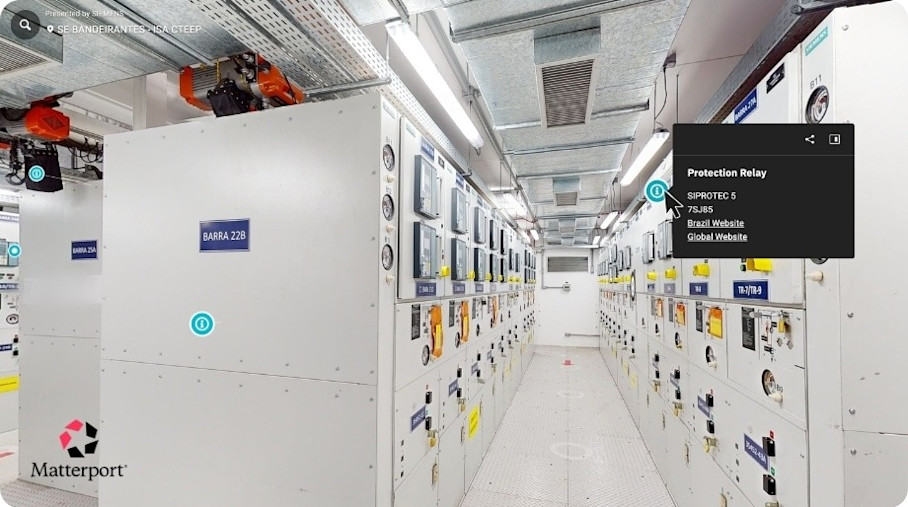
Digital twins help document and visualize these assets in their actual physical context. High-fidelity 3D models of substations, storage sites, and control rooms allow optimization planners and engineers to see the physical environment surrounding sensors and telemetry devices without traveling to the site. They can easily see where monitoring coverage is incomplete and prioritize instrumentation upgrades.
Embedding Tags and Notes in a model to flag key locations and attach additional context helps record sensors, equipment, installation dates, and asset conditions. This creates a single reference for both physical infrastructure and sensor metadata. Virtual walkthroughs help engineers verify sensor placement and connectivity before deployment, reducing site errors and unnecessary travel.
2. The intelligence layer: Analytics and forecasting
AI and machine learning are changing how utilities approach load forecasting, generation, and maintenance.
Core optimization use cases at this layer include:
Dispatch optimization: Determining which generation and storage resources to commit, and when, to minimize cost while meeting reliability targets.
Network reconfiguration: Identifying the switching configuration that minimizes losses or relieves congestion on constrained feeders.
Topology optimization: Analyzing the network structure to find more efficient operating configurations.
Real-time operational decision-making: Providing control room operators with actionable recommendations based on live grid conditions.
AI/ML is also used in the data layer for monitoring purposes. The distinction between that and predictive models is important. Monitoring spots anomalies after they develop, such as voltage deviations, unexpected load spikes, or equipment operating outside normal thresholds. These are useful insights that support rapid response but still rely on reactive intervention. They are closer to the informative data layer.
Predictive models, by contrast, analyze historical trends, environmental factors, and asset behavior to identify failure signatures in advance. AI-enabled software can now analyze vast amounts of sensor data collected throughout the grid, and from smart meters, sensors, and weather forecasts. Based on this, it can create a predictive model that forecasts wear and tear over time, and even recommends when to repair or replace parts before problems occur. This shifts grid optimization from responding to problems to predictive maintenance that mitigates risks and prevents unplanned outage.
The same principle applies to renewable variability. Monitoring might detect a sudden drop in solar output once cloud cover moves in. A predictive model, however, uses weather forecasts, historical irradiance patterns, and load projections to anticipate that drop hours in advance. Instead of simply reacting to falling generation, a predictive system could proactively schedule storage resources or adjust dispatch plans ahead of time.
Digital twins help teams to visualize analytics outputs in the context of actual infrastructure. A planner reviewing forecasted DER dispatch can see how outputs map to the real substation layout: where equipment sits, how access paths route, and whether planned changes physically fit.
Using the digital twin as a spatial foundation, teams can use APIs and integrations to layer sensor data on top of an accurate model or synchronize with simulation platforms to imitate operational scenarios virtually. This helps to assess how forecasted load shifts or renewable variability might impact real equipment and site access. Automated Measuring inside digital twins supports precise, remote validation of infrastructure changes suggested by analytics, reducing risk during execution.
3. The orchestration layer: DERMS, automation, and storage coordination
Utilities orchestrate distributed energy resources (DERs) and grid operations using multiple interdependent tools:
Distributed Energy Resource Management Systems (DERMS) enable utilities to monitor DER performance, forecast generation and load, and dispatch resources in response to grid conditions. This is especially important for managing variability and maintaining resilience during peak demand or for outage planning. These platforms orchestrate distributed resources like rooftop solar, battery storage, EV chargers, and demand response programs, treating them as coordinated grid assets rather than uncontrolled variables.
Substation automation, FLISR, and automated switching enable faster response to grid events. FLISR algorithms locate faults, isolate the affected section, and restore service to unaffected sections through automated reconfiguration of the distribution grid. What once took field crews 30 minutes or more can now happen in seconds, dramatically reducing outage durations.
Battery energy storage systems are optimized for multiple use cases simultaneously. Over 15 GW of batteries were added to the grid in the U.S. in 2025 alone, according to EIA data. Grid-scale battery storage systems balance supply and demand at the substation level, enhancing grid stability and resilience. Peak shaving, frequency regulation, and renewable firming all draw on the same storage assets. The orchestration layer determines which service to prioritize at any given moment.
Each tool plays a distinct role, but their value multiplies when integrated. DERMS relies on automation and storage coordination to execute dispatch decisions, while automation tools depend on DERMS for situational awareness and accurate forecasting. Battery storage must integrate with both DERMS and substation controls to act where and when it’s needed most. The orchestration layer only works effectively when it combines accurate data, reliable communications, and a clear understanding of the physical infrastructure.
Digital twins provide the shared visual and spatial reference that ties these tools together. A DERMS platform dispatching a battery array can map electrical parameters, physical layouts, access paths, and safety clearances within a single model. Field crews can remotely review substations and storage sites before executing automated switching or battery deployments, reducing safety risks and errors.
Cloud-hosted, accessible models help planners and field crews to coordinate across distributed locations. This ensures orchestration decisions align with real-world site constraints. For utility asset management across large territories, Capture Services accelerates the creation of digital twins without requiring internal scanning teams, with models delivered as fast as 24–48 hours after a site visit.
Closing the gap between grid intelligence and field reality
Power grid optimization reaches its full potential only when data, intelligence, and visual infrastructure context work together. The three-layer framework outlined above only holds when each layer has access to accurate, current information about the physical assets it governs.
Utilities investing in sensors, AI/ML, and DERMS should also invest in digital twins to capture visual infrastructure that makes every other technology more effective. Without spatial context, optimization algorithms operate on an abstraction of the grid. With it, they operate on reality.
Integrating Matterport digital twins into grid operations turns optimization insights into coordinated, actionable outcomes. Planners get accurate site documentation. Engineers verify infrastructure changes remotely. Field crews arrive prepared. Executives see the same conditions that everyone else does. Together, these capabilities improve reliability, resilience, and efficiency across the entire grid.
Explore Matterport for Utilities teams