


 Sign In
Key Technologies Transforming Office Space Management
Traditional space management tools—think static CAD drawings, spreadsheets, and manual audits—often struggle to keep up with the pace of change in today’s workspaces. Hybrid working models, new regulations, and higher employee expectations demand a more dynamic approach.
Digital transformation in space management is pushing a shift from reactive, paper-based processes to integrated, data-driven operations. It connects the physical and digital worlds to address gaps in efficiency.
In this article, we’ll explore the technologies reshaping office space management, explain how to connect them for smarter workflows, and show how digital transformation can build resilience across your CRE portfolio.
8 technologies that are evolving corporate space management
The modern space management technology stack brings together a range of solutions, each playing a distinct role. Here’s a quick overview of core technologies and how they work across the function:
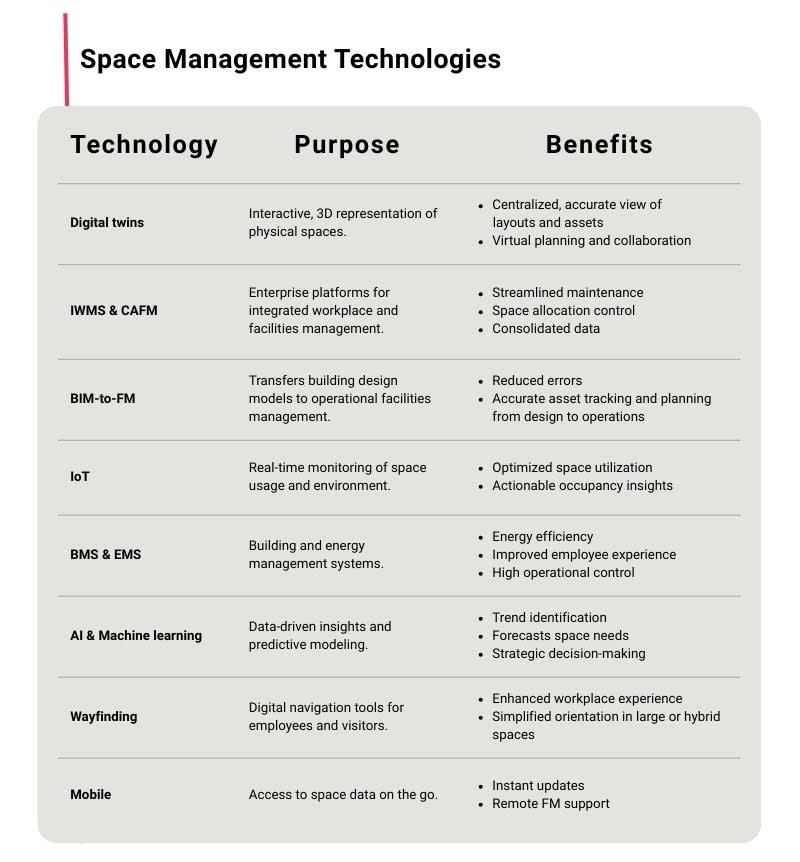
Digital twins are interactive 3D models of physical spaces that provide a single source of truth for layouts, assets, and occupancy, enabling virtual planning and collaboration.
Integrated Workplace Management Systems (IWMS) and Computer-Aided Facility Management (CAFM) are used by facilities and workplace management teams to streamline moves, adds, and changes (MAC), maintenance, and space allocation.
BIM-to-FM processes convert Building Information Models (BIM) into operational data for facilities management, reducing errors and supporting accurate asset tracking.
IoT devices monitor space usage, movement, and environmental conditions in real time to optimize utilization.
Building and Energy Management Systems (BMS/EMS) control lighting, HVAC, and energy consumption for operational efficiency and comfort.
Machine learning and AI tools intelligently process occupancy, utilization, and operational data to provide predictive insights and support strategic decision-making.
Wayfinding systems are digital navigation tools that help employees and visitors locate spaces quickly, enhancing workplace experience.
Mobile applications give facilities teams, planners, and employees access to space data anywhere, improving responsiveness and collaboration.
Next, we’ll break down how to connect and use these technologies for maximum impact.
How to leverage digital transformation for smarter office space management
Digital space management tools are most powerful when integrated, creating a seamless flow of spatial data across the organization. The following stages outline how they function across the space management lifecycle, and how to connect them to your business ecosystem.
Digitize: capture accurate, up-to-date data on your spaces
Start by capturing a complete and reliable digital foundation. Modern technologies make it possible to capture not just the physical layout of offices, but the operational state of every space.
1. Map the physical space with a digital twin to create accurate 3D models of every room and common area. Matterport’s Property Intelligence automatically provides precise measurements and other context from digital twin scans to form a reliable baseline.
2. Capture operational data by deploying IoT sensors that monitor occupancy, temperature, air quality, and energy use. These data streams reveal how spaces are actually used day to day.
3. Survey and update regularly with mobile mapping apps to quickly audit changes and ensure digital records stay current.
Accurate layouts paired with real-time operational insights will create an actionable overview of existing conditions. This also ensures all stakeholders work from the same, up-to-date information.
Integrate: connect spatial data to existing platforms
Once your space data is digitized, link it with enterprise systems to enable a unified flow of information across teams and tools.
1. Connect to BIM platforms by exporting digital twins to BIM formats. These are compatible with Autodesk tools for synchronization of design and operational data.
2, Leverage APIs to enable data sharing between your digital twin and other systems, and perform specific actions on your digital twins. This can help with a number of processes, including:
Workflow automation
Analytics
Collaboration
3. Integrate IWMS/CAFM tools to align these systems to real spatial data, streamlining move, add, change (MAC) and maintenance workflows.
Interoperability across the tech stack will improve processes and ensure a consistent record of data as spaces evolve.
Optimize: use analytics to improve decisions
Analytics turn this connected data into a strategic asset. With actionable intelligence to work from, you’ll be able to reveal how spaces are really used and where improvements could drive productivity, comfort, or sustainability.
Use AI and machine learning to analyze patterns in occupancy, energy use, or space utilization and identify inefficiencies.
Monitor IoT dashboards to track real-time performance metrics from sensors, including occupancy, temperature, air quality, and energy consumption.
Use EMS to align energy usage with actual space needs to reduce waste and improve sustainability.
Track occupancy to understand how spaces are used day-to-day and proactively model reconfigurations that maximize efficiency.
Implement predictive maintenance processes that anticipate equipment failures and schedule maintenance based on usage patterns.
Digital twins provide an accurate baseline for analytics, enabling teams to visualize trends, model changes, and make data-driven decisions with confidence that their spatial data is up-to-date.
Embed: roll out digital transformation practices across teams
To maximize the value of digital transformation, it’s essential to embed new practices across your organization and ensure they are adopted effectively.
Establish clear ownership of spatial data, decision-making processes, and workflows to maintain consistency across teams.
Confirm compliance and security practices meet people, privacy, and data security requirements before rolling out new tools.
Assess data quality and regularly calibrate sensors, reconcile digital twin models with physical spaces, and validate updates to maintain accuracy.
Communicate changes by sharing training resources that build understanding and buy-in. Digital twins can function as a hub that hosts resources like policies, booking rules and safety information embedded in Notes and Tags in relevant locations in the space model. They also function as a virtual walkthrough, which is ideal to support wayfinding. Make sure resources are accessible by mobile so teams can use them at their convenience.
A consistent, resource-supported roll-out will help cross-functional teams to commit to lasting improvements in digital transformation.
Automate: streamline workflows and updates
Automation turns data into actions that grow operational efficiency and reduce manual effort, freeing teams to focus on strategic work.
Leverage IoT automation platforms to process sensor data and update occupancy, environmental, and energy records without manual input.
Trigger administrative flows like maintenance requests, approvals, or reconfiguration tasks to activate automatically when specific conditions are met. Set up automation workflows in ticketing platforms or workflow automation software to handle these repetitive and labor-intensive tasks.
Integrate smart building systems to adjust HVAC, lighting, and other systems dynamically in response to occupancy and environmental changes.
Connect digital twins and facility management systems via APIs to ensure updates and inspection records are synchronized with the space for efficient document management.
Automating space management operations will ensure that every sensor update, inspection, or maintenance task flows directly into actionable workflows, to reduce delays and align day-to-day operations with strategic goals.
Adapt: continuously evolve with real-world feedback
Digital transformation is not a one-time initiative. Spaces must adapt continuously based on real-world feedback to remain effective and resilient.
Apply insights from predictive analytics that use historical and real-time data to forecast occupancy trends, space needs, and operational challenges.
Incorporate ESG and reporting tools to track energy, sustainability, and compliance metrics and align space strategies with organizational goals.
Establish digital feedback loops that collect data from IoT sensors, user input, and occupancy patterns to inform ongoing adjustments.
Run AI scenario modeling to simulate utilization patterns or environmental strategies and identify the most effective configurations.
Use space simulation platforms to test new configurations virtually before implementation, reducing risk and improving decision-making. Digital twins provide an ideal baseline to visualize changes, plan new layouts, and model future scenarios. Use the Defurnish tool to visualize your space as a blank canvas and work from a clear baseline.
Stay adaptable to ensure your workplace and portfolio remain resilient in the face of evolving business needs.
Business benefits of digital transformation in office space management
Digital transformation in space management is best understood as an investment in resilience and long-term performance, not just an operational upgrade. Organizations gain an edge in a number of areas, including:
Resilience and agility
While day-to-day efficiencies matter, significant value lies in how well an organization can adapt and compete as conditions change. Space decisions are increasingly shaped by forces that are difficult to predict in advance—shifts in workforce patterns, energy costs, regulatory requirements, and organizational priorities. Adaptability allows organizations to right-size or adjust operations with confidence, so real estate supports business continuity rather than becoming a constraint when conditions evolve.
Cost efficiency and ROI
Accurate spatial data reduces reliance on manual audits and digital automation keeps records current without ongoing effort, allowing organizations to right-size space earlier and make investment decisions with confidence. When teams can see how space is actually used, they stop paying for square footage that no longer serves the business. This commonly results in faster payback on real estate decisions and more predictable returns across the portfolio.
Portfolio scalability and governance
As portfolios grow more complex, consistency becomes harder to maintain. Digital transformation creates a shared spatial foundation that scales. Standardized data models make it easier to compare performance, enforce policies, and manage change without losing control. Leaders gain visibility across the portfolio while local teams retain flexibility. This balance allows organizations to scale their footprint without increasing operational risk or fragmentation.
Together, these benefits position space management as a strategic capability—one that strengthens business continuity today and creates a durable advantage over time.
Design your corporate real estate portfolio for continuous adaptability
The ultimate goal of digital transformation in space management is to create spaces—and portfolios—that can evolve as fast as the business itself.
Transformative tools like Matterport digital twins support new ways of working without missing a beat. By embracing digital transformation, businesses build a foundation of precise data and seamless, adaptable workflows that offer the flexibility to adapt space in response to exponential change.
Learn more about how other professionals are using modern tools like Matterport to enhance their corporate real estate strategy.
Get in touch with our team