


 Sign In
7 Best 360 Cameras for Real Estate: A Buyer's Guide for Agents
Homebuyers cite photos as one of the most important elements of a listing, and listings with virtual tours have been shown to sell homes even faster. For agents in competitive markets, this creates a clear edge. But that edge only shows up if you can produce tours affordably and quickly, with quality that matches buyer expectations.
The best 360 camera for real estate helps you walk into a property, capture everything you need, and get a polished listing live in hours. Some cameras do that with a single scan that generates a full 3D tour, floor plan, and room measurements. Others need more manual work but cost a fraction of the price.
In this guide, we’ll evaluate how each camera performs inside real properties with bright windows, dim hallways, and tight bathrooms.
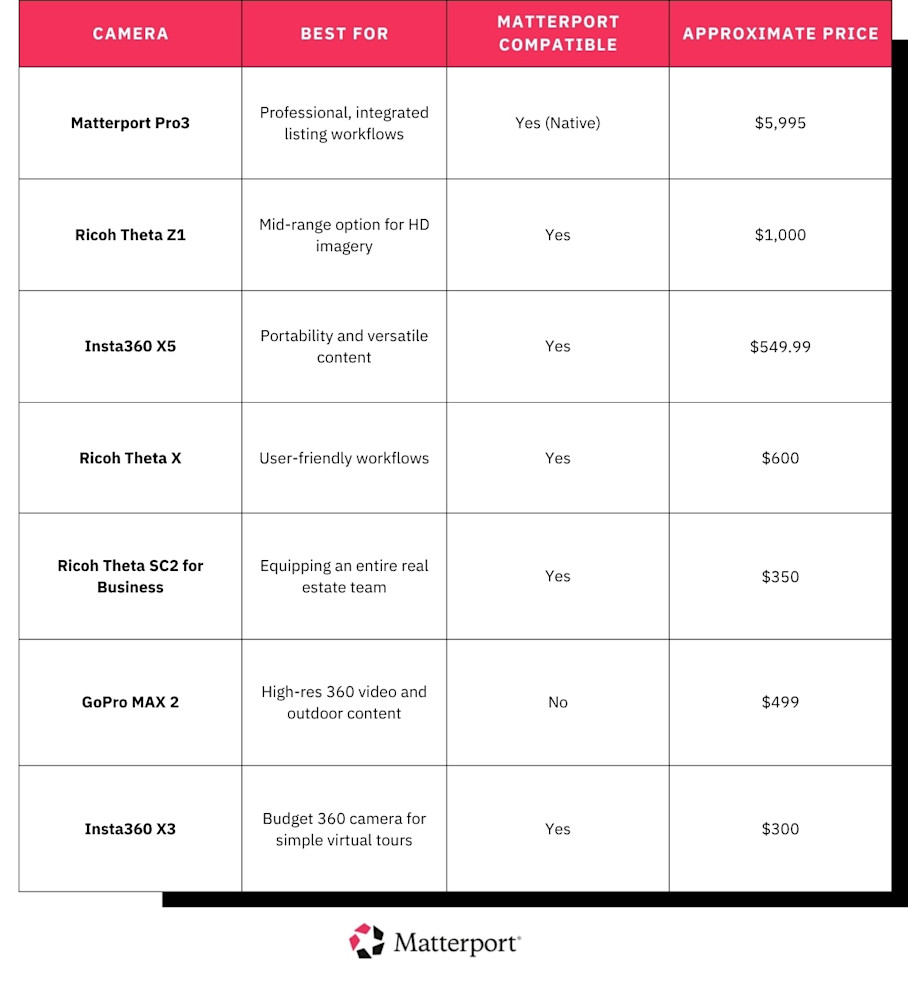
Here’s a quick comparison of how the seven cameras in this guide stack up.
Pricing Disclaimer: Pricing is subject to change at any time. The numbers in this article reflect values at the time of writing (May 2026).
What makes a 360 camera right for real estate?
The right 360 camera for real estate should help you to create stunning virtual tours, despite varying conditions and workflows. Agents face variable lighting, tight rooms, and back-to-back shoot days, so choosing the right hardware to fit your properties and process is essential.
Five factors separate the cameras that earn their keep from the ones that create extra work:
HDR performance and dynamic range. Real estate interiors are high-contrast environments. Cameras with strong HDR processing or LiDAR-assisted depth capture handle these extremes more gracefully, resulting in balanced exposures across every room.
Stitching quality in tight spaces. Dual-lens 360 cameras combine two images into one sphere. In a narrow hallway or a small bathroom, it can produce visible artifacts, wavy door frames, or ghosted objects. Wider lenses or depth-aware stitching minimize these issues.
Capture speed and single-operator efficiency. Most agents work alone, so a camera that boots instantly and captures quickly saves time when capturing multiple listings.
Platform compatibility and tour publishing. A standalone 360 camera captures images, but you still need to upload, stitch, and publish those images separately. An integrated platform like Matterport pairs purpose-built cameras with cloud-based processing that turns raw captures into navigable 3D tours, floor plans, and measurements automatically.
Price relative to listing ROI. A higher-end camera can be a smart investment for real estate professionals working with high property volume, high listing value, and significant time dedicated to selling each property.
Weigh the upfront investment against how many listings the camera will serve, how much time it saves you per property, the resources that can be produced from the capture, and the quality your customers expect. A cheap camera that adds 30 minutes of manual work to every listing can end up costing more than it saves.
7 best 360 cameras for real estate listings
Choosing a 360 camera for real estate comes down to your portfolio, budget, and how much of the post-capture work you want to automate with an integrated platform. The seven options below cover the range of needs you're likely to run into.
Important note: The cameras on this list are organized by use case, not ranked.
1. Matterport Pro3: Best for professional, integrated listing workflows
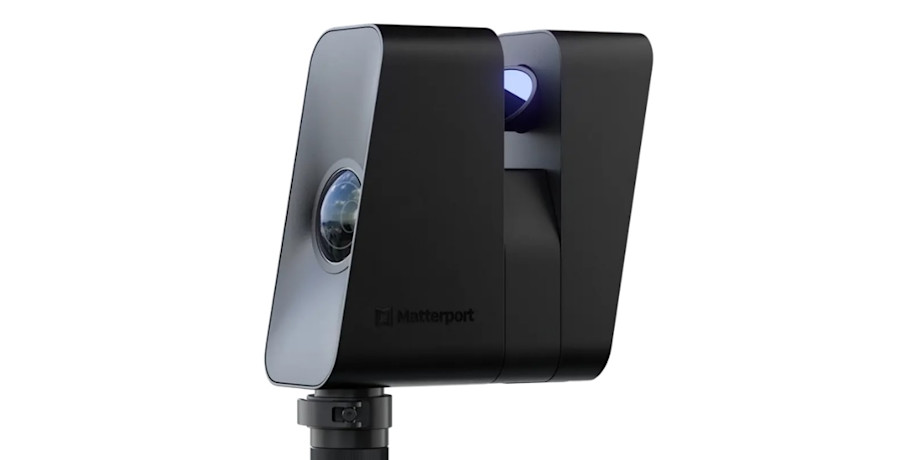
The Pro3 is Matterport's flagship 360 camera. It combines LiDAR scanning with high-resolution photogrammetry to produce dimensionally accurate, photorealistic digital twins that can be navigated by potential buyers.
With a custom 20-megapixel sensor and 12-element lens covering an ultra-wide angle, the Pro3 produces detailed scans in life-like color.
Price: Starting at $3,995.
Matterport compatible: Yes (Native)
The Pro3 separates itself from every other camera on this list in challenging interior lighting. The camera uses LiDAR, which eliminates depth issues with sunlight entering through windows and skylights indoors, resulting in consistently balanced scans.
The high-precision LiDAR sensor captures 1.5 million points per scan in conditions ranging from dim light to direct sunlight, up to a range of 20 meters at less than 20 seconds per sweep. This means agents need fewer scan positions in open-plan homes and larger properties, directly reducing on-site capture time.
With the Pro3, agents also benefit from a single-operator workflow. One person captures the full property using a tripod and the Matterport Capture App.
From that single scan session, the Matterport platform generates a navigable 3D virtual tour with fully stitched spaces, auto-generated Property Intelligence details like room labels, listing descriptions, and accurate room dimensions, and schematic floor plans. In-tour tools like Automated Measuring and Defurnish remove the need for separate measurement and staging visits.
For busy agents with far-reaching portfolios, professional Capture Services are also available in 700+ cities globally, where experienced technicians capture Pro3 scans and deliver completed digital twins within 24 to 48 hours.
Pros:
LiDAR-based scanning for measurement-grade accuracy (+/- 20mm at 10m precision)
Long-range scanning reduces setup time
Interior and exterior scanning in all lighting conditions
Cloud processing and fast publishing pipeline
Produces full 3D tours, property details, listing assets, and floor plans in one workflow
Cons:
Premium price point
Requires an active Matterport subscription plan
The Matterport Pro3 is best suited for agents, teams, and brokerages focused on ROI. It delivers the highest listing quality, accurate spatial data, and a fully connected capture-to-publish workflow that eliminates manual steps between scanning a property and embedding a tour on a listing page.
2. Ricoh Theta Z1: Best mid-range option for HD imagery
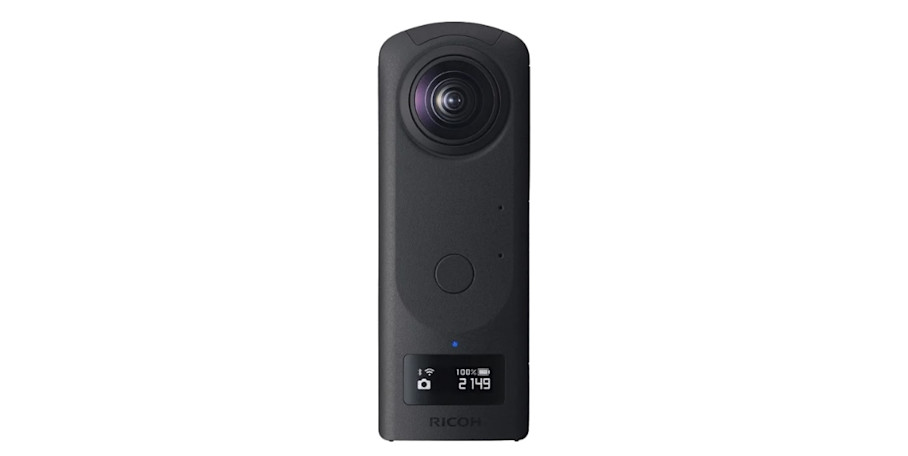
Image source: Ricoh Theta
The Ricoh Theta Z1 51GB 360 is a compact, dual-lens 360 camera that delivers strong image quality at a mid-range price point.
Price: Starting at $1,000, with option to subscribe to RICOH360 Tours or other tour platform.
Matterport compatible: Yes. Captures can feed directly into the Matterport platform for processing into 3D tours.
Theta Z1 uses dual 1-inch sensors to produce highly realistic spherical images with more detail, improved color accuracy, and a wider dynamic range than most mid-price consumer 360 cameras.
The Z1's dynamic range correction reliably handles bright-to-dim transitions, making its HDR performance especially useful indoors, where overhead lights, lamps, and window light all share the same frame.
Pros:
1-inch sensors deliver strong image quality for the price
Good HDR performance in typical residential lighting
Compact and portable
Straightforward capture experience
Cons:
No LiDAR depth data, causing less spatial accuracy than dedicated 3D cameras
Extreme contrast scenarios, like direct sunlight through a large window, can still challenge HDR processing
More visible stitching artifacts in tight rooms compared to LiDAR-based cameras
The Theta Z1 is best suited to agents who prioritize image quality at a mid-range price point and want to connect to Matterport for virtual tours with visually polished results.
3. Insta360 X5: Best for portability and versatile content
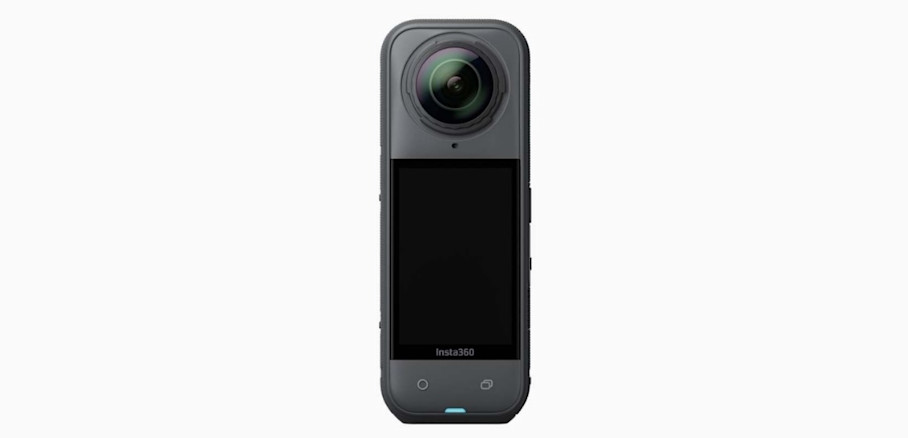
Image source: Insta360
The X5 is Insta360's latest flagship 360 camera, with improved image quality. It upgrades the X-series with larger 1/1.28-inch sensors and Insta360's new Triple AI Chip processing system.
Price: Starting at $549.99, with option to subscribe to third-party tour creation platforms.
Matterport compatible: Yes. Captures can feed directly into the Matterport platform for processing into 3D tours.
Compared to the previous X4 model, the new sensors capture roughly 144% more light area, which is meaningful for interior shoots where lighting is often the limiting factor.
This sensor upgrade handles typical residential interiors without dramatic exposure shifts. However, bright window blow-out is still noticeable in south- or west-facing rooms during afternoon showings. LiDAR-assisted cameras like the Pro3 maintain more balanced exposures in those conditions.
Insta360’s X5 is designed to handle virtual tour capture and social media content from the same device, making it useful for agents who want listing media and short-form video without switching gear.
Pros:
Ultra-portable and lightweight
Intuitive app with fast capture workflow
Strong video capabilities for social media content
Cons:
Consumer-grade sensors may underperform in dim interiors compared to dedicated real estate cameras
No depth or spatial measurement capability. Tour output requires manual upload and processing steps that platform-native cameras handle automatically (adds 15–20 minutes per listing to the post-capture workflow)
Less suited for producing measurement-grade outputs
The X5 is best suited for agents who want a versatile, ultra-portable camera for quick captures and social media content, and who prioritize speed and convenience over image precision.
4. Ricoh Theta X: Best for user-friendly workflows
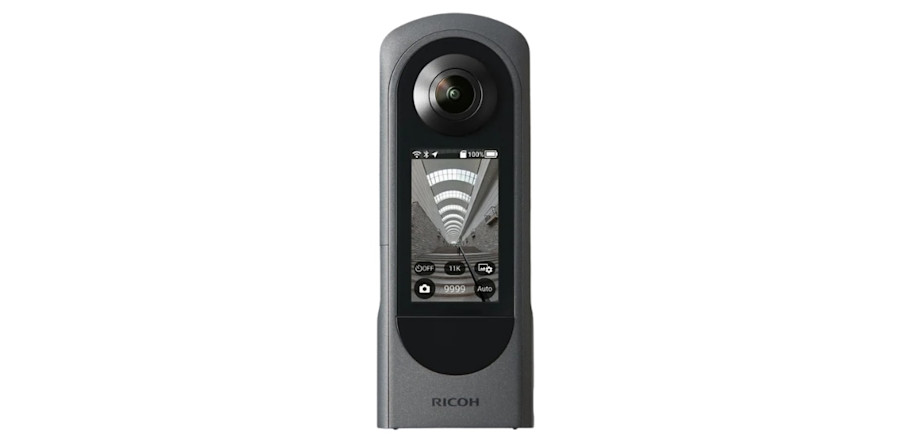
Image source: Ricoh360
The Ricoh Theta X is a 360 camera designed around ease of use, featuring a large built-in touchscreen, removable batteries, and a self-contained workflow that keeps things simple.
Price: Approximately $600, with option to subscribe to RICOH360 Tours or other tour platform.
Matterport compatible: Yes. Captures can feed directly into the Matterport platform for processing into 3D tours.
The large touchscreen lets agents frame and review captures on the device itself without relying on a smartphone. Removable batteries support longer shoot days, making it practical for agents juggling multiple listing appointments back to back.
The Theta X is built for agents who want a self-contained, pick-up-and-go camera with a minimal learning curve.
Pros:
Built-in touchscreen for on-device preview and control
Removable battery for extended shoot days
Intuitive workflow for non-technical users
Compatible with multiple virtual tour platforms
Self-contained operation without phone dependency
Cons:
No LiDAR or depth sensing
Image quality in high-contrast interiors does not match the quality of dedicated real estate cameras
No automated outputs like floor plans or measurements
The Theta X is best suited for agents who value simplicity and a frictionless capture experience. Set up, tap, and capture without needing to troubleshoot apps or manage complex settings.
5. Ricoh Theta SC2 for Business: Best for equipping an entire real estate team
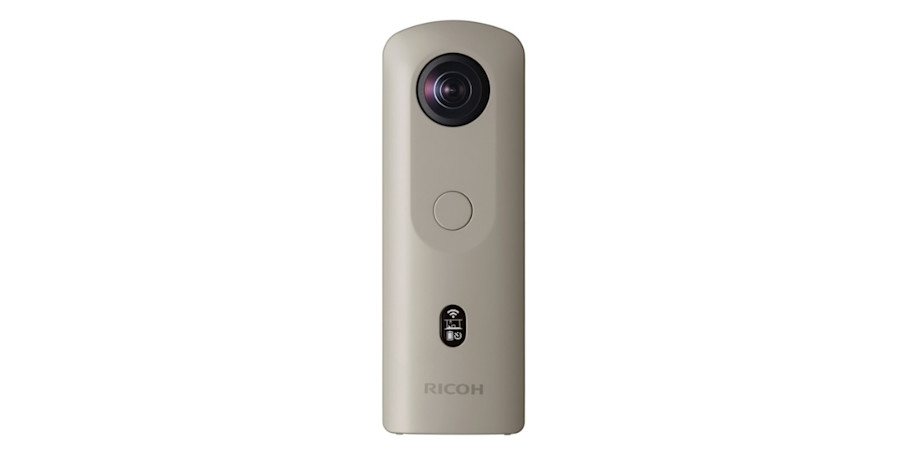
Image source: Ricoh
The Ricoh Theta SC2 for Business is sold by Ricoh as a full 360 camera kit, purpose-built for business deployment. It's designed so that brokerages can put a camera in the hands of every agent on the team, even those with no photography experience.
Price: Starting at $350 for the camera alone, with option to subscribe to RICOH360 Tours or other tour platform.
Matterport compatible: Yes. Captures can feed directly into the Matterport platform for processing into 3D tours.
The SC2 for Business defaults to ROOM mode HDR, which automatically optimizes exposure for interior spaces. Agents don't need to adjust settings or understand HDR to get usable results. Point it at a room, press the shutter, and the camera handles the rest.
Boot-to-shoot time is approximately 1.5 seconds. Agents can walk into a property, power on the camera, and start capturing almost immediately
The "for Business" variant adds features tailored to professional workflows, including remote shooting via API and integration with business platforms.
At the low cost per unit and close to zero technical onboarding, the SC2 for Business standardizes capture across all agents, even if they’re not photography specialists.
Pros:
Price point makes team-wide deployment affordable
ROOM mode HDR default produces balanced interiors without manual settings
1.5-second boot-to-shoot for fast, no-fuss capture
Time Shift removes the photographer from the frame automatically (useful in tight hallways and small bathrooms)
Lightweight, pocketable, and simple enough for non-technical agents
Cons:
Smaller sensors than the Theta Z1, so image quality drops noticeably in challenging lighting
No removable battery limits shooting capacity per charge
No touchscreen, so it requires a connected smartphone for preview and control
No LiDAR, depth data, or automated floor plan outputs
At this price, every agent on the team can be equipped with an SC2. It's a smart choice for brokerages standardizing virtual tours across their roster without a large per-agent investment.
6. GoPro MAX 2: Best for high-res 360 video and outdoor property content
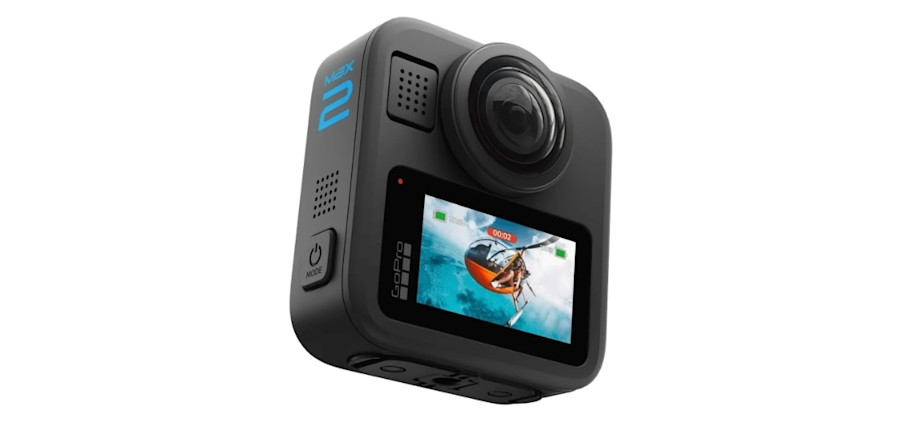
Image source: GoPro
The GoPro MAX 2 is GoPro's latest 360, dual-purpose camera that captures both 360 footage at true 8K resolution and traditional 4K video, with the stabilization GoPro is known for.
Price: Starting at $499, plus an active GoPro or a third-party platform subscription.
Matterport compatible: No. The GoPro MAX 2 works with GoPro's own software and select third-party tour platforms.
The MAX 2’s 8K resolution, replaceable lenses, and built-in GPS make it a strong option for agents who prioritize video walkthroughs, exterior property content, and social media reels.
For agents weighing the MAX 2 against the Insta360 X3 or X5, the key differentiator is platform compatibility. The X3 and X5 feed directly into Matterport's integrated tour-building workflow. The MAX 2 does not, meaning you'll need a separate system to create virtual tours from your captures.
Pros:
True 8K 360 video resolution
Replaceable lenses for long-term cost savings and durability
Built-in GPS for geotagging property captures
Waterproof design for exterior property capture
Stabilization for smooth video walkthroughs
Strong app ecosystem with easy editing and sharing
Cons:
Not Matterport-compatible; requires a separate tour-building workflow
Primarily designed for video, so 360 photo quality does not match dedicated real estate cameras like the Theta Z1 or Pro3
No LiDAR, depth data, or automated floor plan outputs
Limited HDR performance in high-contrast interiors (bright windows, dark rooms)
The MAX 2 is best suited for agents who want high-resolution 360 video for social media and exterior property marketing. But it's worth weighing the lack of platform compatibility against cameras like the X3 or Theta Z1 that connect directly to Matterport.
7. Insta360 X3: Best budget 360 camera for simple virtual tours
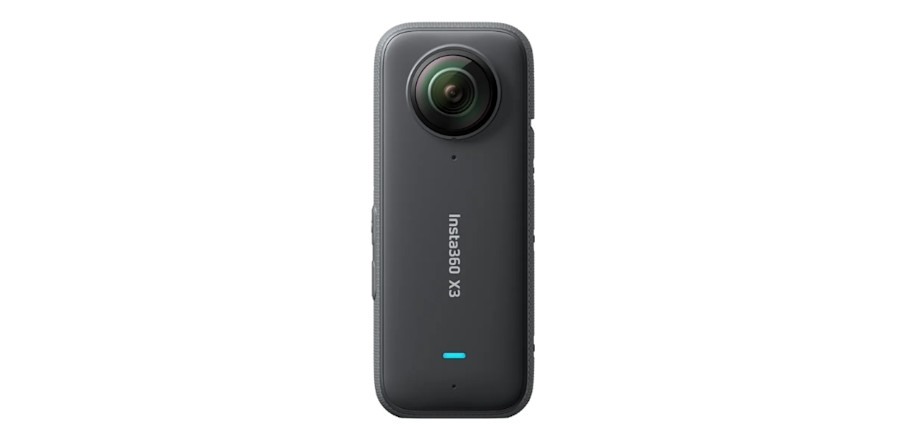
Image source: Insta360
The Insta360 X3 is an affordable, consumer-friendly 360 camera that gives new agents a low-cost entry into virtual tour production.
Price: Approximately $300, with option to subscribe to third-party tour creation platforms.
Matterport compatible: Yes. Captures can feed directly into the Matterport platform for processing into 3D tours.
The X3 is one of the most affordable branded 360 cameras available, making it accessible to agents testing virtual tours for the first time. It’s a great option for agents who need both virtual tour content and social media video from one device.
At this price point, the X3 produces adequate results in well-lit, mid-range residential listings. Like a standard 3-bedroom suburban home with good natural light. But it struggles in luxury listings where buyers expect crisp detail in every corner, or in older homes with dim interiors and uneven lighting.
Pros:
Affordable price point for a well-known 360 camera brand
Large touchscreen for on-device control and preview
HDR photo and video modes for interior capture
Versatile: produces virtual tour content and social media video
Compact and lightweight
Cons:
Smaller sensors than the Theta Z1, producing lower image quality in dim or high-contrast interiors
No depth data or automated floor plan outputs
Stitching can struggle in tight or cluttered spaces
Battery life (~80 minutes) limits back-to-back shooting
The X3 is best suited for new agents on a budget who want an accessible, well-supported 360 camera to start producing basic virtual tours and social content at a low hardware cost.
How camera choice shapes the real estate workflow (and your time to listing)
Your camera choice affects every step of the listing process, from walking into a property to publishing a polished listing.
Here’s how:
Faster cameras reduce time on-site. A camera that scans in under 20 seconds per position means fewer minutes at each property. Across a week of listings, that time adds up.
Platform-connected cameras eliminate manual upload and editing stages. Six of the seven cameras in this guide are Matterport-compatible, meaning agents can choose based on budget and workflow preference while staying within a connected, workflow-first platform. The GoPro MAX 2 is the exception. It’s a strong standalone video camera that requires a separate tour-building workflow.
Cameras that generate floor plans remove the need for a separate measurement visit. Instead of booking a separate appointment to measure rooms and sketch a layout, agents walk out of the property with a schematic floor plan already in hand.
Integrated systems produce multiple listing assets from one visit. Matterport's connected workflow demonstrates how a single scan session produces a navigable 3D tour, a schematic floor plan, and accurate room measurements, all processed automatically in the cloud and ready to embed on a listing page. Property Intelligence takes this further by automating additional listing preparation tasks. It generates property descriptions, extracts room dimensions suitable for MLS entries, and reduces the manual steps between scanning and publishing.
The difference between a 3-hour and a 30-minute listing workflow often comes down to whether your camera connects to a platform that handles the post-capture work for you.
Get in touch with our team

