


 Sign In
Manufacturing Maintenance Planning: 5 Best Practices to Reduce Downtime
Manufacturing downtime is expensive. Every hour a line sits idle costs lost production, and in high-throughput plants, a single unplanned stop can erase the margin on an entire shift.
Manufacturing maintenance planning exists to prevent this. It is the work that happens before any wrench turns: figuring out what work needs doing, what parts, tools, and personnel it requires, and building a clear plan before anyone touches the equipment.
Most MRO teams already have solid preventive and predictive maintenance programs, yet shutdowns still overrun. Too often, planning stops at the work order and doesn't account for the plant floor itself: what's changed since the last outage, what access looks like now, what's in the way. The five manufacturing maintenance planning practices below work from the floor up so the plan holds up once work actually starts.
1. Build a complete and current asset baseline
Before a planner can sequence work, estimate labor, or write a job plan for a production line, they need accurate answers to three questions:
What equipment exists in the facility?
Where is it?
What condition is it in?
In a manufacturing plant, where equipment is dense, interconnected, and constantly modified to keep pace with changing production needs, that baseline is harder to maintain than it sounds. When the information is wrong or missing, every downstream decision inherits the error. Planners might estimate the wrong parts, crews find blocked access, and a routine job stretches into an overrun.
Most planning failures trace back to one of the following issues with documentation:
Outdated drawings that no longer match the floor
Missing or misfiled manufacturing process documentation or equipment manuals
Incorrect asset locations that send crews to the wrong spot
Undocumented modifications from past retrofits and repairs
Unfortunately, most crews only discover these issues after production stops, when a clearance conflict or a missing tie-in detail turns billable wrench time into standing-around time. By then, the delay is already baked into the schedule.
Planners need a record they can trust in order to avoid documentation-based errors. It should reflect the plant as it exists today, be accurate enough to measure against, and be accessible enough that a planner doesn't have to walk the floor to confirm what's actually there.
Digital twins capture existing conditions across entire production areas, giving planners a current visual baseline to work from for every job. Matterport’s models recreate not just the equipment directly involved, but everything around it in 3D. With individual assets tagged at their exact location, the digital twin serves as a searchable asset repository.
Any major maintenance event, equipment install, or layout modification should trigger a recapture of the modified section to avoid creating false confidence, which is worse than no record at all. Capture Services can schedule technicians to do this on a recurring basis or dispatch them after a specific event. Using Merge Spaces, teams can then integrate the updated sections into the master digital twin without requiring a full facility re-scan.
That same before-and-after capture doubles as an audit record. Planners can compare pre- and post-shutdown digital twins with Side-by-Side (in public beta) to verify that work was completed to specification and document the as-left condition.
2. Define maintenance tasks with detailed job plans
Documenting job plans well turns them into long-term assets for repetitive tasks. Most preventive maintenance in a manufacturing plant isn't unique. The same lubrication routine, belt inspection, or bearing replacement might run hundreds of times a year across different lines and shifts. Once a task is planned properly, every future instance of it draws from the same procedure instead of a technician working it out from memory or a supervisor's verbal instructions.
A complete job plan spells out the specifics so nothing gets improvised on the floor:
Step-by-step procedures for the task
Safety requirements, including lockout/tagout and confined space permits
Parts and tools lists
Labor estimates by trade
Any special equipment or rigging needed
A procedure buried in a shared drive or a binder in the maintenance office does a technician no good when they’re standing in front of the actual equipment. Embed the job plan documents as Attachments at the asset point in the digital twin so planners and technicians can reach them without digging through shared drives or three-ring binders. A planner can pull up a pump's maintenance history by walking to it in the model instead of hunting through a spreadsheet. In that same view, they can see exactly where it sits relative to the isolation point and the nearest access route.
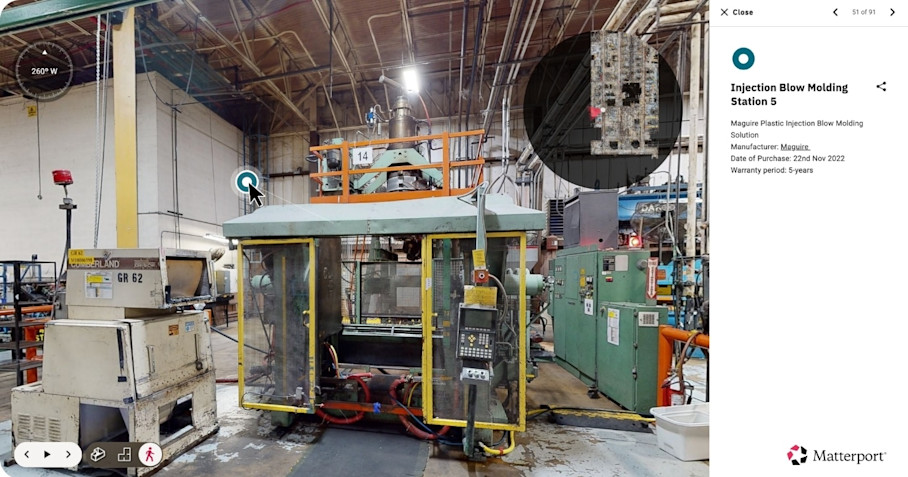
Documented work “to be done” needs somewhere to live before it gets scheduled. Create a planned backlog that outlines the queue of approved, fully planned work orders waiting for a date and a crew. Everything in it should already have gone through scoping, so nothing will be added to a shift's workload half-planned.
Most plants aim to keep two to four weeks of work in the queue. Too little, and schedulers run out of ready work and crews sit idle between jobs; too much, and the backlog stops reflecting real priorities. A healthy backlog also gives managers a forward view of resource demand for forecasting, helping them to understand what parts need ordering, which jobs will need a contractor, and how labor should be allocated across the coming weeks.
3. Plan around plant conditions and access constraints
A job plan can list the right parts, the right labor, and the right procedure, and still run long if it doesn’t account for the space around the equipment. Unverified site conditions are among the most common reasons shutdowns overrun, and they're expensive precisely because they surface after the line is already down.
Conflicts to watch out for include:
Equipment access blocked by machinery installed or repositioned since the last outage
Insufficient clearance for a crane lift or rigging path
Overhead obstructions (e.g. conduit, ductwork, piping) interfering with a removal path
Scaffolding that can't go up without cutting off an adjacent work zone
Asset locations on the drawing that don't match where the equipment actually sits
These typically won’t be found in a CMMS or EAM system, because those systems track the asset, not the physical space around it. A pump's maintenance history doesn't tell a planner whether there's room to pull it clear of the piping next to it.
Navigate the digital twin in a 360-degree immersive walkthrough to confirm space allowances remotely. Carry out the following specific checks in advance of the shutdown:
Confirm that replacement parts or pieces of lifting equipment will actually fit through the space they need to travel
Verify that scaffolding can go up without cutting off a neighboring work zone
Check that laydown areas and temporary structures don't block an emergency egress path
Automated Measurements allow planners to confirm clearances, access routes, and equipment dimensions fit directly in the digital twin. This can happen remotely, before the shutdown starts. There’s no need to coordinate a walkthrough around a running line, no PPE, and no escort for a five-minute measurement just to confirm clearance.
Congestion, where multiple trades converge on the same work zone at the same time, is one of the most common ways a shutdown loses hours it can't get back. Spatial sequencing helps to assign work zones and staging areas based on the plant's actual layout, not an assumed one. Use Schematic Floor Plans generated from the digital twin for an accurate base to work from for that sequencing. This keeps crews from ending up on top of each other mid-shutdown.
4. Coordinate contractors and stakeholders with shared documentation
A shutdown often brings in crews who've never worked the plant before. Riggers for a crane lift, a specialty electrical contractor, and an OEM technician might all be flown in to service a single machine on the line. If the external crew arrives without real context about the facility, the first hours of an expensive window go to orientation instead of work.
Every party should have the same picture of the site before the maintenance window opens, including what's isolated, what's still live, where each trade is staged, and what access looks like around the specific equipment they're touching. The digital twins offered by Matterport are cloud-hosted and easy to share, so internal teams, OEMs, and contractors all have shared context to review from wherever they are. They replace the usual back-and-forth of emailing photos, PDFs, and marked-up drawings to a crew trying to picture a line they've never stood on. A contractor who's reviewed the twin arrives already knowing where to park a lift truck and which panel is theirs to isolate.
Digital twins can also live alongside the tools the plant already coordinates work through. Matterport integrates with BIM, CAD, CMMS, and EAM platforms, so the visual context sits inside the maintenance and asset management workflows that teams already use, instead of becoming one more reference they have to be pointed to.
Siemens has used this approach across its manufacturing sites, giving stakeholders a way to review assembly line design and process optimization remotely. Meetings that once required gathering a group on the production floor, with the noise, safety exposure, and space constraints that come with it, now happen instead around a shared digital twin, without pulling people onto the floor or interrupting the line to do it.
5. Track KPIs that reflect real planning effectiveness
The only way to know whether a manufacturing maintenance planning process is actually working is to measure what happened against what was planned, and feed that back into how the next shutdown gets scoped.
These metrics reflect planning quality:
Mean time to repair (MTTR) measures how long a repair takes once work starts. It's an execution metric on its face, but sustained improvement in MTTR usually means jobs are arriving better prepared, not that technicians are working faster.
Mean time between failures (MTBF) tracks how long assets run before failing again, and reflects whether preventive plans are actually catching problems before they become breakdowns.
Planned maintenance percentage is the share of total maintenance work that was planned in advance rather than reactive. Manufacturing plants running a mature planning process typically keep this at 80% or higher.
Schedule compliance is the percentage of scheduled work completed on time. A plan that consistently misses its own schedule isn't realistic, or the resources behind it aren't showing up when expected.
Backlog health looks at the volume and age of planned work waiting to be scheduled. A backlog that's growing or stalling out signals a mismatch between how much planners are producing and how much scheduling can absorb.
Wrench time is the share of a technician's shift spent actually doing maintenance work, as opposed to walking to get parts, waiting on access, or hunting for information. Wrench time rising over time is one of the more direct signals that planning is removing friction from the job.
Downtime (total lost production hours) is the ultimate measure of planning effectiveness.
OEE (overall equipment effectiveness) rolls availability, performance, and quality into a single number, tying maintenance planning directly to what the plant actually produced.
Reviewing these numbers only tells a planner that something went wrong, not what went wrong. To answer that, you’ll need to look back at the site conditions a shutdown actually ran into. Check the plan and execution records against a digital twin to trace where delays occurred: whether that’s due to access constraints, the work zone layout, or anything else that shaped how the job went. When built into the planning cycle this way, digital twins help turn each shutdown into an input for the next one. Job plans, access procedures, and resource estimates can be refined against conditions that were actually verified.
As more of the plant is captured over time, digital twins become more than planning tools. They serve as a manufacturing knowledge base that holds onto what the plant looks like and how it runs, independent of whoever happens to be on staff.
Effective manufacturing maintenance planning starts long before the shutdown itself. Give every crew, task, and resource the best chance of keeping production on schedule.
Get in touch with our team

