

 Sign In
Why Oil & Gas Document Management Fails in the Field (+How to Fix It)
A single oil and gas facility can generate tens of thousands of controlled documents over its lifecycle. Each one of those documents exists because someone, somewhere, needs it to complete a task correctly and safely.
Managing oil and gas documents correctly is a life-critical standard. When documents are outdated or inaccessible, the consequences can range from hours of unplanned downtime to a serious risk to employee safety. Yet the gap between what's stored in a document management system and what's accessible at the point of work remains dangerously wide.
The most effective system depends not just on where files are stored, but on how well documentation connects actual physical spaces. In this article, we’ll explore why traditional methods fail in the field and outline a modern, facility-first approach to oil and gas document management that closes the gap that spreadsheets and shared drives leave open.
Why oil and gas document management carries outsized risk
In the oil and gas industry, documents are not just records, but operational assets tied directly to safety, uptime, and compliance. Documents that require controlled management span every phase of a facility's lifecycle, and include:
Piping and Instrumentation Diagrams (P&IDs)
Isometric drawings
Standard Operating Procedures (SOPs)
HSE records and risk assessments
Permits to work
Inspection reports
Equipment warranties and vendor manuals
Maintenance logs and work order histories
Turnover packages
When the wrong document—or the wrong version—reaches the field, the consequences fall across a spectrum from inconvenience to catastrophe:
Rework costs from acting on outdated information—installing the wrong part or following a superseded procedure.
Unplanned downtime from delays in locating the correct documentation when equipment fails.
Regulatory penalties from incomplete or untraceable records during audits.
Safety incidents from wrong procedures at the point of work, leading to injuries or fatalities.
The last scenario isn't hypothetical. On the Piper Alpha platform in 1988, a routine maintenance operation took place involving one of the platform's condensate pumps. The pump's pressure safety valve had been removed for servicing, and a blind flange was installed temporarily. A failure to fully update and distribute documentation during shift handover meant that the incoming night crew was unaware of the change. They restarted the offline pump, triggering a chain of events that led to the deadliest offshore oil disaster in history, killing 167 people.
Oil and gas operations are some of the most distributed of any industry, so risks compound across multi-site operations. Documents may originate in plant warehouses, laboratories, planning offices, docks, and field locations—each with different constraints—and live in shared drives, siloed EDMS platforms, email threads, vendor portals, and physical binders simultaneously. Yet all documents must ultimately be accessible, secure, and traceable.
The problem is rarely a lack of documentation. It's that the right document can't reach the right person at the right time. The way documents are controlled, shared, and updated directly affects safety, uptime, and coordination between onshore and offshore teams.
The common gap between documents and physical assets
Even minor errors or inefficiencies in document management can escalate into significant losses at a large scale of oil and gas operations. The persistent challenge is connecting stored information to the physical reality of assets in the field.
Oil and gas documentation can easily drift from actual conditions, introducing risk. Common drift scenarios include:
MOC events that update equipment but not the drawings
Turnarounds where temporary modifications become permanent
Retrofits that alter piping routes or control logic
Contractor modifications made without updating the master files
Risk assessments and health & safety plan revisions that don't make it back to the central repository
Traditional folder-and-metadata organization also fails in field contexts. Site workers think in terms of "the pump on the second level of the north unit," not "SharePoint > Site A > Mechanical > Rotating Equipment > Rev 3." These file structures were designed for office workers, and are not well-suited to field technicians.
Closing this gap requires rethinking how documentation is structured—shifting from file-based organization to a facility-first approach that aligns information directly with site and facility assets.
7 core capabilities for every oil and gas document management system
Most oil and gas organizations already have some form of document management. But a mature document management infrastructure depends on four key capabilities to ensure the system actually reduces risk, improves performance, and keeps pace with the operational demands of this industry.
Centralized access: Fragmentation is the root cause of most document management failures. Siloed records can lead to compliance violations, while inconsistent document handling across departments or sites increases operational risk. To avoid this, all documents should live in a single, structured system accessible to everyone who needs them—so you always know which version is approved and current.
Version control: Version control with check-in/check-out, revision history, and superseded document handling ensures technicians always access the current approved revision. Controlled distribution matters too. If outdated copies persist in email inboxes, local drives, or laminated binder pages, a centralized system can't protect you from the decisions people make with stale information.
Searchability: Large oil and gas repositories can contain hundreds of thousands of documents and workers dedicate significant time to interpreting unstructured data. Metadata tagging, OCR, and full-text search cut that retrieval time dramatically. Instead of hunting through nested folders or waiting for someone to email a file, operators can search by equipment tag, document type, or keyword and pull up exactly what they need in seconds.
Workflow automation: Manual document processing often involves a series of approvals and handoffs, leading to delays in critical workflows and hindering responsiveness to changing circumstances. Automating review, approval, and routing workflows eliminates manual bottlenecks to keep documents moving in processes like transmittals, management of change (MOC) documentation, and permit-to-work packages.
Secure permissions: Role-based access controls manage who can view, edit, or distribute documents. This includes secure external sharing for contractors and regulators who need temporary access without compromising the integrity of the master repository. Not everyone needs access to everything, and some documents, like HSE records or proprietary engineering data, require very strict controls.
Audit trails: Oil and gas companies must maintain secure and auditable records for all projects. Companies that want to qualify for ISO quality certification or ISO 14000 environmental management standards must be able to maintain and control all project-related documentation electronically—including finance, taxation, and HSE records. Accessible, digital audit trails with effective dates, approval lineage, and retention policies prepare teams for regulatory inspections and internal audits.
Integration with asset management systems: Document management can't operate in isolation. It has to connect to the systems that drive daily operational decisions like EAM/CMMS platforms, EHS systems, MOC workflows, and asset hierarchy or GIS tools. When a work order is generated, the technician should be able to pull all the documents they need directly from that work order.
How to implement a facility-first approach to oil and gas documentation
A facility-first approach organizes and retrieves documents by asset location. Instead of navigating a directory tree, users navigate the facility itself in an immersive, virtual model.
Digital twins provide the spatial foundation for this. These navigable, dimensionally accurate 3D models of facilities can serve as a visual index for all associated documentation. Think of it as Google Maps for your plant, where every record is mapped to the exact piece of equipment it describes.
Let’s explore how digital twins can address challenges across oil and gas documentation workflows.
Capture and verify current conditions without relying solely on drawings
Digital twins provide a comprehensive, photorealistic, and immersive view of oil and gas facilities. This allows stakeholders to visually confirm layouts, equipment placement, and conditions as they actually exist on site. When as-built drawings are decades old or MOC events haven't been fully documented, a digital twin can act as the baseline truth.
Additionally, Matterport’s digital twins are dimensionally accurate to ±20mm at 10 meters. The Pro3 camera uses LiDAR to capture both indoor and outdoor spaces with depth capture up to 100 meters and scan times under 20 seconds per sweep. It can document large process areas, pipe racks, and equipment yards without significant operational disruption. For organizations that need high-fidelity detail on thin structures like piping and wiring, High Density Scanning delivers the resolution engineers need for meaningful verification.
Floor plans are delivered automatically, and Automated Measuring tools within the digital twin allow users to capture distances and dimensions remotely. This helps to accurately validate essential spatial information for key workflows.
Time-stamped records captured from within the model document asset conditions at specific points in time. This creates a visual history that supports as-built vs. as-is comparisons after MOC events, refinery turnarounds, or retrofits. This becomes especially valuable during audits or incident investigations when you need to prove what the facility looked like on a specific date.
Attach documents directly to equipment locations
A digital twin allows you to attach documentation to the specific physical asset it describes. Instead of relying solely on folder structures or document repositories, files can be anchored directly to equipment within a digital model of the facility. Spatial markers like Tags and Notes allow teams to attach PDFs, CAD drawings, inspection reports, photos, videos, links to external systems, and even conversations to pinned locations inside the model.
This changes how teams retrieve information. An operator navigating a digital twin can move to a heat exchanger, select the marker attached to it, and immediately access the current P&ID, vendor manual, inspection history, or related work order.
By organizing documentation around physical asset locations, teams make it easier for field personnel to find the information they need in the same context where the equipment exists.
Find critical information fast with a searchable repository
Information attached to field assets is significantly more convenient to locate. Matterport’s Space Search tool allows users to find information based on equipment tag, location, procedure type, or keyword and get relevant results instantly. Tags, Labels, Notes, Measurements, and Highlights are all searchable within a model, so you don’t need to know which folder or system holds a document—just what you’re looking for.
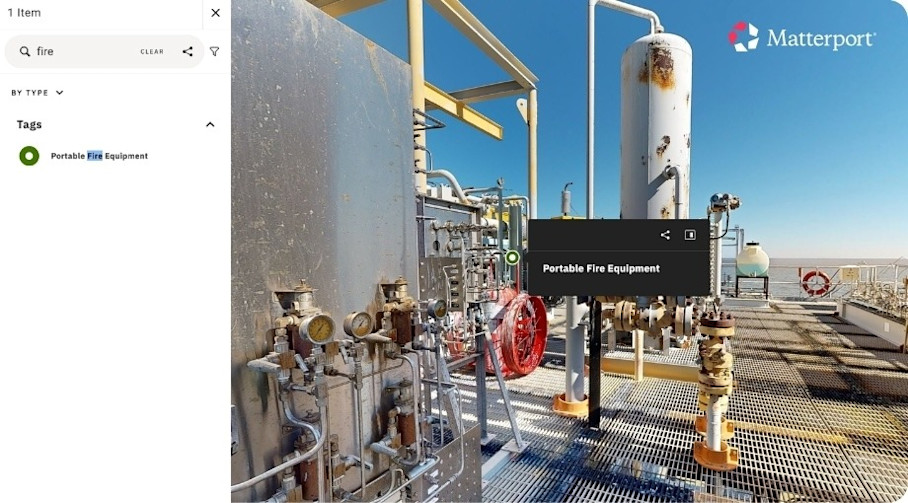
For example, an HSE officer could search “pressure relief valve” to instantly locate every tagged PRV in the facility along with its attached inspection reports. The results show each asset’s location in the model and surface all relevant documentation in seconds, eliminating time-consuming folder navigation or database queries.
This approach reduces document sprawl by making the physical asset the access point for all related information. Instead of searching multiple disconnected repositories, oil and gas teams can retrieve the right documents quickly, reducing errors and improving operational efficiency and emergency response.
Control access and connect existing systems
A facility-first documentation approach requires secure, role-based access and seamless integration with existing systems. Matterport’s role-based access controls offer a high level of governance over who can view, edit, or add information. This ensures sensitive operational documentation stays protected while remaining accessible to authorized stakeholders, including contractors who may need temporary visibility.
Digital twins can also connect to existing CMMS, EAM, BIM, and document management systems via integrations and BIM/CAD exports. By linking spatial markers in the twin to work orders or other repository content, the model provides a visual, asset-anchored layer on top of existing infrastructure. Teams can reference, export, or integrate documents without abandoning the systems they already use.
This strengthens security and usability simultaneously. Sensitive areas can be restricted or blurred, while the spatial context of the digital twin makes information easier to find and apply. Instead of replacing established workflows, the digital twin acts as an intuitive interface that connects documents and systems in context.
Build context for documentation compliance and audits
Auditors and inspectors typically look for evidence that documents are well-controlled. Signals include:
Traceability with clear links from an asset to its controlling documents
Effective dates showing when procedures or drawings were approved
Approval lineage proving who reviewed and signed off
Evidence of current conditions confirming the asset matches the documentation
Proof that controlled copies reached the field and weren't just filed away
Organizing documentation around the physical assets themselves makes it easier to provide this evidence. Using a digital twin, teams can guide an auditor virtually through an immersive 3D walkthrough of the facility, showing each asset alongside its associated records—without assembling binders or pulling files from multiple systems. Click on a vessel to show the inspection report. Click on a control panel to show the SOP and the training records for operators. Time-stamped visual records provide additional proof of asset condition, supporting inspection documentation and audit responses.
Role-based access controls allow secure, targeted sharing with regulators or third-party auditors, giving them the information they need without exposing the full model or risking uncontrolled document changes.
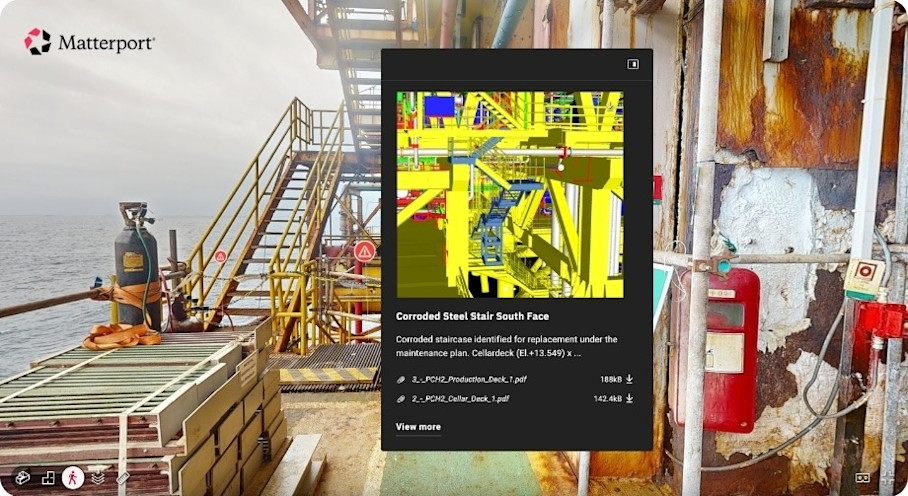
By tying documents directly to assets, audit preparation time can shrink from days of compiling evidence to minutes of navigating a model where everything is already organized by location and context.
Build a connected oil and gas document management infrastructure with Matterport
The value of oil and gas document management infrastructure depends on how effectively it connects documentation to the workflows in everyday operations. Filing systems and metadata tags aren't enough when technicians need answers at the point of work, when auditors need proof of compliance, or when outdated drawings create safety exposure.
Matterport digital twins serve as a visual index that anchors documents to equipment, verifies current conditions, and accelerates both daily operations and audit workflows. By organizing information around the facility itself—not around folder structures—teams close the gap between what's documented and what's real.
Explore Matterport for Oil & Gas teams