

 Sign In
Oil & Gas Facility Documentation: 5-Step Framework for Field-Verifiable Records
Oil and gas facilities don't sit still. Equipment gets replaced, piping gets rerouted, and structures get modified during turnarounds. But the documentation rarely keeps pace with those changes. Stored information drifts from the physical reality of assets in the field, introducing risk. A valve shown on a P&ID that doesn't exist on the plant floor isn't just a drawing error, but a serious safety hazard.
Effective oil and gas industry documentation goes beyond having records on file. A field-verifiable source of truth should accurately reflect current conditions and support safe, efficient operations. When your as-built drawings are decades old, and your modification records live in disconnected systems, your documentation becomes an archive.
This article provides a practical framework for how teams should capture, organize, verify, and maintain facility documentation throughout the asset lifecycle.
Why accurate documentation matters in complex industrial environments
Oil and gas industry documentation encompasses the full set of records that describe a facility's physical layout, installed equipment, processes, and operating history. It includes as-built drawings, P&IDs, inspection records, equipment specifications, maintenance logs, and safety documentation.
When this body of records is accurate and accessible, it becomes an operational asset, enabling teams to make faster decisions, reduce rework, and avoid mistakes caused by incomplete information.
Strong oil and gas documentation practices produce measurable benefits across every function:
Safety: Accurate records ensure that operators and maintenance crews understand the current state of equipment and piping before starting work. Out-of-date documentation could lead to serious harm and injuries.
Regulatory compliance: OSHA mandates 14 elements, each requiring documented programs and evidence of implementation.
Risk reduction: Reliable, up-to-date documentation improves hazard identification, supports safer decision-making, and helps organizations reduce the likelihood and severity of process safety incidents.
Controlled execution of work: Complete documentation ensures that work packages include the right task sequences, materials, and isolation requirements.
Collaboration: Oil and gas operations span multiple environments. Documents originate in plant warehouses, laboratories, planning offices, and field locations, yet all must ultimately be accessible, secure, and traceable.
Operational continuity: Over half of experienced engineering professionals are expected to retire within the next ten years. Without documentation that captures what they know about a facility, their departure creates blind spots that new hires can't fill.
Cost control: Every hour of unplanned downtime carries production losses, and unexpected shutdowns compound the damage across the year. Accurate records help teams prevent the mistakes that trigger these events.
These benefits are only accessible when documentation is aligned with the current reality of a facility. In many operations, it isn't. There are a number of reasons why.
Failure mode | What happens |
|---|---|
Uncaptured facility modifications | MOC events update equipment but not drawings, contractor modifications happen without master file updates, and turnaround modifications meant to be temporary often become permanent. |
Paper-based or static PDF records | Despite advances in digital systems, paper remains common in oil and gas operations. Permits, inspection forms, and signed approvals often begin on paper and stay there. |
Siloed document management systems | Site workers think in terms of "the pump on the second level of the north unit," not a nested folder structure designed for office workers. |
Workforce turnover | Many operators have discovered that documentation of shut-in assets was incomplete, with production histories and facility configurations scattered across systems or locked in the memories of departed employees. |
Infrequent updates | Physical changes should trigger piping layout verification, or at a minimum, facilities should update records every 3 to 5 years. Most don't hit either mark. |
A 5-step framework for standardizing oil & gas facility documentation
The following framework walks through how teams should capture current conditions, organize records around physical assets, verify accuracy against reality, keep documentation current, and govern how it's shared.
1. Capture: Document current field conditions
The first step in any documentation improvement effort is capturing what actually exists at the facility today. Many sites still rely on legacy drawings from original construction, sometimes decades old, that no longer reflect what's installed. When as-built drawings are outdated or MOC events haven't been fully documented, a digital twin can act as the baseline truth.
These 3D models provide a dimensionally accurate replica of a facility's current state. They capture equipment, piping, structures, and site layout in a format teams can navigate remotely from any device.
Instead of relying on manual measurements or hand-drawn updates, Matterport digital twins allow you to create a walkable, measurable replica of the space, with ±20mm at 10-meter accuracy. They replace the need for manual measurements and hand-drawn updates, giving teams a reliable baseline to plan against without dispatching someone to the field.
For organizations that lack the internal bandwidth or equipment to scan consistently across sites, professional Capture Services provides a fully managed option. Vetted technicians handle the capture and deliver a completed digital twin in as little as 24 to 48 hours, with enterprise-level service available in 700+ cities and no property size limit. That makes it practical to establish a current visual baseline across an entire portfolio of facilities.
2. Organize: Connect records to physical assets
Documentation is most useful when it's linked to the physical asset it describes, not buried in disconnected folders or file systems. By organizing information around the facility itself rather than folder structures, a spatial source of truth accelerates both daily operations and audit workflows.
Tags and Notes allow teams to pin records directly to equipment or locations within the 3D model, creating a spatial document management system. A technician looking at a compressor in the digital twin can immediately access its maintenance history, inspection reports, and operating manuals without navigating a filing hierarchy.
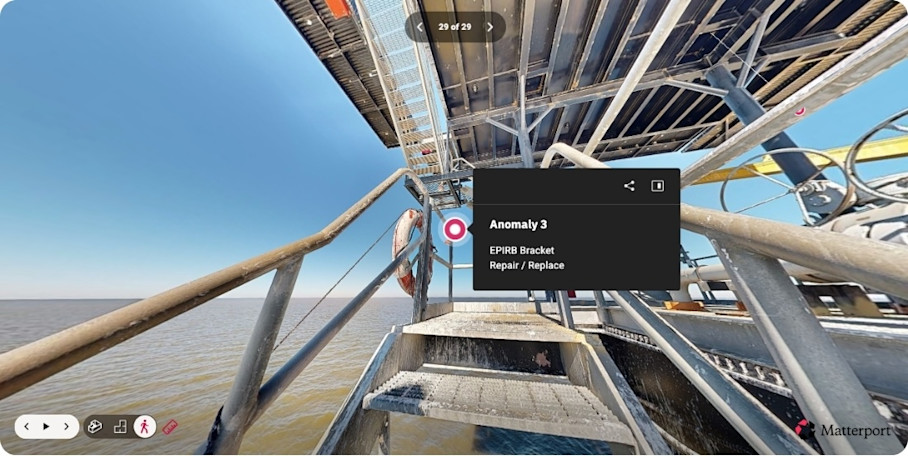
Any team member can navigate to a piece of equipment in the digital twin and access every document associated with it. That cuts the time spent searching for records and ensures that field teams get the information they need at the point of work.
3. Verify: Reconcile documentation with reality
Verification is the step most often skipped, and the one that creates the most risk. Documentation must be checked against actual field conditions to confirm accuracy. A drawing that shows a valve in one location when it's actually been relocated during a previous turnaround creates a discrepancy that leads to safety incidents and blown project budgets.
Teams can view two captures of the same facility in Side-by-Side Spaces, comparing conditions over time to identify modifications or deterioration that may not be reflected in current records. This is especially valuable after turnarounds, where temporary modifications sometimes become permanent without updating the master drawings.
Automated Measuring enables teams to validate layouts, check clearances, and confirm dimensions without requiring a physical site visit. Inspection teams preparing for a scheduled integrity assessment, or planners scoping a shutdown, can confirm critical spatial data remotely before anyone enters the facility.
4. Update: Keep documentation current
Documentation should follow a defined update cadence tied to maintenance cycles, project milestones, and regulatory timelines, not on ad hoc revisions. Federal regulations often require operators to submit as-built diagrams within a specific time frame of new or modified production safety systems being placed in service to certify that the system has been installed.
Matterport-compatible cameras and Capture Services offer a fast and convenient capture workflow, allowing organizations to re-scan facilities on a consistent schedule and create updated digital twins that reflect current conditions after every modification, turnaround, or inspection cycle.
Each new capture creates a time-stamped record, building a visual history of the facility that supports change tracking, audit trails, and historical reference. Over time, this library becomes a powerful resource. When a question arises about a modification or what a section of the plant looked like before a turnaround, the answer is in the captured record, not someone's memory.
5. Share and govern: Control access to facility documentation
Facility documentation often contains sensitive information, like proprietary process configurations and security-critical infrastructure details. Sharing it requires strict controls.
Matterport integrates with CMMS, EAM, BIM, GIS, and EDMS platforms. This helps teams distribute trusted facility documentation through existing operational systems while maintaining a single governed source of truth.
When you need to share a model externally, the Trim and Blur tools let you restrict what's visible. Security-sensitive zones or proprietary process units can be trimmed from the model entirely. Equipment labels or personnel captured during scanning can be blurred. The shareable version protects confidential details while still giving recipients the spatial context they need.
Role-based access controls define who can view, edit, and distribute digital twins and their attached documentation. For enterprise teams, custom roles and permissions, audit logs, and SAML SSO align documentation governance with the rest of the security stack.
Documentation best practices across key field scenarios
The documentation workflow described above applies broadly, but specific operational contexts call for tailored approaches. The sections below cover best practices for operations, inspections, safety, and turnaround planning, each building on the framework without repeating it.
Operations and maintenance
Documentation supports day-to-day decision-making for operations and maintenance teams. It gives them the spatial context to scope work, assign resources, and coordinate execution remotely.
Follow these best practices for operations and maintenance documentation:
Link maintenance records to specific equipment locations. Technicians should be able to review work history and current conditions before arriving on site.
Use virtual walkthroughs for pre-job planning. A 3D walkthrough lets maintenance teams review equipment locations, access paths, and surrounding conditions without entering the facility.
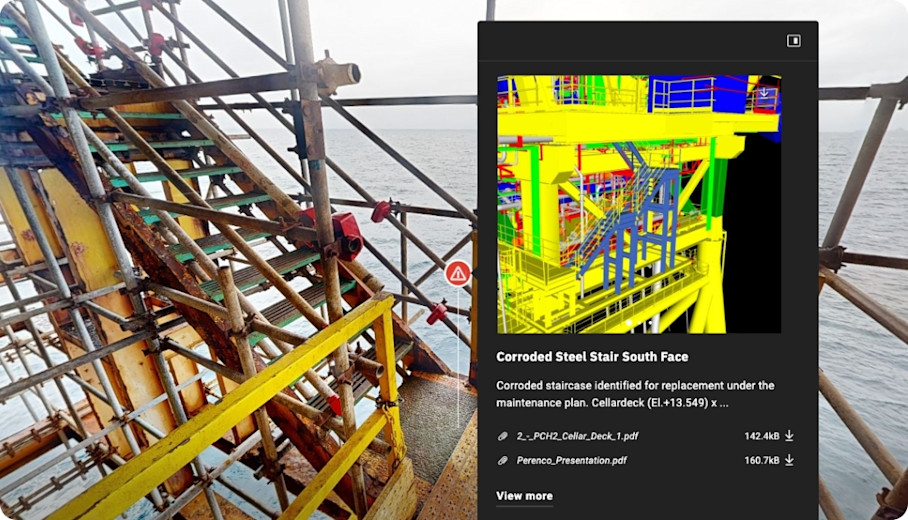
Tag known issues directly in the digital twin. When an operator identifies a leak, corrosion, or unusual vibration, pinning that observation to the exact location in the model ensures the maintenance team sees it in context and can track it over time.
Confirm clearances and access routes before dispatching specialty equipment. Verifying that a crane path or scaffold footprint fits the available space prevents wasted mobilization costs.
Inspection and asset integrity
Inspections depend on accurate, current documentation to identify what needs to be inspected, where it's located, and what has changed since the last review.
Follow these best practices for inspection and asset integrity documentation:
Document the surrounding environment, not just the asset. Inspectors need context: adjacent piping, overhead obstructions, and proximity to other equipment all affect how an inspection is scoped and executed.
Build a defensible documentation trail. A photorealistic, time-stamped digital twin provides visual proof of equipment condition at a specific point in time, supporting audit responses, regulatory inquiries, and internal reviews.
Enable remote pre-inspection reviews. Letting inspectors walk the space virtually before traveling to the site reduces time in the field and improves the quality of findings.
Safety, compliance, and emergency preparedness
Safety and compliance documentation must be immediately accessible and reflect real facility conditions. When an incident occurs, responders don't have time to search for the right revision of a floor plan or wonder whether the layout accounts for recent modifications.
Follow these best practices for safety, compliance, and emergency preparedness documentation:
Use visual documentation for permit-to-work coordination. Showing the actual conditions around a work zone, including adjacent hazards, egress paths, and isolation points, gives permit issuers and workers a shared understanding of the space that written descriptions alone can't provide.
Give emergency responders a clear picture of the facility layout before an incident occurs. A remote safety walkthrough tool like an immersive 3D model showing egress routes and equipment locations allows response teams to rehearse scenarios and plan approach paths without entering the plant.
Reduce unnecessary exposure in hazardous environments. Remote access means personnel can gather information, confirm conditions, and plan work from a safe location rather than entering a live or hazardous area only for information gathering.
Align documentation with confined space and hot work protocols. Visual records of confined spaces, hot work zones, and surrounding equipment improve pre-entry and pre-ignition planning by showing isolation points, ventilation locations, and nearby ignition sources before high-hazard tasks begin.
Turnaround and shutdown planning
Turnarounds are documentation-intensive events where the cost of inaccurate or missing information is measured directly in hours of downtime and budget overruns.
Follow these best practices for turnaround and shutdown documentation:
Use current facility documentation for scope definition. A digital twin captured before the planning phase gives the turnaround team an accurate picture of installed equipment and piping configurations. That baseline feeds scope development, reducing the discovery of "found work" that blows up budgets.
Onboard contractors with a virtual walkthrough. A 3D allows contractors to come prepared with the right questions rather than discovering access constraints on day one.
Capture the facility after the turnaround to establish the new baseline. A post-turnaround scan documents completed work, creating an updated as-built record that feeds directly into the next planning cycle, making the documentation current instead of drifting further from reality with every outage.
Procedures that support safe, repeatable documentation practices
Documentation should be governed by procedures that define how it is created, reviewed, updated, and distributed. Without that structure, even the best capture technology produces records that degrade over time as ad hoc practices introduce inconsistency.
Every oil and gas facility should have the following procedural elements in place:
Procedural element | What it covers | How digital twins support it |
|---|---|---|
Capture standards | Defines what gets documented, when, and how, ensuring consistency across sites and teams. | Repeatable Matterport captures establish standardized capture protocols that don't vary by technician or location. |
Review and approval workflows | Specifies who reviews documentation, approval criteria, and how sign-offs are recorded. | Tags and Notes support review workflows by linking approvals and observations to specific assets within the 3D model. |
Change management integration | Ensures every facility modification triggers a corresponding documentation update, aligned with MOC processes. | Time-stamped captures create an auditable change record tied to modification events, giving MOC teams visual proof of what changed and when. |
Access and distribution controls | Governs who can view, edit, and share documentation, protecting sensitive information from unauthorized access. | Role-based access controls, audit logs, and SAML SSO enforce distribution governance at the platform level. |
Handover protocols | Defines how documentation is transferred between teams, contractors, and project phases to preserve continuity. | Shareable and integrated digital twins simplify handovers by giving every party access to the same verified spatial record. |
When these procedures are in place and backed by a visual documentation platform, facilities move from reactive record-keeping to a proactive system where documentation is a working tool, not a compliance afterthought.
Explore Matterport for Oil & Gas teams