


 Sign In
Nursing Home Maintenance Checklist: Essential Tasks for Resident Safety and Comfort
Nursing homes run around the clock. Maintenance cannot operate the way it does in most tenant buildings. A simple HVAC malfunction that would represent discomfort for other tenants can be a severe health emergency for elderly residents with compromised immune systems. And every task happens in an environment where vulnerable residents are present, care delivery is continuous, and disruption carries real consequences.
A structured, frequency-based maintenance checklist is one of the most effective preventive tools for protecting residents and staying inspection-ready. Strategic, documented facility maintenance programs can reduce corrective maintenance costs significantly. But in senior care, the payoff can be measured in avoided injuries and residents who feel safe in their home.
Here, we’ll provide you with a frequency-based nursing home maintenance checklist for senior living facility management. It covers area and asset-specific tasks, plus practical guidance on how to strengthen maintenance documentation.
Nursing home maintenance checklist by area
When a maintenance task gets missed in a nursing home, the consequences can range from a regulatory citation to a medical emergency, so every area of the building needs a recurring schedule of inspections and upkeep.
Areas requiring regular maintenance and inspection include:
Resident rooms: The most personal and consequential space in the facility. Faults here affect resident safety, dignity, and daily comfort.
Common areas: Spaces like dining rooms, lounges, activity spaces, gardens, and corridors directly shape the quality of life for residents who spend most of their day here. When they are poorly maintained, the impact on morale and well-being is immediate.
Kitchen, laundry, and service areas: Equipment failures and hygiene lapses in these spaces create health risks and are among the most common citation points during state health inspections.
Building systems (HVAC, plumbing, and electrical): These systems underpin every aspect of resident safety and comfort. For elderly residents with cardiovascular, respiratory, or thermoregulatory vulnerabilities, a system failure is a serious clinical risk.
Fire, life safety, and accessibility systems: Sprinkler systems, fire alarms, emergency generators, nurse call systems, and accessibility infrastructure protect residents around the clock. Gaps here create regulatory exposure and, more importantly, put vulnerable people at direct risk.
Each zone carries its own inspection rhythm and its own set of consequences when that rhythm breaks down. Keeping a consistent schedule protects both resident safety and operational continuity most effectively, and different inspection frequencies serve different purposes.
Weekly inspections focus on the systems residents depend on every day. These are the assets most likely to show wear or failure within short cycles, and the ones where a lapse has the most immediate consequences.
Monthly inspections cover higher-effort tasks that go beyond daily observation. These tasks keep the facility environment stable and flag developing problems before they escalate.
Quarterly inspections address building infrastructure and mechanical systems that degrade more gradually. Failures here carry significant remediation costs and, in a nursing home, a genuine health risk.
Annual inspections focus on deep-system servicing, full compliance certification, and condition audits that feed capital planning of assisted living facilities. These typically require extended scheduling windows, dedicated budget, and third-party specialists.
Consistent scheduling only delivers its full value when it is properly documented. In a nursing home, the maintenance record is also a compliance record. State surveyors and health inspectors review maintenance logs as part of standard surveys, and a facility that cannot produce a clear history of completed work is at a significant disadvantage, regardless of the actual condition of the building. Wherever possible, records should include visual evidence alongside text for proper documentation.
Digital twins provide a modern and accessible solution for facility documentation. In a nursing home, re-entering an occupied room to verify a repair, photograph a fixture, or brief a contractor creates disruption for residents. These photorealistic, navigable 3D facility models reduce that disruption significantly. Maintenance managers can review room conditions, annotate issues, and share precise visual context with vendors and compliance teams without setting foot in a resident's space.
The checklist below covers maintenance areas organized by zone, with tasks broken out by recommended frequency. Each completed task should be logged against the relevant space or asset as it is finished, not reconstructed from memory at the end of a shift. Digital twins offer an easy way to do this.
Resident rooms
All room-level maintenance should be scheduled to minimize resident disruption. Coordinate with nursing staff on timing, and wherever possible, complete inspections during activities, meals, or other periods when rooms are unoccupied. For any repair lasting more than a few minutes, notify the resident and their family in advance.
Weekly
Asset / Area | Tasks |
|---|---|
Nurse call and emergency pull cords | - Test all call button functions and pull cords - Confirm audible and visual alerts activate at the nursing station - Document test results and any faults |
Bathroom fixtures | - Test anchoring on all grab bars and towel bars (no movement is acceptable) |
Nightlights and overhead lighting | - Test all fixtures for full operation - Replace burned-out bulbs immediately - Clean lenses and shades |
Flooring | - Inspect for loose edges, curling, cracks, or moisture damage - Identify and flag any trip hazards for immediate correction - Spot clean stains or spills |
Monthly
Asset / Area | Tasks |
|---|---|
HVAC vents and filters | - Inspect vents for dust buildup - Replace filters (clogged filters reduce efficiency and air quality) - Verify supply and return airflow is unobstructed |
Window seals, locks, and hardware | - Test opening and locking mechanisms - Check for drafts around frames and sills - Inspect weatherstripping condition |
Paint, walls, and ceiling | - Inspect for scuffs, stains, damp patches, or cracks - Touch up minor damage - Flag any signs of water intrusion for further investigation |
Electrical outlets | - Test outlet function and GFCI reset - Check for loose faceplates or scorch marks - Confirm all outlets are accessible and unobstructed |
Quarterly
Asset / Area | Tasks |
|---|---|
Bathroom fixtures | - Inspect caulking around sinks, tubs, and showers and reseal as needed - Descale faucets and showerheads - Test exhaust fan operation and clean blades |
Bed frames and adjustable furniture mechanisms | - Test all adjustable positions on beds and recliners - Tighten loose fittings and fasteners - Inspect mattresses for wear, stains, or damage and rotate per manufacturer guidance |
Door closers and hinges | - Lubricate hinges and locking mechanisms - Test door closer resistance (doors should close fully without slamming) - Inspect strike plates and threshold seals |
Smoke detectors | - Test alarm function - Replace batteries on scheduled cycle - Verify no obstructions within 18 inches of detector face |
Annually
Asset / Area | Tasks |
|---|---|
Flooring | - Deep clean or replace high-wear sections - Inspect subfloor for moisture if soft spots are detected |
Window seals and weatherstripping | - Replace worn seals - Inspect frame integrity for any structural concerns |
Paint, walls, and ceiling | - Full repaint per facility cycle (typically up to every 10 years) - Inspect ceiling for moisture or structural concerns |
Bed frames and mattresses | - Full condition audit - Schedule replacement for items beyond serviceable life per manufacturer standards |
Typically, re-entering occupied rooms would be essential throughout these processes: to verify a completed repair, photograph a fixture for a work order, or walk a contractor through a layout. This means disrupting a resident's private space, sometimes repeatedly for a single issue. For residents with dementia, anxiety, or limited mobility, that disruption is not trivial.
Instead, digital twins give maintenance teams a navigable view of every room without anyone needing to physically enter it. A vendor can review the exact room layout, confirm measurements with Automated Measuring, and identify access constraints before arriving on site. A corporate facilities team can have familiar staff capture the twin and then conduct room condition audits from a single, cloud-hosted interface without scheduling disruptive walkthroughs.
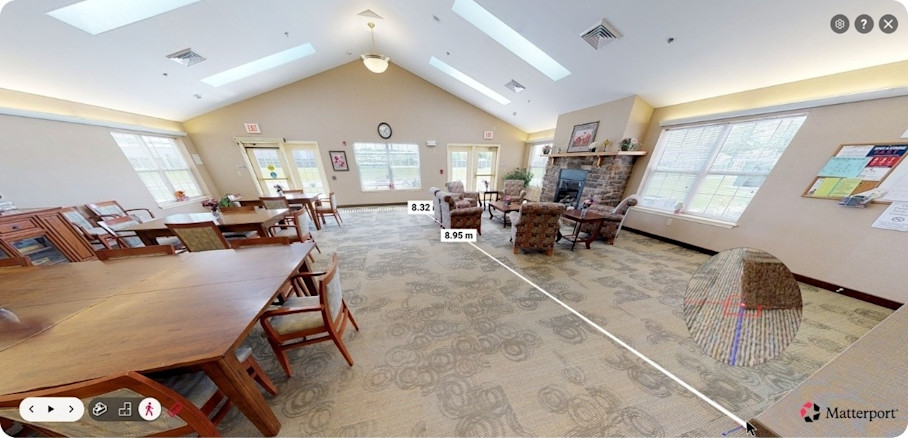
If any issues are opened, teams can flag them in Tags and Notes, pinned to the relevant location directly within the 3D model. This provides precise visual context for repairs, task assignments, and vendor communication. Once a repair is complete, the tag is updated with the resolution date and supporting photos, creating a maintenance history that is reviewable without ever re-entering a resident's room.
Common areas
Dining rooms, lounges, activity spaces, outdoor gardens, and corridors are where residents spend the hours outside their rooms. These spaces carry real weight for the quality of life. A flickering light in the lounge, a cracked tile in the corridor, or a jammed door to the activity room is not a small thing for a resident who relies on easy access to those spaces every day.
Weekly
Asset / Area | Tasks |
|---|---|
Emergency exits and fire doors | - Confirm all exits are unobstructed and clearly signed - Test self-closing mechanism on fire doors - Verify exit lighting is functioning |
Corridors and doorways | - Inspect for clearance — minimum 60 inches for wheelchair passage - Check floor surfaces for damage or trip hazards - Confirm handrails are secure along all lengths |
Flooring and walkways | - Inspect for loose tiles, worn carpet edges, or moisture - Flag and address any uneven surfaces immediately |
Monthly
Asset / Area | Tasks |
|---|---|
Furniture in lounges and activity spaces | - Inspect all seating for structural integrity and tears - Tighten loose fittings - Flag items needing replacement |
Lighting (interior and exterior) | - Test all overhead and accent fixtures - Replace burned-out bulbs - Inspect exterior pathway and parking lot lighting for function and coverage |
Ceiling tiles | - Inspect for stains, sagging, or water damage - Replace any displaced or damaged tiles promptly |
Electrical devices (TV, radio, nurse call stations) | - Test all functions - Check cable connections and firmware update status - Confirm nurse call stations in common areas trigger correct response |
Quarterly
Asset / Area | Tasks |
|---|---|
Elevators | - Conduct required safety inspections per local code - Test door sensors, emergency phone, and lighting - Lubricate guide rails |
Automatic doors | - Test sensor range and obstruction response - Lubricate hinges and check closing speed - Inspect threshold plates |
Stairwells | - Inspect handrails for secure anchoring - Check all tread surfaces for wear or damage - Test stairwell lighting and emergency backup |
Outdoor walkways, ramps, and visitor parking | - Inspect ramp surfaces for cracks or uneven settling - Check handrail and guardrail anchoring - Clear any drainage obstructions |
Landscaping and gutters | - Inspect trees and shrubs for overgrowth that could obstruct sightlines or pathways - Clear gutters and downspouts - Check fencing and gate hardware |
Annually
Asset / Area | Tasks |
|---|---|
Walls and trim | - Full repainting on facility cycle - Inspect for damp or structural damage |
Flooring | - Deep clean or replace high-traffic carpet sections - Refinish hard-surface floors as needed |
Exterior building envelope | - Full inspection of siding, roofing, caulking, and masonry - Address any moisture intrusion points before the wet season |
Teams should compare digital twin captures from different time periods side-by-side to review before-and-after documentation that tracks gradual or recurring wear. For a corridor showing scuff damage that compounds over months, or a garden path that develops drainage issues seasonally, a comparison view makes it far easier to prioritize fixes and demonstrate corrective action to surveyors.
Kitchen, laundry, and service areas
Kitchen and laundry areas are among the most common citation points during health inspections. Temperature logs, equipment service records, and grease trap documentation are all subject to review. For an auditable record, every completed task in these areas should be logged with the date, the name of the person who completed it, and any findings or follow-up actions required.
Weekly
Asset / Area | Tasks |
|---|---|
Commercial refrigerators, freezers, and walk-in coolers | - Verify and log temperatures (min. twice daily for food safety compliance) - Inspect door seals and gaskets - Clean condenser coils |
Commercial laundry | - Clean lint traps after every cycle - Inspect drum seals and door gaskets - Test all cycle programs |
Floor drains | - Test flow and confirm no standing water - Clear any visible debris from drain covers |
Pest control | - Inspect kitchen and storage perimeters for evidence of activity - Document findings and schedule licensed treatment as needed |
Monthly
Asset / Area | Tasks |
|---|---|
Commercial ovens and cooking equipment | - Deep clean interior and exterior - Inspect burner function and ignition systems - Check door hinges and seals |
Range hoods and exhaust systems | - Clean filters and grease traps - Test fan operation and airflow - Inspect duct connections for grease buildup |
Dishwashers | - Descale wash arms and interior - Check temperature at wash and rinse cycles for compliance - Inspect door latch and gasket |
Water heaters and plumbing connections | - Check for leaks at all connections - Verify thermostat settings (typically 120°F/49°C to prevent Legionella) - Flush sediment from water heater tank |
Quarterly
Asset / Area | Tasks |
|---|---|
Kitchen fire suppression systems | - Inspect nozzles, fusible links, and agent containers - Test manual pull station - Confirm service records are current and posted |
Garbage disposal units | - Test operation - Inspect mounting and drain connections - Clean interior and deodorize |
Storage rooms | - Inspect shelving for structural integrity - Verify clear aisle access and proper chemical segregation - Check for moisture, pests, or temperature concerns |
Laundry exhaust vents | - Clean full duct run - Inspect exterior vent cap for obstructions - Test airflow to confirm adequate exhaust velocity |
Annually
Asset / Area | Tasks |
|---|---|
Commercial kitchen appliances | - Full service by licensed technician - Calibrate thermostats and controls - Replace worn components per manufacturer schedules |
Grease traps | - Professional cleaning and inspection - Document service for health inspection records |
Water system | - Conduct full water risk assessment - Flush low-use outlets - Test and document results per local health authority requirements |
Time-stamped visual documentation with attachments like notes, photos, equipment manuals, and service history helps significantly when presenting records to an inspector. A well-populated digital twin creates a traceable record of recurring issues, surfaces patterns that predict equipment failure, and provides the completion evidence required for a defensible audit record.
HVAC, plumbing, and electrical systems
In most commercial buildings, an HVAC or MEP failure means discomfort. In a nursing home, it can mean a medical event. These systems require very thorough inspection schedules, along with redundancy planning and pre-established vendor relationships that guarantee rapid response when something fails.
Weekly
Asset / Area | Tasks |
|---|---|
HVAC system | - Inspect air handlers and return vents for obstruction or visible damage - Confirm thermostat readings align with set points in resident wings |
Plumbing fixtures | - Inspect under sinks and around toilets for visible leaks - Test emergency shut-off valves in high-risk areas |
Sump pumps | - Test operation (especially prior to rain events) - Confirm discharge line is unobstructed |
Monthly
Asset / Area | Tasks |
|---|---|
HVAC filters and coils | - Replace or clean air filters - Inspect evaporator and condenser coils for fouling - Document filter replacements with date and filter spec |
Thermostat calibration | - Verify thermostat accuracy in all resident wings with a calibrated thermometer - Adjust or replace any units reading outside ±2°F (1°C) tolerance |
GFCI outlets | - Test and reset all GFCI outlets throughout the facility - Document any outlets that fail to reset and schedule replacement |
Electrical panels | - Visually inspect all panels for labeling accuracy, heat discoloration, or tripped breakers - Tighten any loose connections identified during inspection |
Quarterly
Asset / Area | Tasks |
|---|---|
HVAC exhaust fans | - Clean fan blades and housing - Test operation and listen for unusual noise - Lubricate bearings per manufacturer specification |
Ductwork | - Inspect accessible duct sections for gaps, corrosion, or insulation damage - Test airflow balance in resident rooms and common areas |
Backflow prevention devices | - Test and document per local plumbing code requirements - Replace any devices that fail test |
Water heaters and boilers | - Inspect anode rods and replace if depleted - Test pressure relief valves - Check expansion tanks for correct pre-charge pressure |
Annually
Asset / Area | Tasks |
|---|---|
HVAC full service | - Commission full HVAC system service by licensed technician - Clean and inspect all duct runs - Test refrigerant charge levels and inspect heat exchangers |
Electrical systems | - Full inspection by licensed electrician - Test load balance across all panels - Inspect wiring in ceiling voids, service areas, and mechanical rooms for wear or rodent damage |
Plumbing system | - Full inspection of supply and drain lines - Test water pressure at all zones - Inspect roof drains, storm drains, and area drains for capacity |
Searchable Tags in digital twins help maintenance staff and external contractors to quickly locate HVAC units, electrical panels, and plumbing fixtures without walking the full property. For multi-wing facilities, this is particularly useful for orienting new technicians, briefing contractors on equipment locations before a site visit, or identifying the correct shut-off valve in an emergency without the delay of hunting through mechanical rooms.
Fire, life safety, and accessibility systems
Life safety and accessibility systems must be tested on a regular, published schedule to ensure that they are aligned with emergency preparedness planning. Waiting for a problem to be reported is not a compliant approach, and it is not a safe one. The recommended testing frequency for these systems is weekly, with all results logged and available for surveyor review. Sprinkler systems, fire alarms, and emergency generators follow quarterly and annual inspection cycles set by NFPA standards and local fire code.
Weekly
Asset / Area | Tasks |
|---|---|
Nurse call systems, wander-prevention alarms, and emergency pull cords | - Test all call buttons and pull cords in resident rooms and common areas - Verify wander-prevention door alerts are active at all controlled exits - Document results in the weekly safety log |
Emergency lighting and exit signs | - Test battery backup activation on emergency lights - Confirm all exit signs are illuminated and legible - Replace any failed units immediately |
Fire extinguishers (visual inspection) | - Confirm all extinguishers are mounted, accessible, and showing full pressure - Check for visible damage or expired tags - Log inspection date on each unit |
Monthly
Asset / Area | Tasks |
|---|---|
Grab bars and accessibility hardware | - Test anchoring on all grab bars — no movement permitted - Inspect accessible toilet and shower fixtures for secure mounting - Check ADA-compliant signage for legibility and correct placement |
Doorway clearances for wheelchair accessibility | - Measure clearance at any doorway flagged or modified since last check - Confirm no furniture or equipment is reducing corridor width below 60 inches |
Ramp surfaces and exterior handrails | - Inspect surface material for cracking, heaving, or wear - Test handrail anchoring and cap condition - Check for drainage issues causing pooling at ramp base |
Quarterly
Asset / Area | Tasks |
|---|---|
Fire alarm system (pull stations, panel communication, detectors) | - Test a rotation of pull stations each quarter so all stations are covered annually - Verify panel communicates with monitoring service - Test all smoke and heat detectors in the zone per rotation schedule |
Sprinkler system (heads and water flow) | - Visually inspect all sprinkler heads for damage, paint, or obstruction - Test water flow alarm and verify correct panel response - Inspect heads near heat sources for early activation risk |
Fire dampers | - Test a sample of dampers per rotation schedule - Document findings and schedule any repairs immediately |
Emergency generators and backup battery systems | - Run generator under load for minimum 30 minutes - Test automatic transfer switch - Inspect battery backup systems for all life safety devices (nurse call, door alarms, emergency lighting) |
Annually
Asset / Area | Tasks |
|---|---|
Fire suppression systems | - Full inspection by licensed fire protection contractor - Document all findings and corrective actions for the inspection record |
ADA compliance review | - Full audit of accessible routes, signage, restrooms, and parking - Document compliance status and any remediation plan |
Drill documentation | - Compile full-year fire drill and emergency response drill log for state survey readiness - Review and update emergency response procedures based on drill findings |
Digital twins support spatially accurate accessibility planning by giving maintenance and compliance teams a complete visual record of accessible routes, doorway clearances, ramp locations, and signage placement. For facilities planning renovations or responding to accessibility citations, the 3D model provides schematic floor plans for designing compliant solutions.
Life safety procedures also carry high knowledge-transfer risk during staff turnover — testing sequences, load-test protocols, and fire damper layouts are operational knowledge that leaves with departing staff. Pinning these procedures to the relevant equipment within the digital twin creates a training resource that survives transitions without requiring shadowing shifts that disrupt residents.
How to turn a nursing home maintenance checklist into an audit-ready system
Paper checklists and spreadsheets are not efficient resources for maintenance planning and tracking. They cannot be searched during an inspection without manual page-turning and version control is difficult to manage. Additionally, records are easily lost during staff transitions, which are frequent in the senior living and care sector.
Matterport digital twins create an accurate replica of all spaces. Maintenance managers can review every part of the facility without physically walking every wing or disturbing residents and log tasks contextually. And when an inspector asks to see evidence of conditions, fully contextual documentation is already accessible and timestamped.
Sharing models through Matterport Cloud allows remote collaboration with vendors, contractors, and corporate facilities teams. Outside partners can review the exact space and issue before arriving on site, reducing unnecessary visits that disrupt care delivery.
Digital twins can also be connected to CMMS systems via integrations, compounding efficiency. Work orders can be linked directly to the location in the digital twin where the issue was flagged, creating a closed-loop record from identification to resolution.
Multi-site assisted living operations can use standardized digital captures to create consistent inspection baselines across every location. Professional Capture Services are available in 700+ cities globally, offering professional scanning for organizations that want to standardize this process at scale, ensuring the same documentation quality whether a property has two buildings or twenty.
Properly documented maintenance operations not only run better day-to-day, but also help defend processes more effectively when surveyors arrive. More importantly for nursing home operators, a well-maintained facility is an expression of the standard of care a home holds itself to and the residents living in it deserve nothing less.
Deliver better Assisted Living experiences with Matterport