


 Sign In
10 Ways to Reduce Multifamily Operating Expenses Without Cutting Service
Key takeaways
The most durable way to cut multifamily operating expenses is to work more efficiently, not spend less, removing redundant trips, rework, and coordination drag so cost leaves the building without residents feeling it.
Controllable costs like turns, labor, vacancy, and vendor scoping carry outsized value: at a 5% cap rate, every dollar of recurring expense removed adds roughly $20 to the property's value at sale.
A Matterport digital twin gives distributed teams one shared, accurate record of each unit, so they can inspect, scope make-readies, tighten vendor bids, and document move-in/move-out condition remotely, from a single capture.
There’s always pressure to trim multifamily operating expenses. Owners want a bigger NOI, and budgets keep tightening while costs rise. Quick fixes like deferring maintenance, thinning out on-site staff, or trimming turn budgets come with a hefty long-term price that is rarely worth it.
There is a better way to reduce multifamily operating expenses without damaging the tenant experience or risking future facility nightmares. It’s a series of strategies built around working more efficiently that removes hidden expenses residents don't notice.
This guide walks through practical, portfolio-scale strategies that protect service levels while lowering spend. Each targets a controllable line item and scales across a spread-out portfolio rather than one property at a time.
Where do multifamily operating expenses accumulate most often?
Two types of operating expenses matter:
Controllable OpEx is the spend you can influence through how you operate. This includes maintenance, turns, labor hours, vendor contracts, and marketing.
Non-controllable costs like property taxes and many insurance drivers sit largely outside your day-to-day decisions.
The distinction between the two is important because of how multifamily properties are valued. Buyers price an asset based on its net operating income (NOI), which is the rent and other income left after operating expenses. Every dollar of recurring expense you remove adds a dollar to NOI.
That dollar then gets multiplied at sale. Property value is roughly NOI divided by the cap rate (or return a buyer expects). At a 5% cap rate, each dollar of added NOI is worth about $20 in asset value.
The most controllable multifamily operating expenses
Operators can influence a handful of big categories:
Maintenance and repairs: Reactive fixes cost more than planned ones.
Turnover and make-ready: Inspection, scoping, and vacant days stack up fast.
On-site and regional labor: Hours spent traveling and re-walking units.
Utilities: Submetering, retrofits, and waste from poor documentation.
Insurance: Rising premiums and higher deductibles shift cost onto operators.
Vendor and contract services: Vague scopes produce padded bids.
Marketing and vacancy loss: Empty days are pure lost revenue.
Administrative costs: Coordination overhead buried in email and phone calls.
The hidden cost drivers across every category
Four hidden cost drivers also cut across every one of those categories. They rarely show up as their own budget line, so it’s important to monitor them. They include:
Redundant site visits: A leasing agent, a maintenance tech, a regional manager, a vendor, and an adjuster each drive to the same unit to see the same thing.
Travel and windshield time: Regional staff burn hours and mileage covering assets spread across a metro or a state.
Rework from incomplete documentation: Wrong measurements, missing photos, and vague work orders send crews back to re-scope and redo.
Coordination overhead: Decisions live in email threads, phone calls, and texts between leasing, maintenance, and vendors, so nobody has the full picture.
Indiscriminate cost-cutting just moves these costs into the future. Deferred maintenance becomes a CapEx line, understaffing lengthens turns, and a trimmed turn budget shows up as higher vacancy and resident churn.
Operational optimization does the opposite. It removes cost while maintaining, or even improving, service levels, vacancy rates, and resident experience.
10 ways to reduce multifamily operating expenses
Operational efficiency strategies aren’t siloed or one-off. Use them in tandem and apply them to each controllable operating expense.
The common thread is that each strategy works at portfolio scale, not one property at a time. A shared, accurate visual record of each unit is the single biggest advantage a distributed portfolio can build, because it lets every team work from the same picture without another trip to the site.
1. Replace routine site visits with remote inspections
Start with the cost of driving. Picture a regional manager who spends 12 hours a week logging 300 miles to cover 10 properties. Over a 48-week year, that’s about 580 hours of low-productivity time, and countless delayed decisions, behind the wheel.
The fix is to bring the property to the RM instead. Scan a unit once, and it becomes a 3D digital twin – an immersive, to-scale model of a real space built from a comprehensive scan. It allows operations professionals to “walk” the space from anywhere without requesting access or dispatching staff.
Matterport Capture Services makes scaling easy. You can order an on-demand scan from a vetted technician network across hundreds of cities worldwide. No need to send your regional team.
There’s no need to hand over the full record or coordinate a live walkthrough. Instead, an operator can create customized Views within the digital twin, sharing only the information a regional manager or vendor needs to see.
With a 3D digital twin, reviewers can check a fresh scan from their desk every quarter without driving to each property multiple times a year. For vacant-unit sign-offs, the regional manager can review and approve a digital walkthrough the same day the scan is captured, getting the unit on the market faster.
2. Shorten unit turns with faster make-ready scoping
Turn cost is multifaceted. Inspection labor, scoping time, vendor mobilization, rework, and days of lost rent add up while the unit sits empty. Most of these have built-in documentation inefficiencies. When the scope is wrong or incomplete, crews get called back, and plans have to pivot.
A 3D scan of the property taken at move-out gives maintenance supervisors, regional managers, and vendors the same view of the unit within hours. Scoping then happens in parallel across the team.
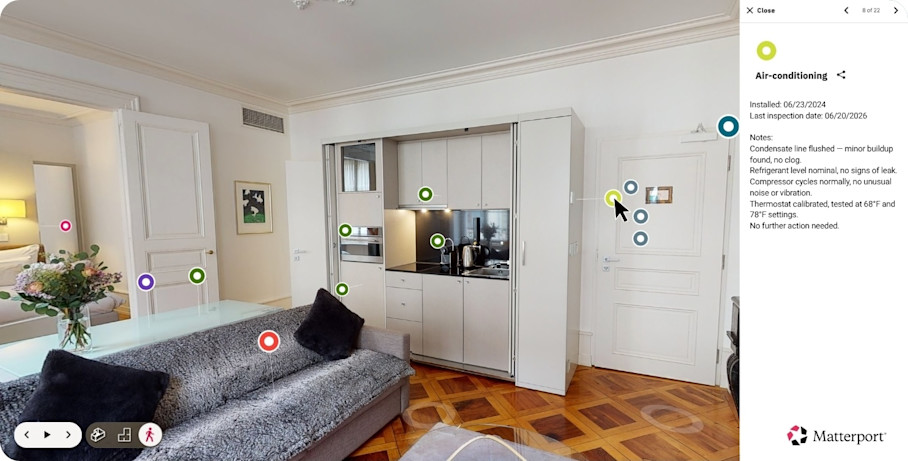
Flag each work item at the exact spot it needs to happen by using Tags inside the resulting digital twin. When a damaged countertop or missing blind gets flagged, important context travels with the location instead of sitting in a separate work order.
Additionally, Automated Measurements establish space dimensions accurately during digital twin capture, enabling scoping. When vendors need more dimensions for flooring, paint, countertops or anything else, those can be pulled directly from the model using Measurement Mode, so there’s no need for a site visit.
The payoff compounds. Shave three to five days off an average turn across 5,000 units at $1,800 rent, and you recover several million dollars of otherwise lost rent each year.
3. Recover more security deposits with airtight move-in/move-out documentation
Deposit disputes cost revenue in multiple ways. Staff burn hours arguing over what changed, and the operator often absorbs damage anyway because photo documentation was too thin to support the charge. Inconsistent checklists and blurry phone photos are the root cause.
Capturing a digital twin at move-in and again at move-out turns documentation into a standard step in the lease lifecycle, helping to reduce security deposit disputes. The record is timestamped, consistent, and easy to justify when a charge is questioned. Side-by-Side (public beta) places the two captures together so condition changes are visible without interpretation. This instant comparison supports deposit recovery and reduces escalations.
There's a knock-on benefit for stretched teams. Fewer conflicting accounts of a unit's condition means a shorter resolution process, so on-site staff spends less time refereeing disputes. Residents also benefit from a transparent, verifiable record of the unit they're renting, reducing friction and improving the experience.
4. Shift from reactive repairs to preventive maintenance
The cost curve of a single issue can quickly get out of hand. A slow leak caught early is a plumbing call. Caught late, it becomes drywall, flooring, mold remediation, and a CapEx line nobody budgeted.
The difference between these two scenarios is visibility. To avoid the higher cost of reactive repairs, set a recurring capture cadence for high-risk areas, such as:
Mechanical rooms
Roofs and roof access
Corridors
Amenity spaces
Units at turn
When you can see how a space changes over time, small issues surface before they escalate.
Keep equipment details like model, serial number, service history, manuals, and warranty documents attached to Tags in the unit model. With a centralized visual record, maintenance directors can spot patterns across properties. A consistently failing water heater or drainage problem gets a different resolution since each incident isn’t seen in isolation.
Here’s an example of a simple preventive inspection checklist to tie directly to the documentation.
Area | What to check | What to tag in the capture | How often |
|---|---|---|---|
Mechanical rooms | Water heaters, pumps, panels, and signs of corrosion or moisture | Model and serial numbers, install dates, service history, and manuals | Quarterly |
Roofs and roof access | Membrane damage, ponding water, clogged drains, and flashing | Problem spots, drain locations, and warranty documents | Quarterly and after major storms |
Corridors | Ceiling stains, flooring wear, and lighting outages | Stain locations and fixture types | Twice a year |
Amenity spaces | Worn flooring, damaged fixtures, and equipment hazards | Equipment details and replacement dates | Quarterly |
Units at turn | Under-sink plumbing, windows, appliances, and HVAC filters | Each issue at its exact spot, with a note for the work order | Every turn |
5. Tighten vendor scopes and bids to eliminate change orders
Vague scopes can hide multiple avoidable costs. Vendors pad bids to cover what they can't see. Then they bill change orders mid-project for what the scope missed.
Verifying finished work remotely is just as hard as scoping it. Operators either drive to the site or take the vendor's word. Instead, send vendors a digital twin where they can use Measurement Mode to bid from accurate dimensions without a site walk, leading to faster and more accurate competitive quotes.
While the work is being planned and executed, add any clarifications as Notes inside the model, so you have a full record of collaboration in context, instead of scattered across inboxes. Once the work is completed, compare the before and after scans of the renovation to verify completion before releasing payment–remotely, across the whole portfolio.
6. Cut utility waste with better monitoring and mechanical documentation
To optimize utility usage, start with a standard playbook. Consider the following tactics:
Submetering and Ratio Utility Billing Systems (RUBS) that shift usage cost to residents
LED retrofits and low-flow fixtures that cut consumption
Irrigation controllers and HVAC scheduling that trims waste
Leak-detection sensors that catch problems early
The next step is addressing the documentation gap that undermines these programs. If nobody knows exactly where the shutoffs, panels, meters, risers, and HVAC equipment sit, contractors bill discovery time at every property before real work starts.
Tag that equipment inside a digital twin of the mechanical spaces to cut vendor work time and speed emergency response. With a navigable map to follow, third parties will also be able to streamline retrofit bidding across similar floor plans.
7. Fill vacancies faster with remote leasing and pre-lease showings
Vacancy loss is an operating expense, not just a marketing metric. Across a 5,000-unit portfolio at $1,800 rent, a single day of blanket vacancy is roughly $300,000 in lost revenue, making leasing speed one of your most controllable expenses.
Round-the-clock virtual tours let prospects walk a unit before a leasing consultant gets involved. That cuts on-site showing hours and the travel needed to show scattered-site or lease-up assets. Since prospects explore on their own schedule and pre-qualify themselves before contacting leasing staff, teams field fewer unqualified showings.
Pre-leasing works here, too. A unit still in make-ready can stay in front of prospects the whole time it's being turned, which compresses the gap between one resident moving out and the next moving in. Fewer repetitive showings free on-site teams to focus on resident service, protecting renewals and reducing team stress.
8. Reduce coordination and onboarding overhead across distributed teams
A surprising amount of administrative time disappears into explaining a space. Someone describes a unit over the phone, re-sends the same photos, or re-walks the property for each new stakeholder. None of it shows up as a line item, but it's labor all the same.
Regain this lost labor by using the digital twin of your properties as one shared visual record for leasing, maintenance, construction, asset management, and ownership. With every team working from the same view of the property, you don't have to reconcile different versions.
Notes keep decisions, tasks, and files attached to the relevant location. That creates an easily searchable record instead of an endless email chain with key details buried deep inside.
Captured properties also make onboarding faster. New on-site staff and new third-party management assignments can get oriented before their first day on site, which matters in a market with chronic hiring and retention pressure.
Picture a third-party manager taking over a 300-unit community with two weeks' notice. With the property already captured, the new team walks every floor plan from their desks and finds tagged shutoffs, panels, and water heaters with complete service histories. They flag common area issues before anyone arrives. They show up on day one with a punch list, not looking for issues.
9. Base capital and renovation decisions on data you already have
Every time ownership asks whether to renovate, reposition, or defer, the default answer is another round of assessments and vendor walkthroughs. That's a fresh cost and lost time for a decision you may not even make. The data to start the conversation often already exists in a capture you paid for once.
Most of those questions can be answered using a digital twin. Property Intelligence generates room-level layouts and property details straight from an existing scan, so a repositioning conversation will start with what you already have instead of another site visit. When a decision moves toward real work, like reconfiguring a kitchen or converting an amenity space, export CAD files to hand design and construction teams accurate, reusable dimensions. And when owners want to picture a space differently,strip a unit to an empty shell in one click with Defurnish, so they can test the idea before paying to clear anything out.
Comparing captured conditions in Side-by-Side also helps you prioritize CapEx across a portfolio, instead of relying on inconsistent property-level reports. Faster renovation decisions connect straight back to vacancy, because units held out of inventory for planning sit empty, and every day counts.
10. Strengthen your insurance and claims position with pre-loss documentation
Multifamily insurance costs have climbed sharply. In a Federal Reserve Bank of Minneapolis survey of multifamily owners across its four-state Upper Midwest district, average premiums roughly doubled between 2021 and 2024, with higher deductibles pushing more loss cost onto operators. That makes documentation quality a direct expense factor and a compliance issue.
Capture units and common areas before a loss so condition and contents are documented when water, fire, or storm damage occurs. Establishing a shared, dimensionally accurate digital twin for insurance makes it easier to justify a claim rather than argue it from memory. Matterport Sketch files also plug directly into Cotality, shortening estimating timelines.
There's a secondary use worth noting. The same record supports litigation and liability matters, where conflicting accounts of a space tend to drive up legal spend. One source of truth reduces adjuster back-and-forth and potential disputes over the scope of damage.
Turn multifamily operating efficiency into durable NOI gains
Significant opportunities exist to reduce multifamily operating expenses without cutting service. The strategies in this guide show how to trim costs by removing waste, redundant trips, rework, and coordination drag, rather than by taking something away from residents or simply deferring maintenance that adds cost in the long run.
Faster turns, preventive maintenance, remote inspection, standardized processes, and tighter vendor scoping compound. Each one protects a controllable line item, and together they protect NOI in a way that shows up at valuation.
The connective layer under all of it is a shared visual record, one accurate capture that leasing, maintenance, and vendor teams all work from.
Get started with Matterport for Multifamily


