


 Sign In
7 Digital Twin Use Cases for Retail Planning & Operations
Stores don't hold still for long. Seasonal resets, fixture changes, and remodels happen on tight timelines, and the teams managing them need accurate spatial data from the moment a project starts. 3D digital twins, which are dimensionally accurate replicas of physical spaces, give retail organizations a live record of every location they can measure, share, and act on without a site visit.
As retailers face mounting pressure to reduce costs, accelerate renovations, and maintain brand consistency across hundreds of locations, digital twins offer a more useful way to manage spatial data that static photos and flat drawings never could.
The seven use cases below show how a single capture session compounds across an entire retail operation.
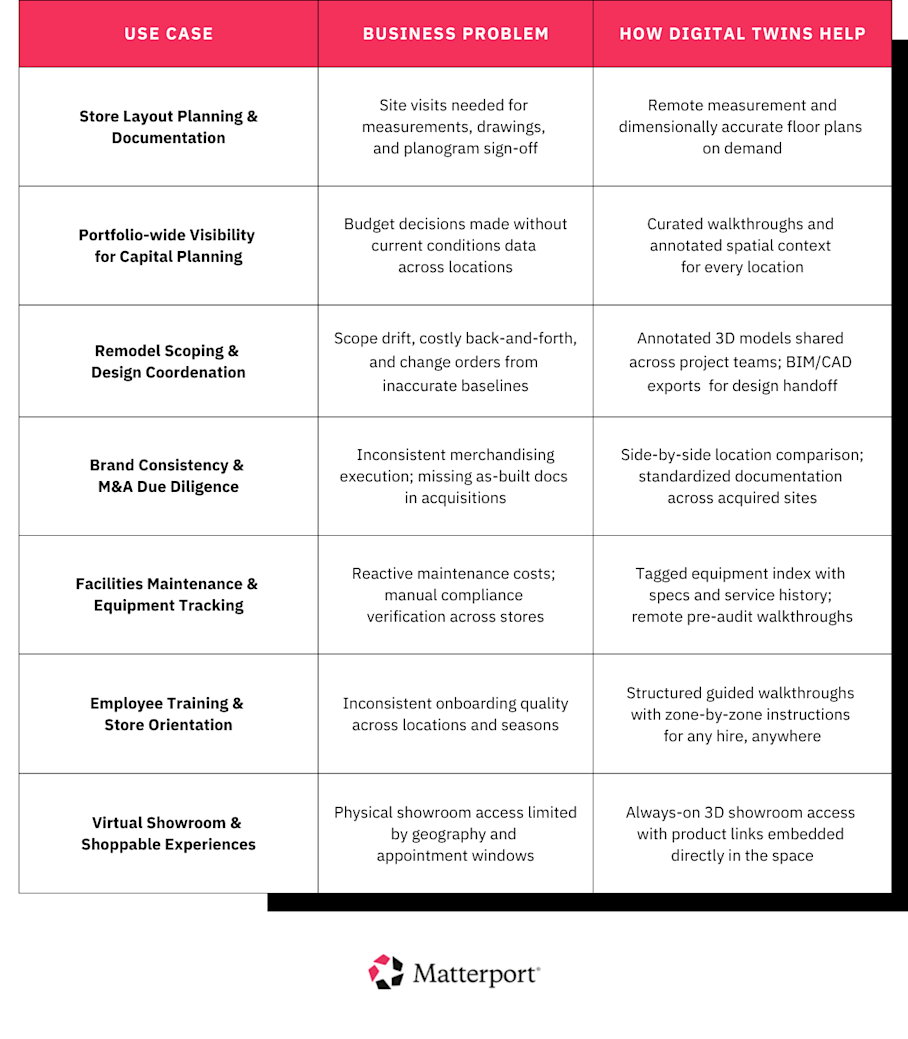
1. Store layout planning and documentation
Retail space planning depends on accurate spatial data. For most teams, getting that data means scheduling a site visit, commissioning a drawing package, or waiting on someone at the store to measure something and report back.
A digital twin cuts all three out of the process via:
Planogram and fixture planning: Merchandising teams can walk through a store remotely and test fixture configurations and planogram changes before committing to a rollout. The annotated model can then be shared with regional managers for sign-off directly. Seasonal updates that used to require multiple rounds of in-person review can move in a fraction of the time.
Remote measurement: Matterport's Automated Measuring provides precise aisle widths, ceiling heights, doorway clearances, and fixture footprints on demand. Whether a new display will fit is a question you can answer from your desk without having to survey the site or coordinate with store staff to get a tape measure out.
As-built documentation: Schematic floor plans can be generated from the same twin in as little as 48 hours. BIM files at LOD 200 deliver in days without commissioning a separate drawing package, hiring a surveyor, or adding another vendor to the queue.
A digital twin can serve as the de facto record of a space, serving as a visual resource for layout decisions.
2. Portfolio-wide visibility for capital planning decisions
Capital planning conversations about which stores to remodel, renew, or exit often happen without anyone in the room having seen current conditions at those locations. Leadership works from slide decks, secondhand reports, and whatever photos a regional manager thought to take. As a result, budget decisions are made based on incomplete evidence.
A centralized digital twin library gives decision-makers direct visibility into current store conditions. When every location has a current scan, Guided Tours and Views let you build curated walkthroughs that bring executives directly into the stores during budget reviews. A store planning director can walk a CFO through specific locations from a conference room, pointing out deferred maintenance in one and an undersized stockroom in another, without booking a single flight.
Tags help document issues and cost drivers directly inside the twin, with useful resources attached. Spatial context helps budget owners understand the reasoning behind a project estimate, not just the number.
Portfolio decisions that improve when every location has a current digital twin include:
Lease renewal vs. termination: Evaluate building condition relative to remaining lease terms.
Remodel prioritization: Compare store models side-by-side to rank projects by need and ROI.
Consolidation analysis: Assess which locations can absorb volume from a closing store.
Expansion site comparison: Review prospective spaces remotely alongside existing locations.
For retailers with 100+ locations, Matterport Capture Services provide a scalable way to build this library. Professional technicians capture each site to a consistent standard, giving corporate a reliable portfolio of models to work from.
3. Remodel scoping and design coordination
Remodel projects often start with a site visit. That's followed by weeks of back-and-forth clarifying what was seen and what needs to change. By the time design work begins, original conditions may already be outdated or misremembered. A digital twin solves that by capturing the space once and making it accessible to anyone who needs it.
Teams can annotate specific areas directly inside the 3D model, adding scope notes, flagged issues, or punch-list items. That keeps the project context attached to the space instead of spread across meeting notes; a contractor reviewing the model can see where new electrical will go and what existing equipment will stay in place.
Matterport’s Procore integration extends this further. Teams tag RFIs and observations inside the twin and sync them directly with Procore’s project management tools, keeping everyone, from the owner’s rep to the subcontractor, on the same source of truth throughout the project.
On the design side, Autodesk integration streamlines handoffs to design teams. Recap plug-ins import BIM files and point clouds directly from Matterport without additional file conversion. CAD exports and E57 files feed into existing design workflows, giving architects and engineers a dimensionally accurate foundation to build from.
The combined impact across a remodel program shows up in:
Fewer pre-bid site visits for contractors
More accurate initial estimates based on real spatial data
Reduced back-and-forth during scoping
Fewer change orders during construction
RPM Pizza, the largest Domino’s franchisee in the U.S., used Matterport to redesign and renovate 30 stores in six months, a process that typically takes twice as long. They cut project initiation time by 50% and, with scans already in hand, bypassed lengthy bidding processes by sending data to multiple contractors simultaneously across different regions.
4. Brand consistency and M&A due diligence
Testing merchandising changes often requires physical mockups or live pilots that disrupt store operations. Digital twins offer a single visual record that can be reviewed and shared without touching the sales floor.
Brand teams can use digital twins to compare locations side-by-side and identify inconsistencies in merchandising execution or fixture placement. Accurate measurements pulled directly from the twin confirm that new fixtures and displays will fit before they ship, which is especially relevant for seasonal campaigns and promotional installations with custom-printed graphics, where a wrong dimension means reprints, delays, and rework.
At GUESS, for instance, visual merchandising teams configure new layouts and displays in a mock store at corporate headquarters. The company then captures a digital twin of its sample space with a Matterport camera and shares it with store managers globally. Color-coded Tags are anchored to specific products with audio, video, or detailed notes to create a visual playbook that store managers reference directly during resets.
Since 2017, GUESS has used Matterport digital twins to achieve a 200% increase in productivity, a 30% decrease in travel costs, and a 95% reduction in departmental paper and printer ink costs.
For M&A scenarios, BIM file and floor plan add-ons help standardize documentation across acquired locations that often come with inconsistent or missing as-built drawings. For example, if a retailer acquires dozens of stores from another brand, digital twins provide:
Faster due diligence cycles by giving evaluation teams spatial context remotely
Reduced travel during evaluation since multiple stakeholders can review locations from anywhere
A ready-made documentation library the integration team inherits on day one
When BMO acquired 503 branches from Bank of the West, floor plans were missing for most locations. The team scanned every branch with Matterport, giving architects, technology, and facilities staff remote access to full spatial context without repeated site visits. BMO recouped 6,000 hours of survey work across the 503 locations and saved over $500,000 in travel and site visit costs within 15 months.
5. Facilities maintenance and equipment tracking
Reactive maintenance is expensive. A digital twin gives facility management teams the spatial and operational context they need to address issues faster and reduce routine costs.
Tags and Notes help build a standardized equipment index across every store in the portfolio. Each tagged asset can be linked to its specifications, maintenance history, and vendor contact. When something fails, the model number is a click away and the service vendor gets a twin link pointing directly to the tagged equipment, including surrounding access constraints, before they load the truck.
Digital twins also streamline compliance audits. You can walk a location remotely to verify equipment placement and safety signage before scheduling an in-person visit, thus catching obvious gaps early and making on-site inspections more focused.
For example, Apex Imaging Services' 3D site surveys help clients uncover opportunities to improve in-store experiences. Clients share the digital twins with real estate, facilities, and loss prevention teams to verify that stores meet standards for equipment condition, insurance coverage, and remodel candidacy.
Their ApexView service is used by teams at brands including Starbucks, Home Depot, 7-Eleven, Fresh Market, and Chipotle. For retailers at that scale, a visual record of every store's physical assets is how you prevent reactive maintenance from eating the facilities budget.
6. Employee training and store orientation
Training quality at multi-location retailers often varies from store to store. A new associate’s first week depends heavily on how much time the store manager has, how experienced that manager is as a trainer, and how complete the available documentation they’re working from happens to be. None of those variables are consistent across hundreds of stores.
A digital twin standardizes the baseline. Guided Tours can be configured as structured orientation paths that walk a new hire through the store zone by zone, with Tags carrying instructions, safety notes, and operational context at each stop. This way, an associate in Atlanta and one in Portland can get the same walkthrough, with the same level of detail, regardless of who is managing their store.
GUESS found that digital twin access and iPad-based training content save store managers 5 to 10 hours per week per store. Multiplied across hundreds of locations and thousands of seasonal hires each year, that’s a significant return on a single capture session.
“In addition to streamlining our process and improving productivity, we’re investing in our associates by advancing their skills with the latest technologies. The combination of iPad, Bigtincan, and Matterport gives us the power to be more innovative and creative with our retail professional development programs.”
- Jacklyn De Antunano, Project Manager, Training and Development, GUESS
The same approach applies to contractor onboarding. Sharing a twin before a bid walk gives contractors full visual and dimensional context, including ceilings, mechanical rooms, and back-of-house zones they might not access during a short visit. Every bidder evaluates the same conditions, which means estimates come in more accurate and surprises during construction are fewer.
7. Virtual showrooms and shoppable experiences
Showroom investments are constrained by physical access. A buyer who can’t travel to New York, Milan, or Paris during fashion week simply misses it. For wholesale-dependent brands, that’s lost revenue and a smaller audience for every collection launch.
A digital twin turns a physical showroom into a destination that’s open around the clock. Tags further improve the experience by linking products in the showroom directly to detail pages, spec sheets, or purchase flows. A wholesale buyer browsing a digitized apparel showroom can simply click a Tag on a jacket, review its full specifications, and place an order without leaving the 3D model.
The benefits show up as:
Showroom investments reaching a wider audience, as one physical space serves customers globally.
Wholesale buyers being able to preview collections without travel, which reduces appointment scheduling friction and expands buyer access.
Online shoppers getting a richer sense of the brand environment, since 3D twins are more immersive than product photos.
When luxury fashion buyers couldn’t visit showrooms in Europe, Retail VR used Matterport to create digital twins that gave them high-definition 3D access to garments from any angle. GUESS used the same approach to share new collections remotely, and has since doubled its showroom appointments while significantly reducing air travel for staff and wholesale customers.
Bringing retail workflows into a single digital view
One capture session creates a digital twin that supports dozens of workflows, without anyone revisiting the site. That compounding value is what separates a digital twin from a static photo or a one-off floor plan. It becomes a reusable asset for planning, design, operations, and training that grows more useful as more teams contribute to it.
Explore Matterport for retail to learn more about how a digital twin supports every stage of the store lifecycle, or schedule a demo with our team.


