


 로그인
8 Predictive Maintenance Challenges and How to Solve Them
Predictive maintenance challenges span data quality, integration, cost, skills, ROI, security, scale, and field execution, and each one has a practical, phased fix.
Predictive maintenance pays off only when alerts become prepared field action, so track alert-to-work-order time and first-time fix rate as core metrics.
Matterport digital twins give predictive programs a dimensionally accurate spatial record of each asset and its surroundings, so teams can document, locate, and inspect equipment remotely alongside the sensors, CMMS, and analytics that predict failures.
Predictive maintenance means that a sensor can now flag a failing asset well before it quits, with the alert reaching your maintenance system in minutes. But there’s still a significant amount of work to connect insights to action: pinpointing the asset, dispatching a technician, and closing the repair before the breakdown hits.
Most predictive maintenance problems live in that gap between the prediction and the fix. This guide breaks down eight of them, covering why each one happens and the practical steps to get your data clean, trusted, and driving action in the field.
1. Poor data quality and incomplete asset records
Predictive models fundamentally depend on accurate records of the assets they monitor. Models trained on incomplete data throw false alarms, and each one teaches technicians to ignore the next, leading to:
Longer diagnostic times
Incorrect parts ordering
Suboptimal maintenance scheduling
Duplication of efforts
It’s important to fix the data foundation for predictive maintenance before scaling the analytics. Do this by:
Auditing the asset register for critical equipment before adding sensors
Standardizing naming conventions and asset hierarchies across sites
Prioritizing sensor coverage by asset criticality and failure history
Setting data-quality thresholds before any model goes live
Adding spatial context that shows where each asset sits and how technicians reach it
Creating a digital twin is a fast and efficient way to add spatial context to a predictive maintenance program. It provides a dimensionally accurate 3D record of a facility and its assets, so every entry in the register points to a real location a technician can walk to. When captured with Pro3 camera LiDAR to within ±20mm at 10m, it fixes each asset’s position and the clearances around it, closing the gap between the asset on paper and the asset on the floor.
Keeping that record accurate as equipment changes is the other half of the problem. Assets get modified, relocated, and worn down, so a record captured once drifts out of sync with the floor unless it’s re-verified on a regular cadence. Compare captures of the same space from different dates in Side-by-Side (public beta) to surface physical changes to equipment and its surroundings so that wear and degradation show up in the facility record, not just in the sensor feed.
Together, these records provide a cleaner data foundation: when asset history is complete and spatially accurate, the model has less to trip over, so it throws fewer false alarms, and fewer false alarms keep technicians trusting it.
2. Siloed systems and legacy integration
Documentation silos create significant barriers to effective predictive maintenance. Sensor readings might sit in an IoT platform, while work orders live in the CMMS and building data in the BMS, and ERP records and as-built documentation are stored elsewhere. Few of these systems share data by default, and older assets without native connectivity need some intervention before they can report anything at all.
Consolidate asset information into a single, accessible system, to remove a major source of friction. In practice, that doesn’t have to be one giant database. Ripping out existing platforms to merge them into one system is enormously expensive, discards tools each team already depends on, and simply trades many silos for one oversized system that’s harder to change.
Instead, focus on creating a common source of truth:
Start with a map: List every system that holds asset data and decide which one is the official source for each detail.
Bridge what can’t connect on its own: For older assets with no native connectivity, use gateways to translate their signals into a format modern platforms can read, rather than replacing the equipment.
Turn alerts into action: Link condition data straight to the repair system, so a warning becomes a work order on its own. Matterport’s APIs and SDKs enable integration with enterprise asset management systems like IBM Maximo, SAP, and Archibus, tying each asset’s history, manuals, and live readings to its location in the digital twin.
Keep your options open: Choose tools with open APIs so you can add data later without rebuilding. The AWS IoT TwinMaker, for example, overlays temperature, vibration, and corrosion data directly onto a digital twin.
Put the data in context: Read each sensor reading where it sits, alongside the equipment around it.
When every system feeds one shared picture, teams don’t have to second-guess the information they’re receiving, and a flagged problem surfaces as scheduled work instead of an email someone has to catch. The technician knows what failed and where to go before leaving the desk.
Siemens used the Matterport SDK to bring real-time IoT data into its digital twins to gain additional insights that weren’t achievable with 2D dashboards and turned raw numbers into specific diagnoses. Feed a predictive maintenance model a complete, grounded picture, and teams can act on its predictions with confidence.
3. High upfront costs
Predictive programs have five main cost categories:
Sensors
Software licenses
Integration work
Implementation services
Training
Spending climbs fastest when programs try to instrument everything at once, before anyone knows which assets justify it. Look for practical ways to contain spend in each category, for example:
Sensors: Pilot on 10–20 critical assets with known failure costs before instrumenting more widely.
Software licenses: Start from the data you already have in BMS, SCADA, and CMMS before buying new platforms.
Integration work: Link systems through existing connectors, APIs, and SDKs instead of building custom middleware.
Implementation services: Scope sensor placement and retrofit work by walking through the space remotely in a digital twin. Even granular scope work like confirming exact dimensions and clearances, which would normally need an on-site visit, can be done from a desk with Measurement Mode. This cuts travel way down on the most visit-heavy phase.
Training: Focus initial training on the small pilot team, then let that group mentor the next as you scale, formalizing what they learn into repeatable procedures as the program matures.
These tactics trim labor from the project and get pilots moving faster. Instead of a large upfront bet on instrumentation that may never pay back, each stage can prove its savings before the next one is funded.
4. Skills gaps across data science, reliability, and the field
A working predictive program draws on three kinds of expertise:
Data scientists build and tune the models
Reliability engineers read the output and decide what it means for a given asset
Technicians take that call and turn it into a repair
Predictive maintenance only works when all three are covered; a model no one can interpret is wasted, and an interpretation no one acts on is just a report.
Technicians are often overlooked, even though they are responsible for carrying the prediction through to a repair. Attention and budget tend to flow to the data science end, where the technology is new and visible, while the people who actually close the loop get the least support. A program can have excellent models and still fail at the last step if the field team doesn’t trust or understand what it’s being told.
Building capability across all three roles takes a deliberate approach:
Build data science capability in stages: Pair your reliability engineers with vendor or partner data science support early, so models are running while you build toward the in-house expertise the program will need. This will kick off predictions and help you understand exactly which skills to hire for.
Train technicians on alerts, not just tools: Make sure the field team knows what each alert means and how to respond, including which failure it points to, how urgent it is, and what to check first. An alert a technician understands drives action.
Capture experience before it walks out the door: Much of a facility’s reliability knowledge lives in the heads of veteran staff. Tag service history, inspection notes, and process documentation in the digital twin so they’re pinned at each asset’s location. Newer technicians standing at the machine will have everything they need in an accessible location.
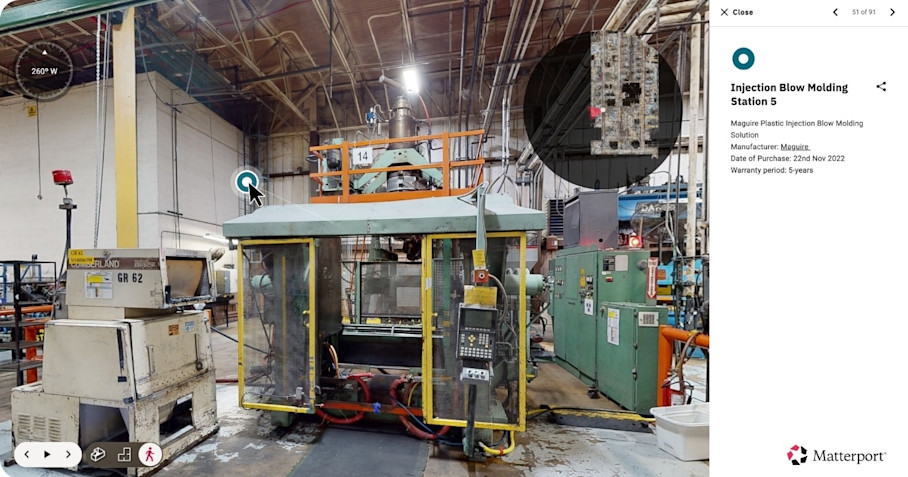
Technicians with the full context on each asset can turn more predictions into completed repairs, and because the record lives with the asset, they can add to it as they work, noting what they found and what they fixed. The knowledge to act well compounds over time instead of walking out the door.
5. Difficulty proving ROI and winning executive buy-in
Predictive maintenance typically pays off in failures that never happen, and finance teams struggle to quantify avoided events. They might see what was spent on sensors, software, and integration, but the return is a cost avoided, which doesn’t show up as a line item.
Federal FEMP guidance estimates 8% to 12% cost savings over preventive maintenance alone, but executives will still want proof from their own facilities. Build evidence into a predictive maintenance pilot by:
1. Setting a baseline before you begin: Record unplanned downtime, emergency repair costs, and repeat visits before the pilot starts. This sets a “before” picture that later results can be measured against. Some key cost factors to consider include:
Average downtime cost per hour
Repair frequency
Spare parts usage
Showing a drop in downtime or repair spend is real and attributable to the program.
2. Track leading indicators, not just outcomes: Some results will show up long before the yearly failure numbers. Look at how fast an alert becomes a work order or how often a technician fixes the problem on the first visit. Reporting these early will earn confidence in the program, and keep funding coming through the first year.
3. Put a dollar value on avoided failures: Look at what past breakdowns actually cost you, then use those figures to price what each caught failure would have cost if it had run to failure. A number built on specific historical incidents is easier to defend than an industry average.
Once the numbers are collected, they need to reach executives, finance, and field teams. Deferred capital spend and longer asset life are considered important ROI for executives, while finance will be more interested in cost context, and technicians will look at field specifics. Tailor space and asset information with customized Views of a single digital twin to serve all stakeholders.
Reporting results wins the argument for the program; acting on them then makes the next one easier to win. When your data shows an asset nearing the end of its life, that finding should flow straight into the replacement project rather than sitting in a maintenance report. Export BIM and CAD files from a Matterport digital twin so planning and engineering teams have accurate as-built deliverables to work from immediately, instead of paying for a fresh survey.
That handoff closes the ROI gap from the other side: the program no longer has to justify itself on avoiding failures alone, because it’s now visibly lowering the cost of the capital projects finance was always going to fund.
6. Cybersecurity and data-privacy risks
Every sensor and gateway connected to a facility for predictive maintenance adds an entry point to the operational technology (OT) network that runs your physical equipment. Much of that equipment was designed years ago to sit isolated, never expecting to be online at all. Left unmanaged, the network that’s meant to protect uptime becomes the easiest route to taking it down.
To contain that risk:
Separate the OT and IT networks: Keep the network running your physical equipment walled off from your corporate IT network, so a breach on the office side can’t reach the machines on the floor.
Encrypt traffic and vet every device: Require encryption on data moving between sensors, gateways, and platforms, and put every connected device through a security review before it goes in.
Control who can see and change what: Apply role-based access to asset data and facility documentation, so each person reaches only the information their job calls for. Limiting roles and permissions on who can view or edit the data held in a digital twin keeps sensitive building information from being needlessly exposed.
Inventory and patch on a schedule: Keep a live list of every connected device and update it on a set cadence, rather than waiting for a problem to find the gaps. Unpatched sensors and gateways are among the most common ways into an OT network, and a known schedule means nothing quietly ages into a vulnerability.
Treating security as a design requirement from day one lets the program scale without new exposure.
7. Gaps between alerts and technician action
Everything upstream can work perfectly and the program may still fail at the last mile if the handoff from alert to repair isn’t addressed well. A caught failure that takes three visits to fix isn’t the win the model promised.
Make sure technicians have access to all relevant predictive information before they leave their desk:
Help them take a look before they’re dispatched: Planners and technicians can inspect the asset and its surroundings in a digital twin before anyone drives out. Seeing the unit, its access route, and what’s around it ahead of time turns a blind dispatch into a prepared one.
Confirm access and clearances remotely: Before ordering parts or scheduling the work, check that the replacement will actually fit and the route to it is clear. Measurement Mode captures distances and clearances straight from the digital twin, so a planner confirms a new unit’s footprint from a desk rather than discovering the problem on site and booking a second visit.
Attach location and history to every alert: A predictive alert should arrive as a work order that already carries the asset’s exact location and service record, not as a notification someone has to chase down. Integrate a digital twin with Procore and pin RFIs, Observations, and Coordination Issues to exact 3D locations so the technician can walk straight to the asset instead of hunting for it.
Make first-time fix rate a headline metric: Track how often a technician resolves the issue on the first visit, and treat it as a core measure of program health. It’s the clearest single signal of whether the last mile is working; a rising rate means alerts are turning into clean repairs, and a stalled one points straight back to the handoff.
Every prepared visit leaves a better record behind it. With confirmed locations, verified clearances, and a repair logged against the asset, the next alert for that machine starts from an even stronger position than the last.
8. Pilot programs that stall at scale
Pilots often succeed on one line or one building, then stall during rollout. Each site records data differently and equipment vintages differ, so what worked as local knowledge at the pilot site might not transfer, and the rollout can slow to a crawl as each new location is onboarded from scratch.
Build a shared standard that helps one site’s approach adapt to the next:
1. Write a playbook: Document the specifics each site can and should copy, such as:
The asset naming scheme
The hierarchy assets roll up into
Where sensors mount on each equipment type
The failure thresholds that trigger a work order
A new site should be configured against that standard instead of relitigating every decision.
2. Set the baseline before you expand: Fix the capture standard every site meets before going live. Choose a format for your documentation hub, like a digital twin, then define how tags and metadata fields are populated, and outline which documentation should be attached to each asset. Uniform input helps compare downtime or fix rates across sites instead of across incompatible records.
3. Bring every site into one view: Roll each site’s condition data, work orders, and KPIs up to a single dashboard, so you can rank sites by failure rate or fix rate and send attention where the numbers are worst.
Standardize first, and scaling becomes routine: every new site follows a path you’ve already proven.
A predictive maintenance program your technicians can act on
Solving predictive maintenance challenges requires data, systems, and people that can work seamlessly together from insight to action. Sensors, CMMS, and analytics do the predicting. A spatial record helps teams turn each alert into a completed repair.
Matterport digital twins support every stage of that work. They provide accurate spatial records, link asset context, integrate with existing systems, and help visualize the work before dispatch. Each one narrows the distance between what the model predicts and what the technician finds on-site.
Get in touch with our team