


 Sign In
Hotel Preventive Maintenance Checklist: What, When, and How to Inspect Efficiently
A guest's impression of a hotel is often formed in seconds, and research consistently shows that the physical environment ranks among the top drivers of satisfaction—or dissatisfaction. A flickering light, a rattling air conditioning unit, or a slow drain signals something more damaging than a minor fault: it signals a property that cannot be trusted. That loss of confidence is extraordinarily difficult to recover.
A structured preventive maintenance program helps hotel teams catch problems before guests do, protecting the guest experience that revenue depends on.
Here, we’ll provide you with a frequency-based hotel preventive maintenance checklist that helps staff on the ground to treat maintenance as a strategic function rather than an afterthought. It covers area and asset-specific tasks from daily walkthroughs to annual inspections, and addresses how to strengthen maintenance documentation using visual tools.
Hotel preventive maintenance checklist by area
Preventive maintenance must reach every corner of a hotel property. Guest rooms often get the most regular attention because they generate revenue, but mechanical spaces and back-of-house areas carry equal weight when a failure occurs. Building systems demand the same level of attention.
Areas requiring regular maintenance and inspection include:
Guest rooms and in-room fixtures: The primary guest touchpoint and most common source of maintenance complaints. Even minor faults here directly affect ratings and rebooking.
Common areas and shared facilities: Parking, lobbies, fitness centers, pools, and spas are actively marketed as part of the guest experience. When they fall short of expectations, the contrast between promise and reality is particularly damaging to trust.
HVAC, plumbing, and electrical infrastructure: These building systems underpin every aspect of guest comfort. When these fail, the impact is immediate and property-wide.
Back-of-house and mechanical spaces: Failures in kitchens, laundry rooms, and loading docks create service delays that guests experience directly, even if they never see the source.
Health, safety, and compliance systems: Fire alarms, sprinklers, and emergency equipment protect guests and staff, and ensure the compliance that keeps the property operational.
Keeping a consistent schedule across these areas protects both guest experience and asset value. Different inspection frequencies serve different purposes.
Pre-arrival inspections act as the last line of defense, ensuring that even minor issues are caught before they become guest-facing problems.
Weekly and monthly inspections focus on the highest-traffic, most guest-visible areas. They target systems most likely to show measurable wear within short time cycles.
Quarterly inspections address building infrastructure and mechanical systems that degrade more gradually. These systems can carry significantly higher failure costs and guest disruption when neglected.
Annual inspections focus on deep-system servicing and full compliance certification. They include capital planning assessments that typically require extended scheduling windows, dedicated budget, and third-party specialists.
Consistent scheduling only delivers its full value when it is properly documented. Verifiable maintenance records satisfy not only general managers, but hotel brand standards teams, auditors, and even regulatory inspectors. They also provide the evidence base for capital planning decisions that text-based logs alone struggle to support reliably.
As you work through the preventive maintenance checklist below, each completed task should be logged against the relevant space or asset to create an evidence trail. Wherever possible, that record should be visual rather than text-based alone.
Comprehensive visual documentation of maintenance, using modern tools like digital twins, creates practical, easily verifiable assets for stakeholders. A photorealistic 3D model of a property can help hotel teams keep track of preventive maintenance tasks, review asset conditions over time, and access a shared reference point for decision-making. For multi-property operations, consistent documentation becomes particularly valuable, reducing the ambiguity that typically arises when teams, managers, and auditors are working from different locations and different sources.
The checklist below covers maintenance areas organized by zone with tasks broken out by recommended frequency.
Guest rooms and in-room fixtures
Guest rooms are the highest-impact area for preventive maintenance because they're the primary guest touchpoint and the most common source of complaints. A thermostat that won't respond or a malfunctioning electrical device can easily become a one-star review. Guest room maintenance directly impacts satisfaction scores and requires systematic approaches to ensure consistency across all accommodations.
Pre-arrival
Asset/Area | Tasks |
|---|---|
Light switches and bulbs | - Test all switches - Replace burnt bulbs - Check for flickering or dimming |
Faucets and fixtures | - Check for leaks - Test water pressure and temperature - Report slow drains immediately |
Shower and tub | - Check drainage - Inspect grout and caulking - Note any mold or staining |
Toilet | - Test flush - Check for leaks at base - Confirm water shutoff valve works |
HVAC: thermostat | - Test heating and cooling modes - Verify temperature accuracy - Set to standard arrival temp |
Door locks and deadbolts | - Test keycard access - Verify deadbolt and night latch function - Check peephole is clear |
TV and remote | - Test power, input, and remote batteries - Sanitize remote |
Wi-Fi and outlets | - Verify connectivity - Test all outlets - Note any loose faceplates |
Mini-bar, kettle, coffee machine | - Test operation - Clean and restock - Check for leaks or damage |
Carpets and flooring | - Vacuum - Spot-clean any stains |
Furniture and soft furnishings | - Inspect chairs, beds, and soft furnishings for visible damage or staining |
In-room safe | - Test operation - Confirm reset function works correctly |
Smoke detector | - Test alarm function - Confirm indicator light is active |
Monthly
Asset/Area | Tasks |
|---|---|
HVAC: vents and filters | - Inspect vents for dust - Replace filters — clogged filters reduce efficiency by 15% |
Mattresses | - Rotate and inspect for stains or damage - Replace per brand standards (typically 5–7 years) |
Window seals and blinds | - Check for drafts - Test blind and curtain track operation - Report any broken slats or runners |
Paint, walls, and ceiling | - Inspect for scuffs, stains, damp patches, or damage - Touch up as needed |
Telephone | - Test dial tone and all function buttons - Check cord and handset condition |
Quarterly
Asset/Area | Tasks |
|---|---|
Light fixtures and lampshades | - Clean fixtures and shades - Check wiring connections - Document any corrosion |
Faucets and fixtures | - Inspect aerators - Descale fixtures - Replace worn washers |
Shower and tub | - Deep clean - Reseal grout lines as needed |
Toilet | - Inspect internal components - Replace flappers and fill valves as needed |
HVAC: exhaust fans | - Clean fan blades - Test operation - Check for unusual noise |
Door locks, hinges, and closer | - Lubricate hinges and lock mechanisms - Inspect strike plates - Test door closer resistance |
TV and remote | - Check cable connections - Update firmware |
Wi-Fi and outlets | - Inspect wiring - Tighten outlet connections - Test GFCI outlets and reset function |
Mini-bar, kettle, coffee machine | - Descale - Inspect electrical cords |
Carpets and flooring | - Deep clean - Inspect for wear patterns - Replace high-traffic areas as needed |
Furniture and soft furnishings | - Inspect for structural integrity - Tighten loose fittings - Report items requiring replacement |
Closet and wardrobe | - Check sliding door tracks, guides, and bumpers - Inspect hooks and hanging hardware |
Smoke detector and carbon monoxide detector | - Test alarm function - Replace batteries - Check expiry date on units |
Annually
Asset/Area | Tasks |
|---|---|
Mattresses | - Deep clean or replace |
Window seals and blinds | - Inspect weatherstripping - Replace worn seals |
Paint, walls, and ceiling | - Full repaint per brand cycle (typically every 3–5 years) - Inspect ceiling for damp or structural concerns |
Furniture | - Full condition audit - Schedule replacement of items beyond serviceable life |
Housekeeping forms a critical first layer of preventive maintenance and are responsible for a significant proportion of pre-arrival maintenance tasks, especially in guest rooms. Housekeeping staff enter every guest room more frequently than any other team, making them the earliest line of detection for developing issues. For a dedicated framework for guest room checks, see our detailed templates:
However, overall responsibility for preventive maintenance sits with the facilities or maintenance team, who are accountable for ensuring all tasks are completed, documented, and reported up to property management. A shared maintenance log ensures that housekeeping observations feed directly into that record, giving the maintenance team, and ultimately the General Manager, a complete picture of room condition across the property.
Common areas and shared facilities
Shared areas see the most foot traffic and shape first impressions. A flickering lobby light or a broken treadmill won't generate an urgent work order the way a guest-room complaint does. But it does quietly erode the perception of quality.
Common areas also carry a higher compliance burden than guest rooms, with elevators, pools, emergency lighting, and accessibility features all subject to regulatory inspection and certification requirements.
Daily
Asset/Area | Tasks |
|---|---|
Lobby furniture and fixtures | - Inspect for damage - Clean and arrange |
Elevators: interiors | - Clean surfaces - Inspect buttons and panels |
Pool: chemical levels | - Test pH, chlorine, and alkalinity - Log results per health code |
Spa/hot tub | - Test chemical levels and temperature |
Stairwells and corridors | - Check for blocked exits or trip hazards |
Floor condition: high-traffic areas | - Clean and inspect for damage |
Carpets and flooring | - Vacuum and spot-clean |
Public restrooms | - Clean and sanitize - Restock consumables - Inspect fixtures for leaks or damage |
Weekly
Asset/Are | Tasks |
|---|---|
Lighting: fixtures | - Replace burnt bulbs - Clean fixtures in corridors and public areas |
Pool: equipment | - Inspect pumps, filters, and heaters - Check for leaks or unusual noise |
Spa/hot tub | - Clean filters - Inspect jets |
Fitness equipment | - Inspect for wear - Clean and sanitize - Test safety features on treadmills |
Parking areas and walkways | - Inspect for cracks, potholes, or debris - Address trip hazards immediately |
Automatic doors | - Test sensors and operation - Clean sensors and tracks |
Pest control: inspections | - Check common areas, kitchens, and storage for signs of pest activity - Report findings immediately |
Monthly
Asset/Area | Task |
|---|---|
Elevators: door sensors | - Test door operation and safety sensors |
Lighting: emergency lighting | - Test battery backup (30-second test) - Document results |
Signage and wayfinding | - Check for damage or fading - Replace as needed |
Ceiling tiles | - Inspect for stains or sagging as indications of roof or plumbing leaks |
ADA accessibility features | - Test ramps, handrails, and accessible doors - Document compliance |
Paint and walls | - Inspect for scuffs or damage - Touch up high-traffic areas as needed |
Public restrooms | - Inspect plumbing connections and shut-off valves - Deep clean grout and tile |
Quarterly
Asset/Area | Task |
|---|---|
Lobby furniture and fixtures | - Deep clean upholstery - Tighten hardware |
Elevators: mechanical systems | - Cable, pulley, and motor inspection by a licensed contractor required |
Pool: deep clean | - Drain, clean, and refill (schedule during low occupancy) |
Fitness equipment | - Lubricate moving parts - Calibrate settings |
Floor condition: high-traffic areas | - Strip and refinish hard floors |
Automatic doors | - Inspect motor and hardware |
Carpets and flooring | - Deep clean - Inspect for wear - Replace as needed |
Pest control | - Schedule professional treatment across all common and back-of-house areas |
Annually
Asset/Area | Task |
|---|---|
Elevators: certification | - Full inspection and certification by a licensed contractor (state-mandated) |
Lighting: emergency lighting | - 90-minute discharge test |
Parking areas and walkways | - Seal cracks - Repaint striping |
Paint and walls | - Repaint common areas |
Exterior building fabric | - Inspect roof, facade, windows, and drainage for weathering or damage |
Keeping these areas in consistent condition protects the guest experience and reinforces the brand standard across every property through documented hotel brand standards examples.
HVAC, plumbing, and electrical systems
Building systems are the backbone of comfort. They may be invisible to guests, but that is only until they fail, at which point the impact is immediate and property-wide.
Additionally, energy-related costs account for a significant portion of hotel operating expenses, and failures here are among the most expensive to repair reactively, so HVAC maintenance is critical. Several components within these systems are also subject to regulatory inspection requirements.
Daily
Asset/Area | Tasks |
|---|---|
Central HVAC: system readings | - Monitor temperatures, pressures, and alarms - Log readings |
Domestic hot water: temperature | - Check supply temperature at point of generation - Verify storage temperature is maintained at minimum 140°F / 60°C - Log readings (temperatures below threshold create Legionella risk) |
Boiler and pump rooms | - Inspect for leaks, unusual sounds, or alarms - Check expansion tank pressure and gauge readings |
Weekly
Area/Asset | Task |
|---|---|
Water heaters: temperature | - Verify operating temperature |
Mechanical rooms | - Inspect for leaks, unusual sounds, or odors - Check all visible pipe connections and gauges |
Sprinkler valve positions | - Verify main valves are open and locked (a closed valve renders the system inactive) |
Fire pumps | - Inspect for leaks - Verify power supply |
Monthly
Asset/Are | Task |
|---|---|
Central HVAC: air filters | - Inspect and replace filters (clogged filters increase energy consumption) |
Plumbing: main lines | - Inspect for leaks or corrosion - Check shut-off valves are accessible and operational |
Utility areas | - Inspect gas lines, water mains, and sewer access points - Document conditions |
Cooling towers | - Inspect for algae, debris, and water levels - Clean basins |
Generators | - Test run for 30 minutes under load - Log fuel levels and run time |
Quarterly
Asset/Area | Task |
|---|---|
Central HVAC: coils | - Clean evaporator and condenser coils |
Central HVAC: refrigerant | - HVAC technician checks levels and inspects for leaks |
Water heaters: pressure relief valves | - Test valve operation |
Plumbing: drain lines | - Inspect and clean main drains to prevent backups |
Plumbing: pipes (exposed) | - Check for leaks, corrosion, and insulation condition - Insulate any exposed pipes at risk of freezing |
Electrical panels and breakers | - Licensed electrician inspects for corrosion, loose connections, and correct labeling |
Cooling towers | - Apply chemical treatment - Inspect fill media to prevent Legionella |
Semi-annually
Area/Asset | Task |
|---|---|
Ductwork | - Inspect for dust accumulation, damage, or leaks - Clean where required |
Annually
Asset/area | Task |
|---|---|
Central HVAC: full service | - Comprehensive inspection and tune-up by licensed HVAC contractor (schedule before peak season) |
Water heaters: sediment flush | - Drain and flush tank to extend equipment life |
Electrical panels: thermal imaging | - Full thermographic scan by licensed electrician to detect hot spots before failure |
Main electrical distribution and grounding | - Full inspection and testing by licensed electrician |
Backflow prevention devices | - Test and certification by licensed plumber |
Generators | - Full load bank test by general contractor (for minimum two hours) |
Back-of-house and mechanical spaces
Failures in kitchens, laundry rooms, and loading docks create service delays that guests experience directly, even if they never see the source.
These areas contain high-use commercial equipment with strict hygiene and safety requirements, making them vulnerable to health code violations.
Daily
Asset/Area | Tasks |
|---|---|
Refrigerators and freezers: temperatures | - Log temperatures (required by health code) |
Dryer lint traps | - Clean lint traps (a fire hazard if neglected) |
Cooking equipment: pilot lights | - Verify operation |
Floor drains: kitchen and laundry | - Flush with water and check for clogs |
Weekly
Asset/area | Task |
|---|---|
Refrigerators and freezers: door gaskets | - Inspect for wear or damage (poor seals increase energy consumption) |
Cooking equipment: pilot lights | - Verify consistent operation |
Dishwashers | - Clean filters and spray arms |
Ice machines | - Clean exterior - Inspect water lines |
Floor drains: kitchen and laundry | - Flush with water - Check for clogs |
Monthly
Asset/area | Task |
|---|---|
Refrigerators and freezers: coils | - Clean condenser coils |
Gas connections | - Inspect for leaks using soap test (safety-critical) |
Cooking equipment: burners and igniters | - Clean and test |
Dishwashers | - Inspect hoses and connections - Check for leaks |
Exhaust hoods and ducts | - Inspect for grease buildup (excessive grease is a compliance violation) |
Ice machines | - Clean interior and sanitize per manufacturer specifications |
Washing machines: drum and hose | - Inspect for leaks or damage |
Loading dock doors and hardware | - Inspect and lubricate - Test safety features |
Quarterly
Asset/area | Task |
|---|---|
Dryer exhaust | - Clean exhaust ducts (required for fire prevention) |
Water supply valves | - Test shut-off valves and verify accessibility |
Commercial oven calibration | - Verify temperature accuracy |
Washing machines: filters | - Clean filters and pumps |
Floor drains: kitchen and laundry | - Deep clean and sanitize |
Semi-annually
Asset/area | Task |
|---|---|
Exhaust hoods and ducts | - Professional deep clean of full duct system by certified contractor, including all horizontal and vertical runs - Retain cleaning certificate on file |
Kitchen fire suppression system | - Licensed contractor inspects nozzles, fusible links, agent storage, and actuation mechanism |
Annually
Asset/area | Task |
|---|---|
Kitchen fire suppression system | - Full service and certification by licensed fire protection contractor. Failure to maintain voids insurance coverage for kitchen fire events. |
Many of these tasks are kitchen or laundry staff responsibilities that tie to health department standards and insurance requirements. Documenting completion isn't optional.
Health, safety, and compliance systems
Safety and compliance systems are non-negotiable. Unlike other maintenance areas where a missed task may affect comfort or efficiency, failures here put guests and staff at immediate risk and expose the property to significant legal and regulatory liability.
Every task in this section should be treated as mandatory, with documentation retained as a permanent record.
Daily
Asset/Area | Tasks |
|---|---|
Fire alarm: panel status | - Check for alarms or trouble signals - Log daily |
Fire exits and routes | - Verify exits are clear and accessible |
Weekly
Asset/Area | Tasks |
|---|---|
Sprinkler valve positions | - Verify main valves are open and locked (a closed valve renders the entire system inactive) |
Fire pumps | - Inspect for leaks - Verify power supply |
Monthly
Asset/Area | Tasks |
|---|---|
Fire alarm: pull stations | - Inspect for damage or obstruction |
Exit signs | - Test illumination (30-second battery test) - Document results |
Emergency lighting | - Test illumination (30-second battery test) - Document results |
Fire doors | - Test self-closing mechanism - Inspect seals (must close and latch fully) |
Stairwell doors | - Test operation - Verify no propping devices are present |
Fire extinguishers | - Verify pressure, accessibility, and signage - Initial the monthly inspection tag with month and year |
Emergency generator | - Test run for 30 minutes under load - Log results |
AED units | - Check status indicator - Verify pads are within expiry date |
First-aid kits | - Inspect contents - Restock as needed |
Carbon monoxide detectors | - Test operation - Replace batteries as needed |
Emergency evacuation signage and plans | - Inspect for damage - Verify plans are current and posted in all guest rooms and common areas |
Quarterly
Asset/Area | Tasks |
|---|---|
Sprinkler heads | - Inspect for damage, corrosion, or obstruction - Maintain minimum 18-inch clearance around all heads |
Sprinkler waterflow test | - Licensed fire protection contractor tests alarm activation |
Annually
Asset/Area | Tasks |
|---|---|
Fire alarm: full system test | - Licensed fire alarm contractor tests all devices and notification appliances - Retain test certificate on file |
Exit signs | - 90-minute discharge test (required) |
Emergency lighting | - 90-minute discharge test (required) |
Fire extinguishers: full service | - Internal inspection and recharge by licensed fire protection contractor - Technician license number must appear on service tag - Pressure test by licensed fire protection contractor (interval varies by extinguisher type but every 5–12 years is common) |
Emergency generator | - Full load bank test by general contractor (minimum two hours required) |
Fire pumps | - Full flow test by licensed fire protection contractor (required) |
Carbon monoxide detectors | - Replace units per manufacturer specifications (typical lifespan is 5–7 years) |
Elevator safety inspection | - Full inspection and certification by licensed elevator contractor (state-mandated) |
Compliance documentation | - Audit all inspection records, contractor certificates, and test documentation - Retain documentation permanently on file (required for insurance, brand standards, and regulatory inspections) |
Maintenance documentation for these systems serves as your defense during an audit, an insurance claim, or a liability review. If a fire occurs and records reveal consistent failures to comply with fire marshal inspection requirements, the financial and legal consequences can be severe.
Building a visual preventive maintenance workflow your hotel team can follow
A checklist only works if it's embedded into daily operations with clear ownership and consistent execution. A printed PDF on a clipboard can track what was done, but it can't show you the actual condition of a corroded pipe, a cracked grout line, or a stained ceiling tile. That's where visual documentation makes a big difference.
Every completed task and inspection should be documented at the asset and zone level. Every stakeholder should be able to confirm the work was performed and verify its quality. Text-only logs describe a condition. Visual records prove it.
3D digital twins create asset-level visual records that go beyond what a traditional hotel preventive maintenance checklist template can capture. Here are six best practices to implement alongside your checklist:
Pin tasks and issues directly to rooms, fixtures, and systems. Using Matterport's Notes and Tags, maintenance teams can document specific problems with detailed descriptions and photos using a hand-held device. A line item on a spreadsheet saying "pipe corrosion noted" is ambiguous. A photo of a corroded pipe joint embedded in a Tag at the exact location in the mechanical room provides essential context.
Integrate with your CMMS or existing maintenance platform. Connect your visual documentation to the work order system your team already uses for structured tracking. This keeps the checklist, the visual record, and the work order in one workflow. Matterport digital twins can sync with a broad range of facility management platforms using integrations and APIs.
Track condition over time. Matterport's Side-by-Side Spaces let you compare the same space across different capture dates. This makes it easy to identify wear patterns, confirm repairs were completed, and provide auditors with verifiable before-and-after evidence.
Enable remote review and collaboration. Not every stakeholder needs to be on-site to assess a problem. Digital twins are accessible on any device, so a regional facilities director can search for assets and review conditions, approve scope, and coordinate vendors without traveling to the property. Enterprise data shows this approach can reduce travel needs (and costs) by 50%.
Scope work without disturbing guests. When assessing repairs, planning furniture replacements, or verifying clearances, Automated Measuring allows teams to take dimensionally accurate measurements directly inside a digital twin. No need to send on-site staff to verify a doorway width or confirm the distance between a vent and a sprinkler head. This also offers the added benefit of reducing disruption to guests.
Scale standardized checklists and documentation across properties. For multi-property operators, the Matterport platform provides a consistent framework for capturing, organizing, and sharing digital twins across every location. Professional Capture Services are available in 200+ cities around the world to digitize your entire portfolio at speed. This creates a unified maintenance baseline that regional leadership can monitor without relying on verbal updates or fragmented spreadsheets.
Consider a scenario: a housekeeper spots a cracked grout line in a guest bathroom. She logs it as a note. A maintenance tech sees the note but isn't aware of how severe it is.
Without a photo, he adds it to next month's list. By then, moisture has seeped behind the tile, and you're looking at mold remediation instead of a $50 grout repair. A photo or a tagged visual record pinned to the exact spot in a digital twin eliminates ambiguity. A second team member or manager can assess severity immediately without a site visit.
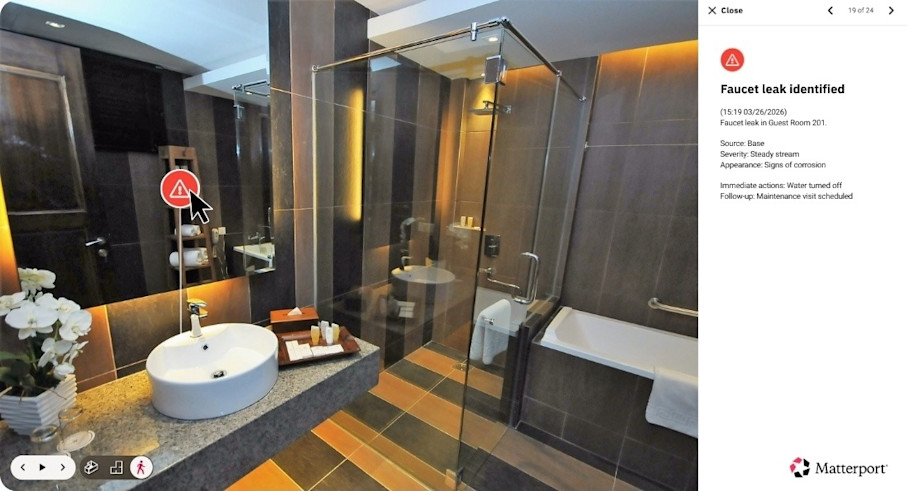
Combining your preventive maintenance checklist for hotel rooms with visual documentation improves clarity and long-term asset visibility. Your team spends less time re-inspecting and more time resolving.
Get started with Matterport for Travel & Hospitality