


 Accedi
Digital Transformation in Energy & Utilities Industry: 2026 Trends
The energy grid was engineered for a world that no longer exists. Decades-old infrastructure is confronting forces unlike any seen in modern history: unprecedented data center and AI-driven load growth, tightened grid constraints, reshoring trends, and rising pressure to deliver at an affordable cost. Peak demand is projected to grow by approximately 26% by 2035, testing today's grid limits.
To keep up, energy organizations are being asked to modernize faster than their assets were ever designed to change. Digital transformation is an operational imperative.
In this article, we’ll uncover digitalization trends in the energy sector and outline practical initiatives to launch a successful, ROI-focused digital transformation strategy.
How operational pressures are pushing energy and utilities companies to modernize
A number of long-simmering factors have reached a boil simultaneously. In 2026, organizations will need more than plug-in digital tools to steer through the sector's transformation.
Here are the specific pressures driving digital transformation in the energy industry right now:
Rising energy demand: After decades of modest growth, U.S. electricity demand began accelerating in 2025. The surge is largely considered to be driven by artificial intelligence training workloads, alongside immense electrification targets in transportation and industry. Data center demand alone could reach 176 gigawatts by 2035, a fivefold increase from 2024.
Complex networks: Many of today's grids were designed for the 20th century when the share of distributed energy resources was small. Now that a growing portion of electricity is produced by variable renewables, greater system flexibility is needed to consistently balance supply and demand. Integrating solar, wind, battery storage, and electric vehicles creates bidirectional power flows and unpredictable generation patterns that legacy systems weren't built to manage.
Environmental regulations: With increasing pressure to reduce carbon footprints and meet evolving regulations, utilities are turning to digital tools that help track emissions, manage renewable integration, and report sustainability metrics more efficiently.
Operational efficiency pressures: Overall grid reliability has been in decline since the mid-2010s due in part to aging infrastructure. As of 2025, 70% of all U.S. transmission lines are over 25 years old, more than halfway through their lifespans. Aging assets mean more unplanned outages, higher maintenance spend, and escalating safety hazards.
Risk management and compliance: FERC and NERC implemented several significant improvements to electric reliability in 2025. These included new standards for cold-weather generator performance, supply chain risk management, and infrastructure modernization.
Data expansion: Big data can now empower utility leaders to make faster, more informed decisions by taking advantage of massive, high-velocity datasets, but only if the tools exist to act on it.
These pressures aren't going away. They're accelerating. The organizations that respond with integrated digital strategies will gain operational control and long-term resilience.
Digital transformation trends shaping the energy industry in 2026
ABI Research forecasts that energy companies will spend $713 billion on power grid modernization over the next six years. This investment is being directed toward technologies that improve visibility, enable real-time decision-making, and support coordination across increasingly complex energy systems.
Some of the key tools doing the heavy lifting include:
IoT sensors and smart meters for real-time monitoring of equipment health, energy flows, and environmental conditions.
Smart grids that balance generation and consumption to manage energy flow, reduce outages, and improve demand forecasting.
AI and analytics for predictive maintenance, failure risk modeling, and operational optimization.
Cloud platforms that integrate data across siloed systems and support cross-team collaboration.
Digital twins that provide spatial context and a shared reference for planning, visualization, and risk assessment.
Let’s explore how these technologies are being applied practically to specific operational initiatives and shaping the energy sector and power grid optimization in 2026.
Grid modernization and infrastructure visibility
The energy grid wasn't designed for two-way power flows, distributed solar, battery storage, and data center loads that didn't exist a decade ago. Even when generation projects are financially viable and technically ready, aging infrastructure prevents them from moving forward. This slows clean energy deployment, raises project costs, and limits the grid's ability to respond quickly to demand growth.
Coordinating upgrades and planning for distributed energy integration requires better visibility than traditional workflows provide.
Modern digital tools help address these challenges by giving teams a clearer, more actionable view of infrastructure conditions and operational constraints.
Smart grids can balance variable renewable generation against demand in real time, enabling predictive maintenance and dynamic energy allocation that significantly reduces energy loss and outages.
IoT sensors and smart meters detect real-time inefficiencies in energy flow, flag equipment degradation, and feed predictive maintenance systems before grid failures cascade. Meanwhile, cloud platforms unify data from substations, pipelines, and control rooms so that distributed teams can plan and respond as one.
Digital twins provide the spatial context that is required by those teams to assess risks and plan work before crews are dispatched. Matterport's digital twin platform enables high-fidelity 3D capture of substations, power plants, and pipeline infrastructure, creating navigable models that support virtual walkthroughs for remote planning and facility management.
The LiDAR-enabled Pro3 camera captures both interior and exterior spaces with centimeter-level accuracy. Resulting digital twins can be tagged with equipment IDs, maintenance notes, and safety information.
For organizations managing hundreds or thousands of assets, utilities asset management can improve visibility helps reduce project delays that are typically caused by incomplete site understanding. They also benefit from improved safety through better pre-work planning and faster coordination across engineering and contractor teams.
AI-driven operational intelligence
AI's role in energy has shifted from experimental to operational. Utilities are expanding AI-assisted analytics in countless areas. AI is increasingly applied to predictive maintenance, risk modeling, and asset optimization, helping utilities shift from reactive to proactive operations.
The primary applications of AI and analytics in energy operations are for:
Predictive maintenance: AI can analyze sensor data, vibration patterns, and thermal readings to forecast equipment failure before it happens.
Failure risk modeling: AI can score asset health across the grid and prioritize interventions by consequence, so maintenance is organized based on actual risk.
Operational optimization: AI adjusts load balancing, generation dispatch, and vegetation management based on real conditions. Predictive models anticipate equipment issues and optimize crew deployment against supply chain and weather constraints.
But AI is only as good as its inputs. Models need accurate, current spatial and operational data to produce trustworthy outputs.
IoT sensors can feed condition data in real time and cloud platforms integrate AI insights for cross-site decision-making. Digital twins provide the spatial "ground truth" that makes analysis actionable.
Matterport's 3D digital twins connect here as a source of as-built context. AI systems are able to reference a detailed, dimensionally accurate model of a substation or plant floor. Predictions tied to real geometry rather than outdated drawings are better equipped to produce reliable insights. E57 point cloud exports and BIM file deliverables can also feed directly into engineering tools like Autodesk Revit for downstream analysis.
In addition to better-informed decisions, data-driven workflows result in reduced unplanned downtime and smarter resource allocation.
Workforce enablement and risk reduction
Energy and utilities organizations are experiencing a significant demographic shift, with a disproportionately large share of employees approaching retirement age,roughly one quarter of the workforce is 55 or older. As seasoned employees exit the workforce, critical expertise risks leaving with them, creating widening capability gaps across field and plant operations.
At the same time, 76% of utility employers report challenges recruiting skilled replacements. This talent shortage is especially concerning in environments that involve high-voltage systems, combustible gases, confined spaces, and complex mechanical equipment, settings where inexperience can quickly translate into serious safety or operational consequences.
Digital tools improve workforce readiness by providing immersive, accessible training environments and better documentation.
In particular, digital twins serve as immersive training environments where new hires can explore substations, plant floors, and pipeline corridors virtually before ever entering the field. Tagged assets and embedded annotations preserve expert knowledge in a walkable, spatial format.
Jotavirtual uses Matterport digital twins to create interactive training scenarios that improve knowledge retention and increase training efficiency compared to traditional classroom or manual-based programs.
Additionally, virtual environments allow all employees to interact with advanced tools in a risk-free setting. They can not only develop critical competencies without disrupting ongoing operations, but also identify hazards safely, prepare emergency plans, and build procedural muscle memory.
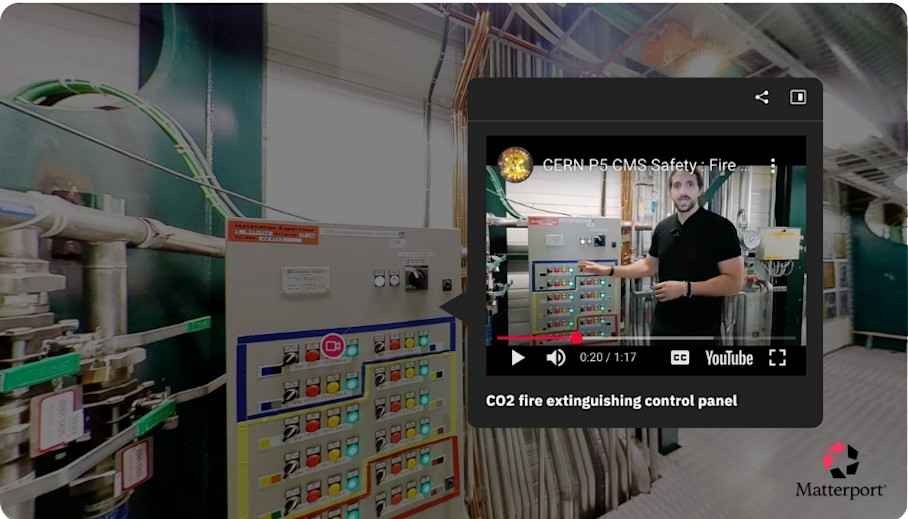
The CERN CMS facility team documents all safety equipment with location pins and explanatory videos in their digital twin.
Using these environments results in safer, more skilled teams, reduced dependency on live site visits for training, and better knowledge management and retention for operational continuity.
Cybersecurity enhancement
Reports suggest that cyber attackers are increasingly attempting to disrupt critical infrastructure. NERC has warned that susceptible points on the electrical grid increase by approximately 60 per day.
The convergence of operational technologies and increased adoption of third-party tools have expanded the digital attack surface. Organizational factors, such as unclear responsibilities for OT security and departmental silos, also compound these risks.
Audit requirements and regulatory pressures are pressing utilities to strengthen their security posture. The operational consequences of failing to comply are severe: fines, safety incidents, and downtime that can affect thousands of customers.
Digital transformation supports compliance and reduces risk across several layers.
IoT sensors monitor environmental and operational conditions to maintain regulatory adherence, providing continuous data streams that can be audited and analyzed, as well as flag anomalies in real time. Cloud platforms provide secure, centralized storage of documentation, while role-based access controls maintain detailed records of who accessed what information and when.
Digital twins act as a secure, immutable visual record of critical assets. By capturing exact operational layouts, teams can verify system configurations and changes without exposing field devices to unnecessary access.
They also offer timestamped historical records of facility conditions, revealing any unauthorized changes, supporting incident investigations, and providing evidence of compliance. Inspectors and auditors can navigate virtual walkthroughs of these environments instead of connecting to live systems, reducing the risk of cyber intrusion.
Audits backed by a navigable visual record reduce compliance risk through better documentation hygiene. Timestamped 3D scans show facility conditions at specific points in time, providing defensible evidence for regulatory reviews.
Project coordination and interconnection
Global electricity infrastructure must expand at an unprecedented scale over the next two decades. Projections indicate that tens of millions of kilometers of transmission and distribution lines will need to be built or modernized by 2040 to keep pace with electrification and renewable generation growth. Yet today, thousands of gigawatts of wind, solar, and other renewable projects remain stalled in interconnection queues. Grid development is not keeping up with clean energy deployment.
Mounting backlogs are compounded by the complexity of coordinating across multiple entities. Large-scale energy projects typically require alignment among utilities, regional grid operators, regulators, landowners, and local authorities. With transmission assets often spanning several jurisdictions, even minor documentation gaps exacerbate delays.
Digital transformation tools help to compress these timelines by accelerating approvals and collaboration.
Smart grids manage energy flows to optimize the integration of new generation sources, reducing the operational unknowns that delay approvals.
Matterport digital twins allow teams to capture existing site conditions, plan upgrades, and share visual documentation in the cloud with permitting authorities and investors. This reduces the back-and-forth that often delays approvals and helps stakeholders understand project scope and impact.
Practical steps to launch a successful digital transformation strategy
Even organizations that agree on the need for digital transformation in energy and utilities run into obstacles. Common challenges to digital transformation in energy include:
Legacy systems that weren't designed to share data
Data silos between OT, IT, engineering, and field operations
Integration complexity when layering new tools onto decades-old infrastructure
Cultural resistance from teams comfortable with established workflows
Workforce skills gaps that limit the adoption of digital tools
Visibility and workflow simplification, anchored in tools like digital twins, mitigate many of these issues by providing a clear, accessible view of operations that everyone can understand and act on.
Follow this ROI-focused approach to launch a successful, adoption-ready strategy for digitization in your energy facility:
Identify critical operational pain points: Start with the sites, processes, or assets where poor visibility costs the most, whether that's unplanned outages, delayed inspections, or repeated truck rolls.
Map existing workflows and gaps: Document how information moves (or doesn't) between field teams, engineering, operations, and external partners. Look for where decisions stall because someone lacks current site context.
Prioritize visibility and context-first solutions: Tools that give teams an accurate, shared picture of assets deliver quick wins. They also build organizational confidence before you tackle larger system integrations.
Pilot scalable tools: Digital twins and remote capture platforms like Matterport can be deployed at a single facility and easily expanded across a portfolio.
Integrate with existing systems, measure outcomes, iterate: Connect digital twins to engineering tools through E57 exports or Autodesk integrations. Track time-to-decision and rework rates, then expand based on what the data shows.
Digital transformation in the energy industry won't happen overnight. Keeping the lights on while rebuilding the systems that do it requires commitment, coordination, and continuous improvement. But the organizations that start now, with practical, ROI-focused initiatives, will be better positioned to handle the operational pressures ahead.
Esplora Matterport per i team del settore petrolifero e del gas

