


 Connexion
Jumeaux numériques dans l'industrie des hydrocarbures : exemples et cas d'usage
Les installations pétrolières et gazières fonctionnent sous une combinaison unique de pressions à laquelle peu d'autres secteurs sont confrontés simultanément. Les installations sont réparties sur des sites distants ; les infrastructures vieillissantes nécessitent une attention constante ; et les travailleurs expérimentés partent à la retraite plus rapidement que les nouvelles recrues ne peuvent assimiler des décennies de connaissances opérationnelles.
Ces pressions créent un défi persistant : les connaissances opérationnelles critiques deviennent fragmentées. Les opérateurs disposent parfois de données de capteurs, de dossiers de maintenance et de plans d’ingénierie, mais sans contexte spatial clair, il peut être difficile pour les équipes dispersées de comprendre ce qui se passe sur le terrain.
Les jumeaux numériques aident à combler cet écart. Ces répliques 3D explorables et aux dimensions précises de stations de compression, de sites de vannes et d'unités de raffinerie offrent une référence visuelle commune pour les installations.
Dans ce guide, nous explorons les cas d'utilisation pratiques des jumeaux numériques dans l'ensemble des opérations pétrolières et gazières, ainsi que la manière dont les équipes les appliquent pour améliorer le temps de fonctionnement, la sécurité et l'efficacité.
7 cas d’utilisation les plus courants des jumeaux numériques dans le secteur pétrolier et gazier (avec des exemples concrets)
Les jumeaux numériques dans le secteur du pétrole et du gaz associent le contexte d’installations réelles à des connaissances opérationnelles intégrées au sein d’un seul environnement accessible. Ils comblent l’écart entre les modèles de conception et la réalité en l’état, offrant aux équipes réparties géographiquement une vue à jour des actifs sans nécessiter de billet d’avion ni de casque de chantier.
Les sept cas d’usage ci-dessous représentent des applications à forte valeur ajoutée où les jumeaux numériques de Matterport offrent des résultats quantifiables pour la maintenance, l’intégrité, l’HSE et l’efficacité opérationnelle dans le secteur pétrolier et gazier.
1. Maintenance prédictive et conditionnelle
La maintenance réactive est la méthode la plus coûteuse pour assurer le fonctionnement des infrastructures critiques. Lorsqu’une pompe tombe en panne de manière imprévue dans une station de compression distante, le coût ne se limite pas à la réparation : il faut tenir compte de la perte de production et des retards en cascade dans l’ensemble des systèmes interconnectés. Le coût d’une seule heure d’arrêt pour les installations pétrolières et gazières a plus que doublé en seulement deux ans, pour atteindre près de 500 000 $.
La plateforme de jumeaux numériques de Matterport permet d’obtenir des relevés visuels détaillés des actifs et de la configuration des équipements des installations. Les dimensions et les plans de niveau sont automatiquement numérisés, et la documentation justificative peut être jointe aux emplacements correspondants dans les balises. Les exports BIM et CAO soutiennent également des initiatives de transformation numérique plus larges.
Cette base spatiale offre aux équipes de maintenance le contexte dont elles ont besoin pour passer de stratégies réactives à des approches de maintenance prédictive, où les systèmes de bâtiment intelligent signalent les problèmes de maintenance potentiels avant qu'ils ne surviennent.
Lorsqu’il est combiné à des intégrations de capteurs IoT et à l’analyse prédictive, le contexte physique essentiel peut être ajouté aux données de surveillance de l'état. Les appareils de surveillance peuvent être liés à des équipements spécifiques dans le modèle 3D, afin que les opérateurs puissent voir exactement d’où proviennent les premières alertes des capteurs et que les ingénieurs puissent voir les infrastructures environnantes et les voies d’accès.
Les résultats positifs de cette approche incluent :
Réduction des temps d'arrêt grâce à la détection précoce des défaillances
Réduisez les coûts de maintenance en passant de stratégies réactives à des stratégies prédictives
Améliorez la fiabilité des équipements et prolongez le cycle de vie des actifs
Améliorez l'affectation des ressources pour les équipes de maintenance
Par exemple, un capteur de vibrations sur une pompe d’une station de compression pourrait déclencher une alerte signalant des valeurs hors normes. Un ingénieur fiabilité pourrait ouvrir le jumeau numérique, accéder à l’emplacement de la pompe et examiner la configuration de la tuyauterie environnante.
Après avoir vérifié l'historique des profils de vibration et les récents registres de maintenance, associés à l'actif dans le jumeau, l'ingénieur pourrait planifier une maintenance proactive pendant la fenêtre d'arrêt optimale. Cette approche permettrait d'éviter une panne non planifiée qui coûterait des centaines de milliers d'euros en pertes de production.
2. Surveillance à distance et coordination des sites
Les activités pétrolières et gazières sont par nature dispersées. Un seul opérateur de transport (midstream) peut gérer des dizaines de stations de compression réparties sur des centaines de kilomètres de corridors de pipelines. Les techniciens sur le terrain, les ingénieurs au bureau et les sous-traitants ont tous besoin d’accéder aux mêmes informations sur le site. Les déplacements entre les sites entament les budgets et prennent du temps, et les problèmes de communication entre les équipes sur le terrain et au bureau génèrent des retards.
Les jumeaux numériques offrent à chaque partie prenante une référence visuelle commune. Matterport Cloud héberge des modèles partageables dotés d’une sécurité digne des grandes entreprises et de contrôles d’accès, afin que les équipes et les sous-traitants puissent accéder aux conditions actuelles sans se déplacer sur le site.
Les équipes peuvent épingler des observations et des Notes avec des @mentions ou des pièces jointes à des emplacements précis dans le modèle, remplaçant ainsi les descriptions ambiguës par e-mail par une communication ancrée dans l’espace. La coordination de chantier à distance au sein des jumeaux numériques permet :
Des décisions plus rapides grâce à un accès immédiat aux données visuelles du site
Réduction des visites sur site et des frais de déplacement associés
Collaboration améliorée entre les équipes d'ingénierie, d'exploitation et de maintenance
Meilleure coordination lors des transmissions de consignes
Par exemple, un opérateur de salle de commande pourrait remarquer une anomalie de pression au niveau d'une station de vanne distante située à 200 kilomètres du bureau d'études le plus proche. Plutôt que d'envoyer une équipe sur place pour enquêter, l'ingénieur d'exploitation pourrait examiner le problème au sein du jumeau numérique.
Il pourrait associer une balise ou une note à l'actif exact contenant les données du capteur et une évaluation préliminaire, puis partager le modèle virtuel avec le technicien sur le terrain. Ensemble, ils pourraient confirmer la réparation afin que le technicien arrive avec les bonnes pièces de rechange et résolve le problème en un seul déplacement, au lieu des deux ou trois déplacements qu'exigerait habituellement une recherche d'information sur place.
3. Intégrité et inspections des actifs
Les installations pétrolières et gazières sont confrontées à des exigences réglementaires parmi les plus strictes, tous secteurs confondus. Les tuyauteries, récipients sous pression, réservoirs de stockage et structures en acier nécessitent tous un historique d'inspection documenté, et ces dossiers doivent être à jour, traçables et liés à des actifs spécifiques.
Il est difficile de maintenir les programmes d’intégrité prêts pour l’audit lorsque les données d’inspection résident dans des systèmes déconnectés où l'on perd le contexte. Les jumeaux numériques offrent aux équipes d’intégrité une structure spatiale pour leurs programmes. Les photos d’inspection, les relevés d’épaisseur et les rapports de corrosion peuvent être joints directement à l’emplacement où le constat a été documenté à l’aide des Balises et des Notes.
Au fil du temps, le modèle devient un registre consultable de chaque inspection, chaque constatation et chaque action de réparation, permettant :
Posture de conformité renforcée et gestion des risques
Moins d’omissions grâce à la documentation visuelle
Préparation d'audit plus rapide grâce à des dossiers organisés spatialement
Coordination améliorée entre les équipes d'inspection et l'ingénierie
Par exemple, lors d'une inspection d'intégrité de routine, une équipe pourrait découvrir de la corrosion sur un support de canalisation. En utilisant des balises contextuelles directement rattachées à cet emplacement dans le jumeau numérique, les ingénieurs pourraient évaluer à distance la gravité de la corrosion, la comparer aux inspections précédentes stockées au même endroit et prioriser les réparations en fonction du risque. Si des auditeurs demandaient de la documentation ultérieurement, l'équipe aurait un accès immédiat à l'historique complet des inspections au sein du jumeau numérique.
4. Arrêts techniques et modifications de sites existants
Les arrêts d’exploitation et les modifications d'installations existantes entraînent des difficultés de planification qui peuvent facilement faire dérailler les calendriers et les budgets. Des conditions de terrain imprévues entraînent des surprises coûteuses lors de l'exécution. Des mesures imprécises aggravent le problème. Les risques pour la sécurité liés aux sites contaminés ajoutent une couche de complexité supplémentaire.
Les visites virtuelles au sein des jumeaux numériques améliorent la précision des dossiers de travaux pour les parties prenantes du projet et réduisent les visites inutiles sur des sites potentiellement dangereux. Les équipes peuvent utiliser des jumeaux numériques aux dimensions précises pour la planification des arrêts de raffinerie, y compris pour analyser en détail les implications opérationnelles des arrêts programmés et des modifications. Les planificateurs peuvent utiliser la prise de cotes automatisée pour évaluer à distance les dégagements et les parcours de retrait des équipements, identifiant ainsi les interférences potentielles avant le début de l'arrêt.
Une préparation anticipée réduit les surprises sur le terrain et permet de respecter les délais d'exécution grâce à :
Des durées d’arrêt plus courtes et des fenêtres TAR
Moins d’écarts sur le chantier grâce à une pré-planification précise
Moins de surprises sur le terrain pour les travailleurs
Sécurité accrue en réduisant le temps passé dans les zones dangereuses
Par exemple, une équipe de raffinerie qui prévoit de remplacer un échangeur de chaleur lors d'un prochain arrêt d'entretien pourrait mesurer le parcours d'extraction au sein du jumeau numérique et découvrir que des échafaudages bloqueront l'itinéraire prévu. Cela leur permettrait de modifier le parcours d'extraction et de positionner l'équipement de manière appropriée avant l'arrêt. Lors de l'exécution, l'échangeur serait retiré sans retard ni reprise de travaux, ce qui permettrait d'économiser des jours de reprises et de respecter le budget de l'arrêt d'entretien.
5. Formation à la sécurité et préparation aux situations d'urgence
Les installations pétrolières et gazières présentent une concentration de dangers que la formation à la sécurité traditionnelle peine à traiter efficacement. Plusieurs facteurs rendent ces environnements particulièrement dangereux, notamment :
Visibilité limitée dans les installations denses et encombrées où la tuyauterie, les cuves ou les espaces confinés compliquent les voies d’évacuation.
Conséquences graves des rejets de matières dangereuses, nécessitant une réponse immédiate et coordonnée.
Emplacements de sites distants ou isolés où les intervenants d'urgence peuvent ne pas connaître l'agencement des lieux.
Coordination complexe de l'évacuation et du rassemblement en raison de multiples voies d'évacuation et points de rassemblement.
Les procédures écrites et la théorie ne suffisent pas toujours pour les scénarios à haut risque. Les personnes ont besoin de voir l’environnement réel et de s'y déplacer pour développer la mémoire musculaire et la conscience de l'espace.
Les jumeaux numériques en 3D permettent une formation immersive à la fois pour les équipes internes et les intervenants externes dans le cadre des plans d’intervention d’urgence. Les visites virtuelles permettent au personnel de se familiariser avec les installations en parcourant les voies d’évacuation et en repérant les points de rassemblement à l’avance.
Les équipes peuvent également étiqueter des ressources de sécurité essentielles comme le matériel de secours, les équipements de sécurité et le matériel de premiers secours directement dans le modèle, créant ainsi une référence visuelle rapidement accessible en cas de besoin. Des formations à la sécurité plus efficaces et des protocoles documentés permettent de :
Moins d'incidents grâce à une meilleure préparation
Temps d’intervention d’urgence plus rapides
Coordination améliorée avec les intervenants externes
Réduire les risques pendant les exercices et entraînements
Par exemple, un site pourrait organiser une formation à l’évacuation d’urgence pour une simulation d’incendie. Au lieu de faire parcourir le site en activité aux équipes (ce qui perturbe les opérations et présente des risques), les formateurs utiliseraient le jumeau numérique pour répéter l’évacuation. Les participants naviguent dans un espace encombré, identifient des itinéraires d’évacuation secondaires lorsque le parcours principal est bloqué et localisent les points de rassemblement, tout en discutant des dangers réels balisés dans le modèle.
RemSense utilise les jumeaux numériques de Matterport pour la formation, l’inspection et l’analyse des risques à distance dans les centrales électriques et les exploitations minières.
6. Développement durable et optimisation des performances
Le secteur pétrolier et gazier subit une pression croissante pour réduire son impact sur l'environnement, tant de la part des organismes de réglementation que des investisseurs. Le scénario Zéro émission nette de l'AIE préconise une baisse de 50 % de l'intensité des émissions des activités pétrolières et gazières d'ici 2030.
Les jumeaux numériques servent de base spatiale à la modélisation de scénarios pour optimiser l’utilisation de l’espace et la consommation d’énergie. Les ingénieurs peuvent combiner les données opérationnelles avec le contexte spatial pour identifier les inefficacités, comme l’agencement des équipements qui nécessite des pompages inutiles, ou les systèmes de ventilation qui gaspillent de l’énergie dans des zones sous-utilisées.
L’accès à distance aux sites via des jumeaux numériques 3D contribue également directement aux objectifs ESG en réduisant les déplacements sur le terrain. Moins de trajets en hélicoptère vers les plateformes offshore et moins de déplacements en camion vers les stations de compression éloignées permettent de réduire les émissions de carbone. Les avantages annexes comprennent également :
Optimisation des ressources par l'identification du gaspillage et des inefficacités
Meilleur alignement avec les exigences en matière de rapports sur la durabilité
Prise de décision basée sur les données pour les projets d’économie d’énergie
Par exemple, si une équipe d’exploitation remarque une consommation d’énergie plus élevée que prévu dans une installation de traitement du gaz, elle peut superposer les données d’utilisation de l’énergie sur le jumeau numérique. Cela permet d’identifier les problèmes de redondance comme des systèmes de refroidissement en double fonctionnant simultanément dans des zones à faible charge thermique.
7. Préservation des connaissances opérationnelles
La dépendance à l’égard des connaissances individuelles est un problème courant dans les installations pétrolières et gazières. Plus de la moitié des professionnels du secteur pétrolier et gazier prévoient de partir à la retraite dans les 5 à 10 prochaines années, tandis que le roulement des sous-traitants crée des lacunes constantes dans les connaissances qui menacent la continuité opérationnelle.
Les jumeaux numériques 3D aident les organisations à préserver leurs normes de fonctionnement. Les connaissances opérationnelles critiques peuvent être associées à des emplacements et des actifs spécifiques au sein du modèle. Cela comprend les procédures opérationnelles normalisées, les informations sur la sensibilisation aux risques et les problèmes d'équipement connus. Au lieu de s'en remettre à la mémoire d'un technicien expérimenté, les connaissances sont documentées directement dans le jumeau numérique où la personne suivante pourra les trouver.
Le contexte intégré aide les nouvelles équipes à monter en compétences rapidement et de manière cohérente. Cela réduit la courbe d'apprentissage et minimise les erreurs, ce qui permet :
Intégration plus rapide pour les nouveaux employés et sous-traitants
Moins d'erreurs procédurales grâce à des pratiques exemplaires documentées
Meilleures transmissions de consignes avec le contexte visuel
Des opérations plus sûres grâce à la préservation de la conscience du danger
Par exemple, lorsqu’un technicien expérimenté qui a entretenu la même station de compression pendant 25 ans prend sa retraite, il emporte avec lui une connaissance irremplaçable des particularités et des solutions de contournement. Avant de partir, il pourrait parcourir le jumeau numérique avec le responsable des opérations, en associant des informations empiriques aux équipements : quelle vanne se bloque par temps froid, quel matériau de joint tombe en panne prématurément et quel manomètre indique une pression inférieure de 5 PSI. Les nouveaux techniciens peuvent ensuite se référer à ces notes au cours de leurs premiers mois en poste, évitant ainsi les erreurs et développant leurs compétences plus rapidement qu’avec un simple manuel écrit.
Opérationnaliser les jumeaux numériques du terrain à la salle de contrôle
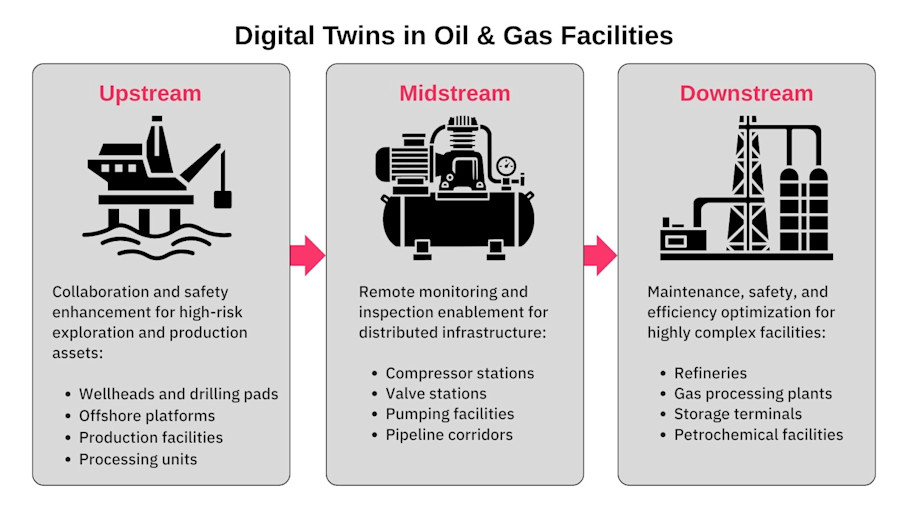
Les jumeaux numériques de Matterport peuvent être utilisés dans l’ensemble des installations amont, intermédiaires et aval pour conserver l’expertise, améliorer la sécurité et accroître l’efficacité. La technologie s’adapte des actifs individuels aux installations complètes, et prend en charge toutes les activités, des opérations quotidiennes à la planification stratégique à long terme.
Pour les organisations prêtes à se lancer, des programmes pilotes axés sur les opportunités ayant le plus d’impact. Ils comprennent :
Actifs à haut risque : Les stations de compression, les installations de têtes de puits ou les unités de raffinage présentant le plus de risques pour la sécurité ou les temps d'arrêt les plus coûteux offrent le retour sur investissement le plus rapide grâce à une visibilité et une documentation améliorées.
Opportunités de capture des connaissances : Les sites où le personnel clé approche de la retraite représentent un cas urgent d’intégration des connaissances avant qu’elles ne soient perdues.
La plateforme de jumeaux numériques de Matterport simplifie la numérisation des installations avec la caméra Pro3 ou les Capture Services professionnels. Le matériel équipé de LiDAR peut numériser les espaces intérieurs et extérieurs avec une précision au centimètre près.
Que vous commenciez avec une station ou une centaine, la base reste la même : une vue précise, partagée et navigable de vos installations qui transforme vos actifs physiques en actifs numériques accessibles.
Explorez Matterport pour les équipes du secteur pétrolier et gazier