


 サインイン
7 Oil and Gas Capital Management Strategies to Control Project Spend
Key takeaways
Oil and gas capital projects often run over budget and schedule because drawings don’t match field conditions, which inflates contingency, invites scope creep, and drives rework once crews mobilize.
Capturing accurate existing conditions once and reusing that record across prioritization, approvals, brownfield tie-ins, turnarounds, and handover lets teams cut travel, catch clashes early, and approve work with more confidence.
Digital twins give capital teams one verified visual record of each facility’s real condition that supports every stage, from funding request through handover to operations.
Oil and gas is a capital-intensive, cyclical business. Commodity prices swing while regulations and ESG expectations shift constantly. Every capital decision also carries safety, risk, and project uncertainty that you can’t fully capture on a simple spreadsheet.
Strong oil and gas capital management protects budgets and schedules when those pressures hit. It also frees capital for growth, because funding and modification decisions rest on a clearer picture of the work. Teams that control spend in a down cycle are better positioned to invest when prices recover.
This article covers seven strategies that follow capital through the project lifecycle. They address investment prioritization, brownfield and greenfield decisions, project controls, and tie-ins. They also cover turnaround planning, remote oversight, handover, and stakeholder alignment.
The scope of oil and gas capital management
Oil and gas capital management is the operational discipline of controlling CapEx, scope, asset condition, and lifecycle cost. It runs from funding approval through handover to operations.
The term also refers to the financial side, including financing, hedging, and cost of capital. That work mostly sits with the treasury and corporate finance. This guide focuses on the operational side, where project teams have direct control over the outcome.
What that control looks like depends on where you are in the value chain. Upstream drilling and facility programs move on short cycle times, so decisions have to keep pace. Midstream pipelines, terminals, and compressor stations span wide geographies, making every site visit expensive. Downstream refineries and LNG plants concentrate much of their spend in turnarounds, where a few tightly scheduled weeks carry a lot of budget risk.
Across the three, the same four costs tend to pull projects off track:
Cost overruns that erode returns on sanctioned projects
Rework and change orders driven by scope gaps
Travel and mobilization to remote or hazardous sites
Unplanned downtime that stretches outages and defers revenue
Not all of these start in the field, but many do. The quality of your existing-conditions documentation sets a ceiling on how accurate your estimate, schedule, and risk register can be.
7 strategies for managing oil and gas capital projects with accurate field data
The strategies below follow a capital dollar in sequence, from prioritization through execution and handover. Each one builds on accurate field data, because a decision is only as sound as the site record behind it. Teams can adopt them one at a time, but they compound when the same record supports every stage.
1. Rank investments with consistent, data-backed records
Capital teams struggle to align on priorities when every site is documented differently. One facility has recent photos, another has aging drawings, and a third relies on anecdotal condition reports. Requests for budget aren’t levied on equal footing.
That gap skews the biggest decisions. For example, an estimator may pad a brownfield contingency to cover what they can’t see. That can make an expansion at an existing site look more expensive than a greenfield alternative, even when the brownfield option is actually more economical.
The solution is to create a standard documentation baseline, with every facility captured and notated the same way. A navigable 3D digital twin is a practical way to build it. It gives capital teams a consistent visual record of each site’s real condition, so leadership can compare refineries, terminals, gas plants, and platforms on the same criteria. Matterport Property Intelligence generates layouts, dimensions, and standardized reports across facilities to make this possible.
The evidence behind each request matters as much as the data. Agree on a short set of categories, such as condition issues, deferred maintenance, and capital needs, and have each site pin them to exact spots in the twin with Tags. When a funding request comes in, reviewers can click straight to the corroded pipe rack or failing pump it describes.
Consistent records make prioritization easier to justify, because every site is judged on the same terms.
2. De-risk brownfield tie-ins before engineering starts
Brownfield projects can fail after years of modifications, temporary fixes, and undocumented changes pile up until the drawings no longer match what’s in the field.
All the mismatches show up during live-plant modifications. A spool fabricated to the drawings arrives on site and won’t fit because a cable tray went in years ago. Each problem costs more once crews mobilize.
That’s why clash and access checks belong in the plan before work packages are issued. But they only work when they align with an accurate existing-conditions record.
Before you price a brownfield scope, capture the area as it stands today. A LiDAR-based camera like Matterport’s Pro3 captures to ±20 mm accuracy at 10m, so estimates rest on measured dimensions. In dense areas like pipe racks, High Density mode adds detail on thin structures such as piping and cabling.
Engineers can then move from a modification decision to scoping faster. BIM Files in .RVT and .IFC formats and registered E57 point clouds open without manual scan translation. Engineers can run clash checks and spot design discrepancies against the as-built.
3. Tighten capital project controls at every stage gate
Stage gates give oil and gas capital management its checkpoints, but reviews often stall here for predictable reasons. Approvers are asked to fund work at sites they’ve never seen. Scope drifts between gates, and nobody can point to exactly what changes. Progress claims are also hard to verify.
The process becomes easier and more reliable when each stage gate has its own verified record. Take a request to replace an aging compressor package. Instead of a written summary and a few photos, the project team can build a Guided Tour through the digital twin.
Finance leaders and stage-gate approvers are walked through annotations and attached context in a defined sequence. The corrosion on the skid, the tight access requiring a crane, and the tie-in point the new unit has to meet all help inform a better budget and plan. Each stop on the virtual tour shows a condition that supports the request, so the approval rests on documented conditions.
Progress reviews need the same discipline. With Side-by-Side (public beta), teams compare two captures of the same area in a synchronized view. Completed work is easier to validate for progress reviews and executive reporting.
Approvers who see the same conditions as the field team make faster, better-informed decisions.
4. Plan turnarounds and shutdowns around verified scope
A turnaround packs months of maintenance and capital work into a few weeks of downtime, so small planning gaps get expensive fast. Scope grows when facility data turns out to be wrong. Equipment access brings surprises. And large contractor crews add coordination risk.
Much of that risk can be settled before the unit goes offline. With an accurate as-built, planners can work out the physical details at a desk:
Clearances around existing structures
Equipment removal paths
Scaffold placement
Work sequencing across crews
Each one is cheaper to resolve in planning than in the middle of an outage, when a blocked path or misjudged clearance holds up every task behind it.
For enclosed spaces like control rooms and compressor buildings, Automated Measurements pull room dimensions straight from the scan. Engineering, estimating, and construction teams can use Measurement Mode to check routing, clearances, and any tie-ins scheduled for the outage window before a crew is scheduled.
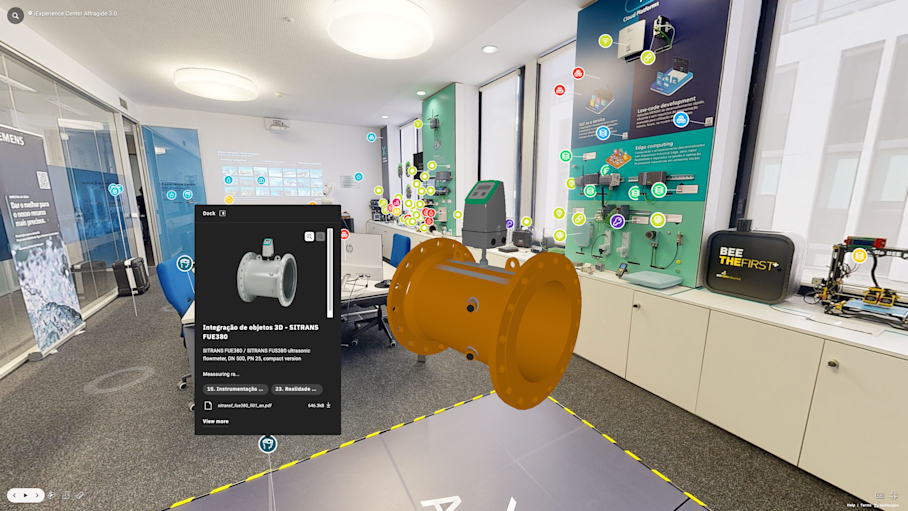
For example, in the Siemens factory relocation, the team reached 99% measurement accuracy and confirmed equipment fit before anyone traveled. That kind of remote check helps teams avoid clashes and the change-order cycles that follow.
Contract crews benefit as well. Coordinating teams can align on work packages and pre-job briefings when they all reference the same digital twin. That shared reference reduces disputes over scope and progress, which protects the turnaround schedule before the unit ever shuts down.
5. Cut travel, mobilization costs, and safety exposure with remote visibility
Every trip to an offshore platform, remote basin, or hazardous process area carries cost and safety exposure. Transport and permits add up when the same location needs repeat verification. So does time away from other work.
Remote reviews can replace many of those repeat checks. Engineers, EPCs, and contractors can open the digital twin from a web link and inspect conditions as of the capture date.
Central Lincoln PUD, an Oregon electric utility, shows what this looks like across a spread-out asset base. Its four-year system upgrade covered 45 facilities, including substations and mountaintop sites, over 750 square miles. The approach eliminated approximately 250+ repeat site visits and kept the project on budget and on schedule.
Virtual site walkthroughs also broaden the vendor bid pool for hard-to-reach locations. Bidders can evaluate the work without traveling, so more firms can compete.
6. Protect asset value with a clean handover to operations
Facility knowledge often disappears at commissioning. As-builts can be incomplete when project teams move on to the next job. Operations teams then inherit gaps.
Capturing final as-built documentation with a digital twin before handover closes those gaps. Operations and maintenance teams get a complete, timestamped visual record of the asset. Capturing at a few key points, such as before insulation and fireproofing go on, also preserves a view of what isn’t easily visible.
From there, operations can keep equipment manuals, inspection records, and measurements tied to exact locations in the twin with Tags and Attachments. That context stays available for future modifications, maintenance, and training. New York contractor Wesbuilt took this approach with a closeout asset model that uses tags to document manufacturer details and as-built conditions.
A clean handover pays off across the asset's life. Teams make fewer site visits and run faster inspections with better documentation. The next capital project also starts with less risk.
7. Align capital project stakeholders on a shared source of truth
Capital projects involve several groups that need the same view of the field. Each group has a different requirement from that view:
Operators need current asset condition and safe access for planned work.
EPCs need verified dimensions for design, clash checks, and estimates.
Contractors need clear scope and access routes for pre-job briefings.
Finance teams need the context behind each funding request.
Executives need a reliable view of progress across the portfolio.
In practice, that means all stakeholders working inside a singular digital twin. A contractor with a question about a valve can leave a Note pinned to that component and @mention the engineer responsible. The reply with resolution stays in the thread, and the exchange stays on record at the exact location. Notes are visible only to people invited to the space, so project discussions stay private.
Not every team needs the same detail. Targeted Views curate what each audience sees, so contractors and finance each get the detail they need.
Capital discipline built on an accurate view of every oil and gas asset
Oil and gas capital management drives growth when prioritization, approvals, modifications, and turnarounds start from accurate existing conditions. Teams that close the gap between drawings and the field spend less on rework and travel. They also approve projects with more confidence.
You don’t have to change everything at once. Start with a pilot on one or two assets and track these metrics:
Change-order rate: How often scope changes after work packages are issued.
Estimate accuracy at sanction: How close the sanctioned estimate lands to final cost.
Site visits per project: Trips taken to verify conditions instead of completing work.
Discovery scope added during outages: Work added mid-turnaround that planning didn’t catch.
Handover documentation completeness: How much of the asset reaches operations with a verified as-built record.
Compare each metric against a recent project to show where accurate field data changes the outcome.
石油・ガスチーム向けのMatterportについて


